3D Printer Accessories: The Eight That Earn Their Place
LayerWalker is a participant in the Amazon Services LLC Associates Program. We may earn a commission when you buy through links on our site, at no extra cost to you.
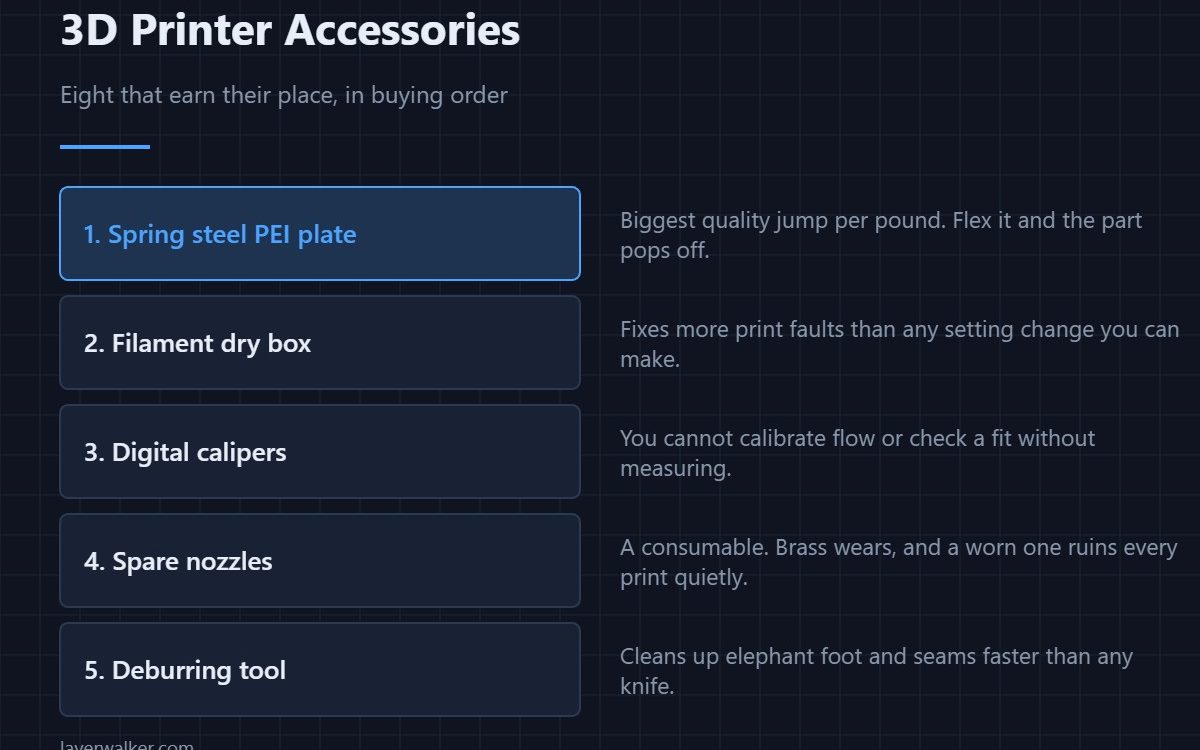
Most 3D printer accessories end up in a drawer. Eight are worth owning, and the order matters: a spring steel PEI plate, a filament dry box, digital calipers, spare nozzles, a deburring tool, a decent scraper, a small tool kit and a hygrometer. Everything beyond that — LED strips, filament runout gadgets, spool counters — is optional.
The accessory market is built on the fact that a new printer owner has enthusiasm and no idea what will actually go wrong. The eight below are the ones that keep getting used a year later, ranked by how much they change the output rather than how clever they look.
Where to buy


The order to buy 3D printer accessories in
- Spring steel PEI plate. The single biggest jump in reliability per pound. Parts release by flexing instead of being chiselled. See which coating to pick.
- Filament dry box. Fixes more faults than any setting you can change, because wet filament causes symptoms that look like six other problems. Options in dry boxes.
- Digital calipers. You cannot calibrate flow rate or check a fit without measuring.
- Spare nozzles. A consumable, not a spare part. A worn one degrades every print quietly — see nozzle sizes.
- Deburring tool. Cleans seams and elephant foot faster and more safely than a knife: why it replaces a blade.
- Hygrometer. A few pounds, and it turns “is my filament wet” from a guess into a reading.
- Scraper or spatula. For the times a part will not release, and for cleaning the plate.
- Tool kit. Hex keys, tweezers, needle files, cleaning needles. The bundled kits are better value than buying separately.
What to skip
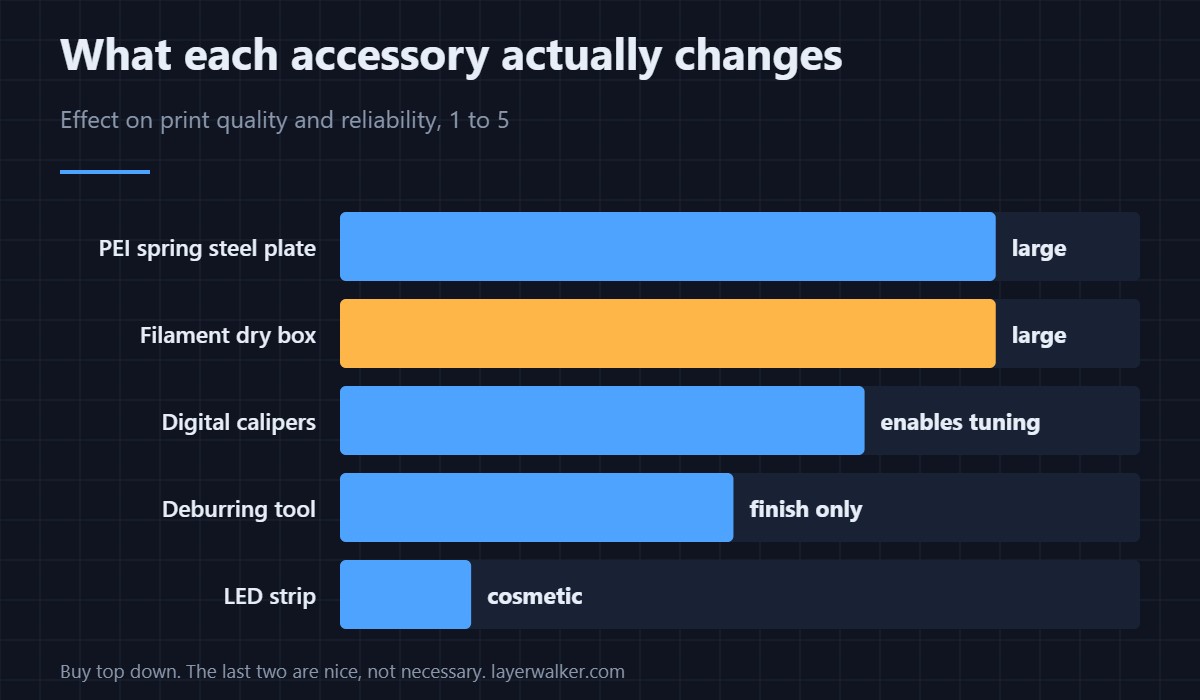
LED strips look good in photographs and change nothing. Filament runout sensors are already built into most modern printers and are a common source of false triggers when retrofitted. Glue sticks are only needed on bare glass or as a release layer for PETG, not as general adhesion. And a second-hand bargain “upgrade kit” is usually a bag of parts for a printer you do not own.
Accessories that are really upgrades
Some things sold as accessories change the machine rather than helping you use it: hotends, extruders, bed probes and control boards. Those belong in a different budget and a different order — the sequence that pays back is in upgrading in the right order. Buy the accessories first; they are cheaper and they tell you what the printer actually needs.
Storage is the one people regret skipping
Filament left on an open shelf degrades on a timescale of weeks for PETG and nylon, days for TPU. A sealed box with rechargeable desiccant costs less than one spool and saves several. The practical routine is in filament storage.
3D Printer Accessories FAQ
What accessories does a new 3D printer actually need?
Calipers, a scraper and somewhere dry to keep filament. Everything else can wait until you have hit a problem that the accessory solves, which is a better guide than any starter-kit list.
Are bundled 3D printer accessory kits worth buying?
The tool kits are, because buying hex keys, tweezers, needle files and cleaning needles separately costs more. The all-in-one kits that include glue sticks and tape are mostly padding.
Do I need a filament runout sensor?
Not as an add-on. Most current printers have one built in, and retrofitted sensors are a frequent cause of false pauses mid-print.
What is the cheapest accessory that improves print quality?
A hygrometer, indirectly. It tells you whether the filament is the problem, which stops you changing settings that were never wrong.

LayerWalker
Print defect diagnosis, calibration procedures and parts that actually fit. Corrections welcome through the contact page.