3D Printer Tool Kit: The Eight Tools You Actually Use, and What the 70-Piece Kits Get Wrong
LayerWalker is a participant in the Amazon Services LLC Associates Program. We may earn a commission when you buy through links on our site, at no extra cost to you.
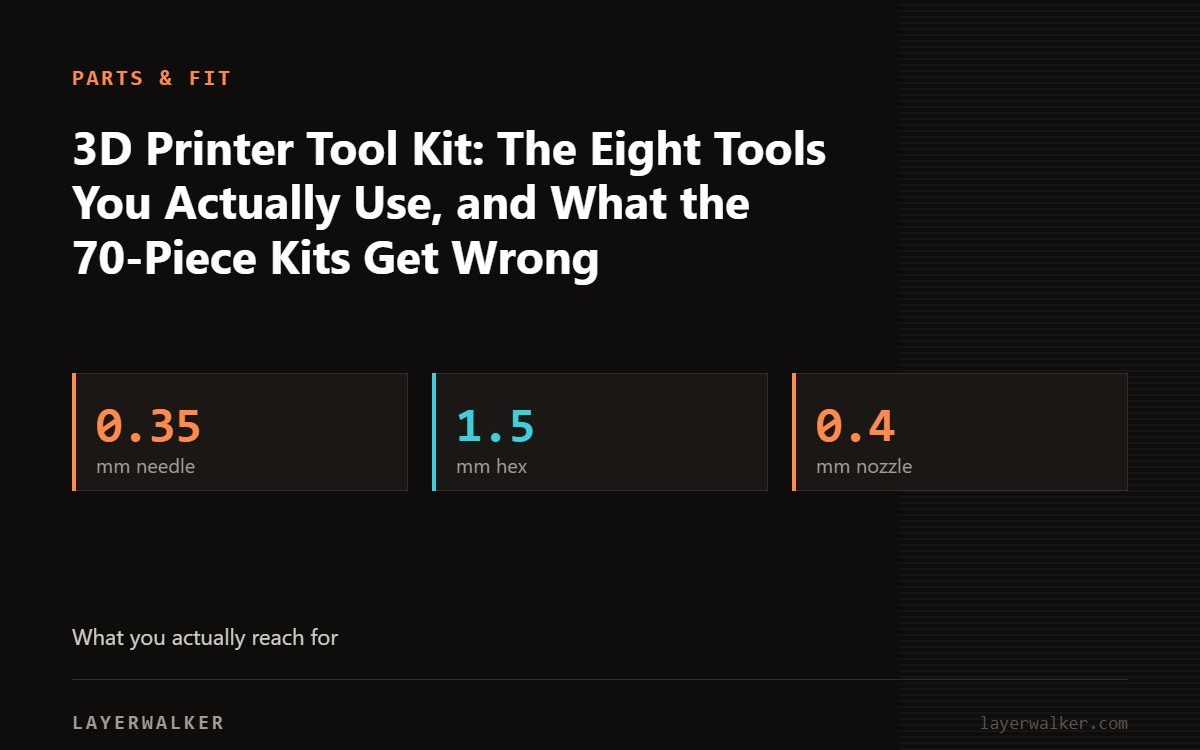
You need about eight tools for a filament printer: flush cutters, a thin scraper, a deburring tool, 0.35 mm nozzle needles, a metric hex key set, a small spanner for the nozzle, needle-nose pliers and a digital caliper. Buy a kit for the case and the odd bits, but judge it on the quality of those eight, not the piece count.
The big tool kits sell on the number on the box. Most of that number is bits you will never use twice: five sizes of tweezers, a set of files, a dozen spare nozzles of unknown quality. What gets picked up every day is a short list, and a kit where those items are decent beats a kit with three times the pieces where they are not. Here is what actually matters, why, and how to judge a kit by it.
Where to buy


The eight that earn their place
- Flush cutters. For trimming filament to a clean angle before loading and for snipping supports and strings. Blades must meet flat.
- Thin flexible scraper or spatula. For parts on a plate that will not flex. Rounded corners so it does not gouge PEI.
- Deburring tool. One pass takes the sharp edge off a hole or a bottom perimeter. The single most-used finishing tool.
- Nozzle cleaning needles, 0.35 mm. For tip clogs. The needle must be smaller than the nozzle; a 0.4 mm needle in a 0.4 mm nozzle opens it out. See clearing a clog.
- Metric hex key set, 1.5 to 5 mm. Every fastener on the printer. Ball-end keys reach the awkward ones.
- Small spanner or socket for the nozzle. 6 mm or 7 mm depending on the nozzle type, plus something to hold the heater block.
- Needle-nose pliers. Pulling filament stubs, gripping a hot nozzle, straightening a bent spring.
- Digital caliper. Measuring filament diameter, checking a printed hole, dialling in flow. Kits rarely include a good one; buy it separately.
What to check in a kit
- Cutter quality. Open and close them in the listing photos if you can; cheap cutters have a visible gap at the tip.
- Deburring blade that swivels. Fixed blades chatter.
- A case with a spot for each tool. The point of a kit is finding the thing.
- Nozzles included are usually low grade. Treat them as spares for emergencies, not upgrades.
The kits in the box
The 68-piece kit with a storage case covers the whole list above with a proper case, and the 34-piece kit is the same essentials without the padding. The Creality-branded 74-piece kit adds a tool roll and Creality’s own spare nozzles, which suits an Ender owner. In each case the cutters, scraper and deburring tool are the parts to judge; the rest is bonus.
What to add separately
A decent digital caliper, a set of brass nozzles for your hotend type, a glue stick, isopropyl alcohol and a soft brush for the plate. Those five plus the kit cover every routine job.
Where a tool kit sits against everything else worth owning, and the order to buy in, is set out in 3D printer accessories.
3D printer tool kit FAQ
Do I need a heat gun?
For removing strings and softening PLA for post-processing, a cheap one is useful. Not essential.
Metal spatula or plastic?
Metal, thin and flexible, with rounded corners. Plastic ones snap.
Is a kit worth it over buying tools separately?
For the case and the small items, yes. Buy the caliper and cutters separately if the kit’s are poor.

LayerWalker
Print defect diagnosis, calibration procedures and parts that actually fit. Corrections welcome through the contact page.