Matte PLA: What the Finish Hides, What It Costs in Strength, and When to Use It
LayerWalker is a participant in the Amazon Services LLC Associates Program. We may earn a commission when you buy through links on our site, at no extra cost to you.
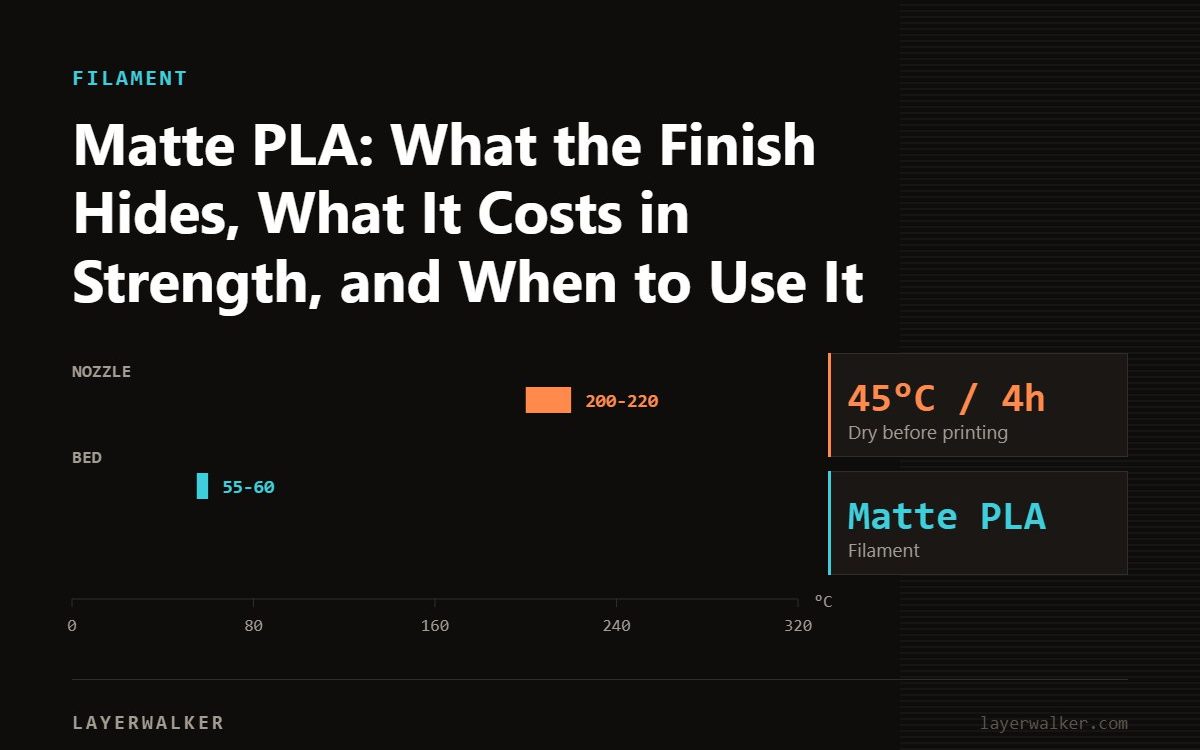
Matte PLA uses a filler that scatters light so layer lines and small surface flaws disappear; a matte part looks injection-moulded straight off the bed. It is a little weaker and a little more abrasive than plain PLA and needs a few degrees more heat. Use it for anything that will be looked at; use plain or PLA+ for anything that will be loaded.
The matte finish is not a trick of pigment. Matte PLA carries a fine mineral filler that roughens the surface at a microscopic scale, so light scatters instead of reflecting, and the eye stops seeing the ridges between layers. The result is the most forgiving surface in filament printing: Z-banding, slight over-extrusion and visible seams all fade. The filler is also why matte PLA is slightly weaker, slightly more abrasive, and flows a little less freely than plain PLA.
Where to buy


OVERTURE 2KG Bundle Matte PLA, Low Warp & Matte Surface 3D Printer Filament
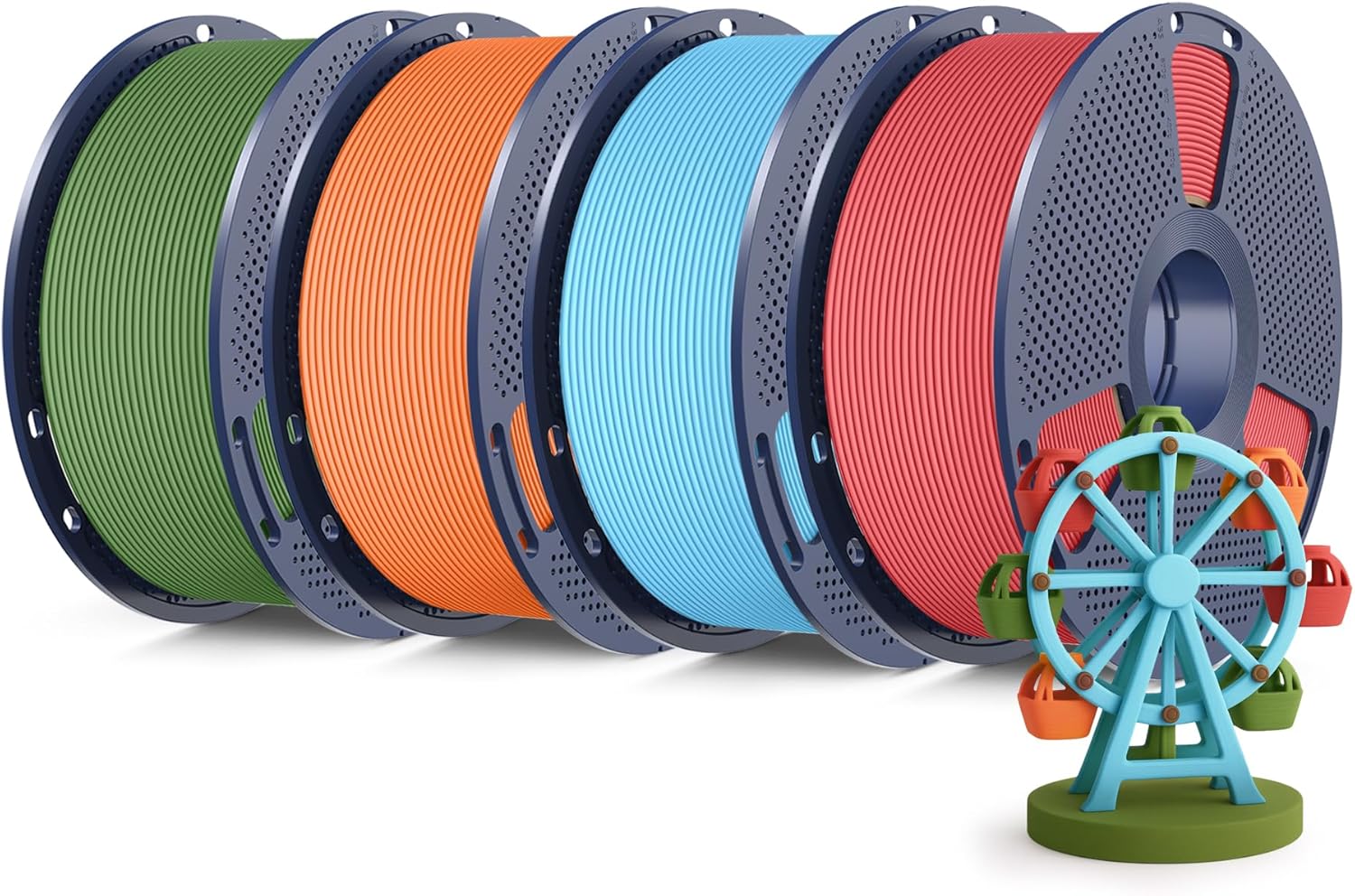
SUNLU High Speed Matte PLA 3D Printing Filament 1.75mm 4KG
What matte changes
- Appearance. Layer lines nearly vanish at 0.2 mm; a 0.28 mm layer looks acceptable.
- Strength. Layer adhesion a little below plain PLA. Fine for housings and models, not for hooks.
- Abrasion. Mild. A brass nozzle lasts many spools, but not indefinitely.
- Temperature. 5 to 10 °C hotter than plain PLA to keep flow and bonding.
- Sanding. Sands and paints very well; the finish is already a primer-like surface.
What to check on the spool
- Tolerance ±0.03 mm; filled filaments vary more without it.
- Vacuum sealed. The filler makes matte PLA absorb water faster.
- Colour range. Matte pastels and earth tones are where the finish shines; matte black hides everything.
The spools in the box
Overture’s matte PLA appears in two colours as the reference matte, consistent and widely profiled. The third spool is an alternative matte blend; compare stated tolerance and choose by colour.
Settings that work
- Nozzle 205 to 225 °C. Start at 215 °C.
- Bed 60 °C on textured PEI. Matte on a textured plate gives a fully matte part; on smooth PEI the bottom is glossy.
- Layer height 0.2 mm is plenty; 0.16 mm brings almost nothing extra.
- Slightly higher flow, 1 to 3 %, after a flow calibration; the filler thickens the melt.
- Seams can go almost anywhere; matte hides them. See seam settings if one still shows.
When plain PLA is the better buy
Parts under load, parts with thin features, and anything you want glossy. Matte is a finish, not a performance upgrade.
PLA matte FAQ
Is matte PLA abrasive enough to need a hardened nozzle?
Not for occasional use. Heavy users swap to hardened steel eventually.
Does matte PLA hide stringing?
No; strings show against a matte surface as much as any. Dry the spool.
Can I mix matte and glossy in a multi-colour print?
Yes, and the contrast is a common design choice.

LayerWalker
Print defect diagnosis, calibration procedures and parts that actually fit. Corrections welcome through the contact page.