SUNLU Filament: PLA, PLA+ or Silk, and Which Line to Buy
LayerWalker is a participant in the Amazon Services LLC Associates Program. We may earn a commission when you buy through links on our site, at no extra cost to you.
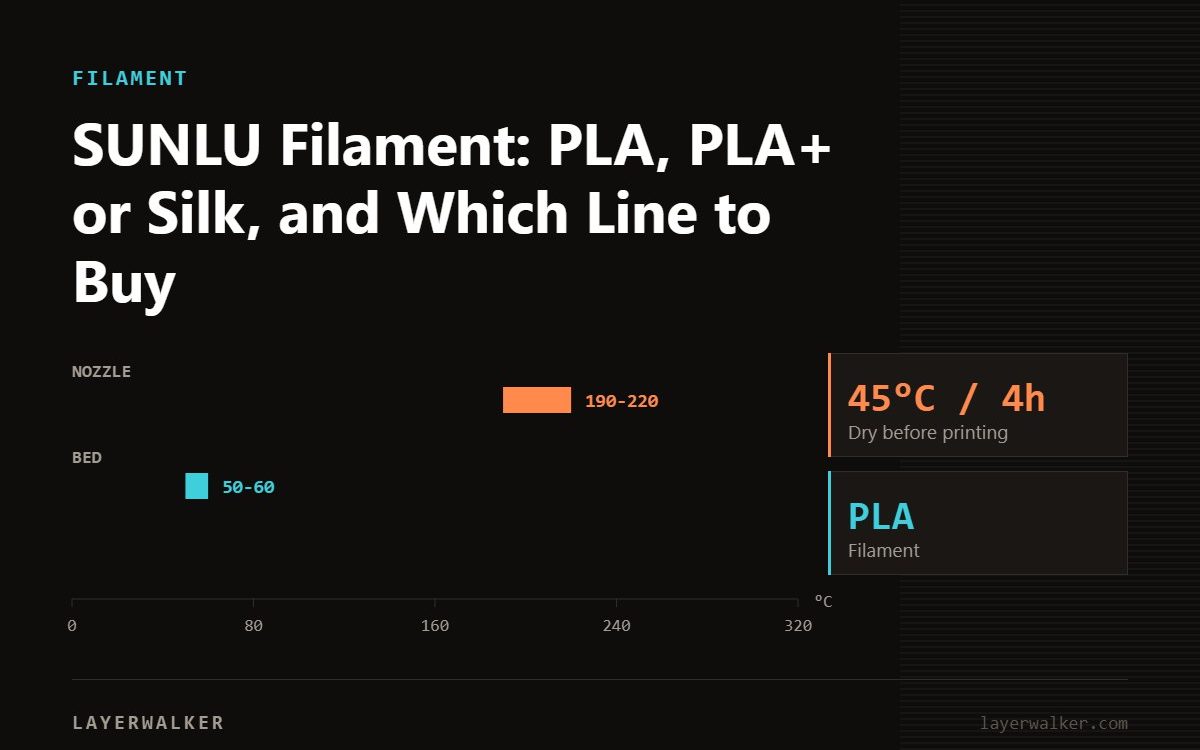
Buy SUNLU PLA+ for parts that get used and dropped, plain SUNLU PLA for models and quick prototypes where cost per spool matters, and Silk PLA only for display pieces where the metallic sheen is the point, because silk blends have weaker layer bonds.
SUNLU is one of the high-volume Chinese filament makers whose spools land in most beginners’ first orders. The brand covers everything from PLA to ABS and TPU, but the three lines that matter for most printers are plain PLA, PLA+ and Silk. They print at similar temperatures and look similar on the shelf; they behave differently in a part, and the labels do not explain how.
Where to buy

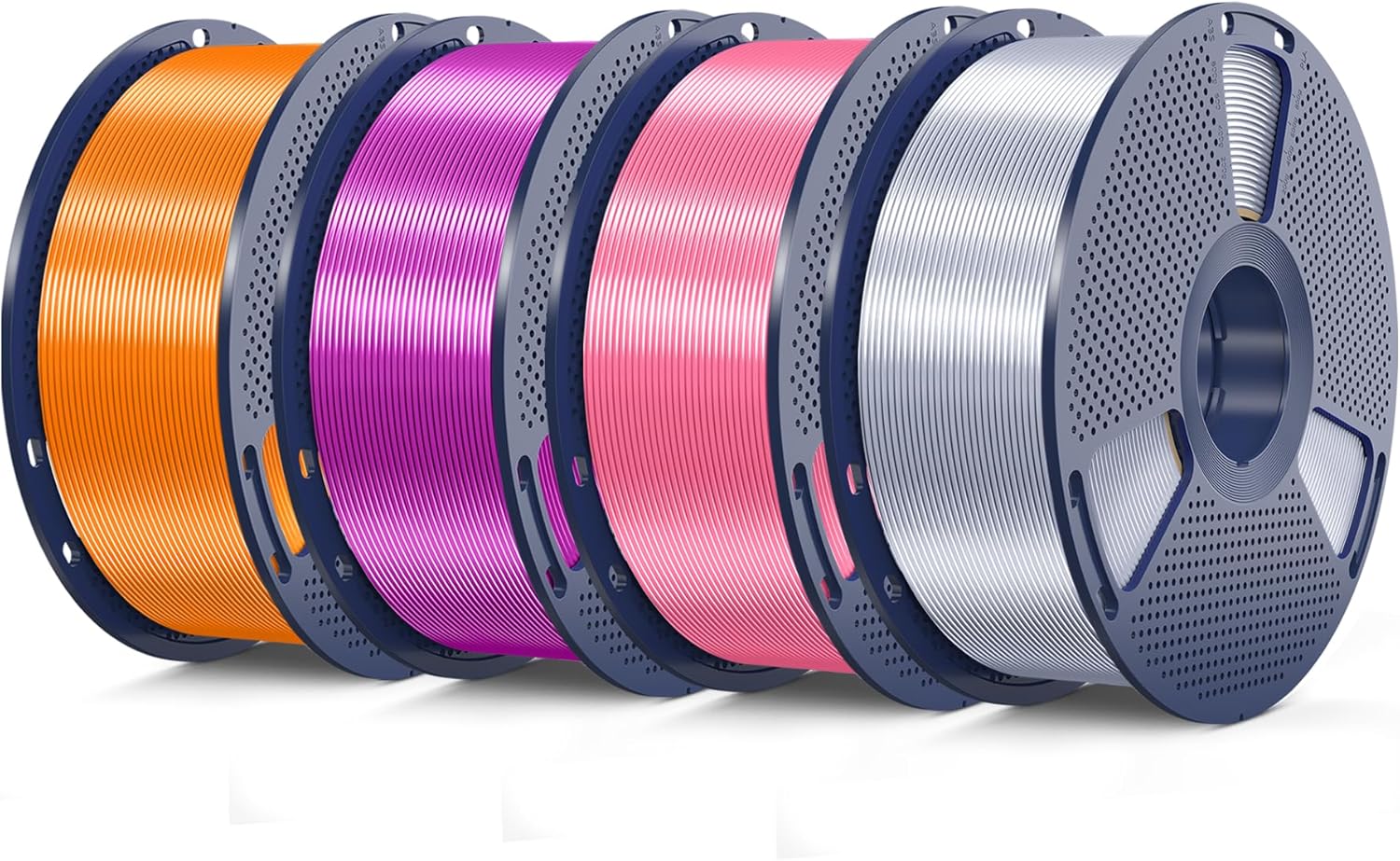
SUNLU Silk PLA Filament 4KG, Smooth Silky Surface, Silk 3D Filament 1.75mm, Dimensional Accuracy +/- 0.02mm, 1kg Spool(2.2lbs), Total 4KG, Silver+Pink+Purple+Orange

The three lines, honestly
- PLA. The standard budget spool. Prints easily at 200 to 215 °C, decent tolerance, colours consistent within a batch and occasionally different between batches. Brittle in thin sections, like all plain PLA.
- PLA+. PLA with impact modifiers. It bends a little before it snaps, survives a drop, and is the line to use for brackets, hooks, handles and anything with a thin wall. Print it 10 to 15 °C hotter than plain PLA, around 215 to 230 °C, or layers will not bond as well as they can.
- Silk PLA. An additive gives a glossy, pearlescent surface that hides layer lines. The same additive weakens layer adhesion, so silk parts split along layers under load. Display models only; print slower and hotter than the box says.
What to check before you order
- Diameter tolerance. SUNLU states ±0.02 mm on most lines; a spool that does not state it is a different grade.
- Spool type. Plastic spools fit every dryer and holder. Cardboard spools are lighter and recyclable but shed fibres into a dry-box feed and can stall a multi-material unit.
- Vacuum seal with desiccant. If the bag is loose the spool has been drinking air. Dry it before the first print regardless.
- Bundles. Multi-colour packs are cheaper per kilogram; the risk is that you get colours you never print. Buy the bundle only for colours you already know you use.
The spools in the box
The 1 kg black PLA is the baseline spool to calibrate a new printer on. The Silk PLA multi-pack is for lithophanes, vases and figurines where the finish is the whole point. The PLA Plus ten-colour bundle is the practical one: tougher parts, a colour for every job, and the same settings across the set once you have tuned one spool.
Settings that work
- PLA: 200 to 215 °C nozzle, 55 to 60 °C bed, full fan after the first layer.
- PLA+: 215 to 230 °C, 60 °C bed, full fan. Hotter than the label if walls look grainy.
- Silk: 205 to 220 °C, 60 °C bed, slower outer walls around 40 mm/s, 0.2 mm layers. The gloss comes from a smooth, slow outer wall.
- Run a flow calibration when you switch between lines; PLA+ typically wants a slightly lower flow than plain PLA on the same printer.
When to buy something else
Parts that live in a hot car, outdoors or under sustained load: PETG or ASA, not any PLA. Parts that must not string on a Bowden printer: a tighter-tolerance premium PLA is worth the difference on fine models.
3D printer filament SUNLU FAQ
Is SUNLU PLA+ the same as eSUN PLA+? Same idea, different additive blends. Both are tougher than plain PLA; settings transfer roughly but re-tune temperature.
Why does my SUNLU Silk string?
Silk blends are stringier by design. Dry the spool, lower temperature 5 °C, and raise retraction slightly. See the stringing guide.
Does SUNLU filament work in a Bambu AMS?
Yes for PLA, PLA+ and Silk on plastic spools. Cardboard spools need the spool adapter rings.

LayerWalker
Print defect diagnosis, calibration procedures and parts that actually fit. Corrections welcome through the contact page.