Filament Holder: The Cheapest Fix for Tangles and Uneven Feed
LayerWalker is a participant in the Amazon Services LLC Associates Program. We may earn a commission when you buy through links on our site, at no extra cost to you.
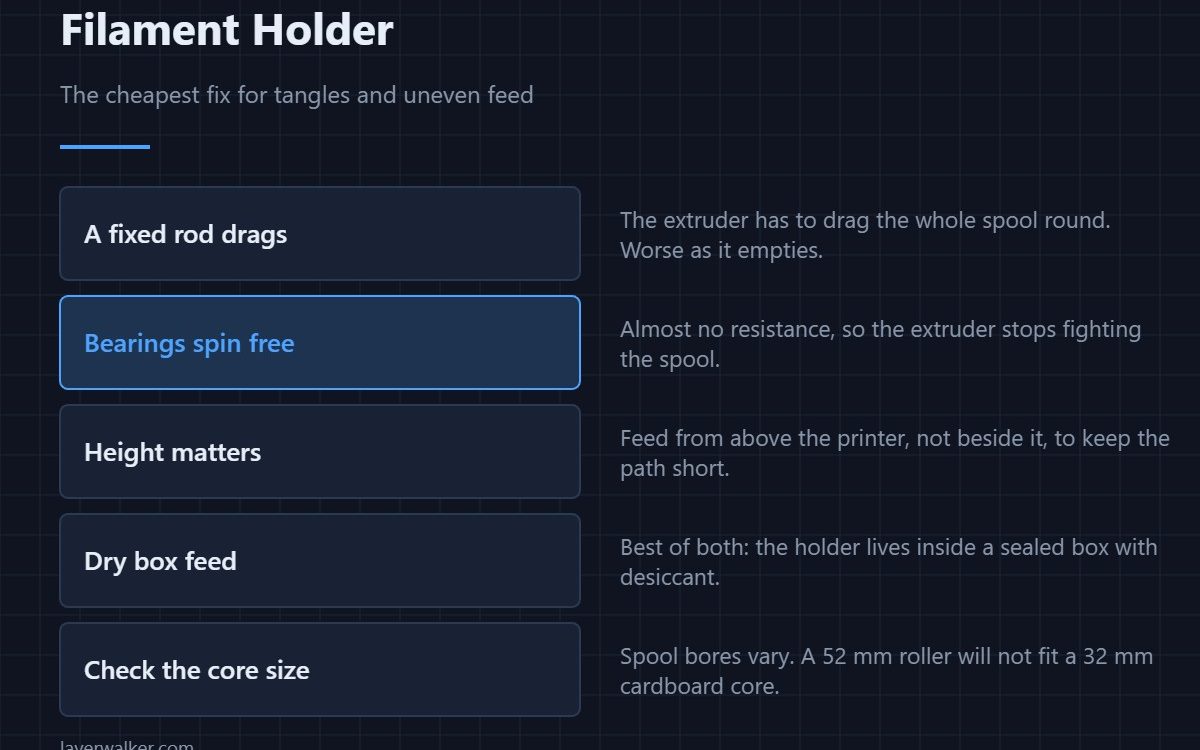
A filament holder decides how hard your extruder has to pull. The rod that comes with most printers makes the extruder drag the whole spool round, and the resistance rises as the spool empties. A roller holder on bearings removes almost all of it for a few pounds. The best version keeps the spool inside a sealed dry box and feeds through a bulkhead fitting.
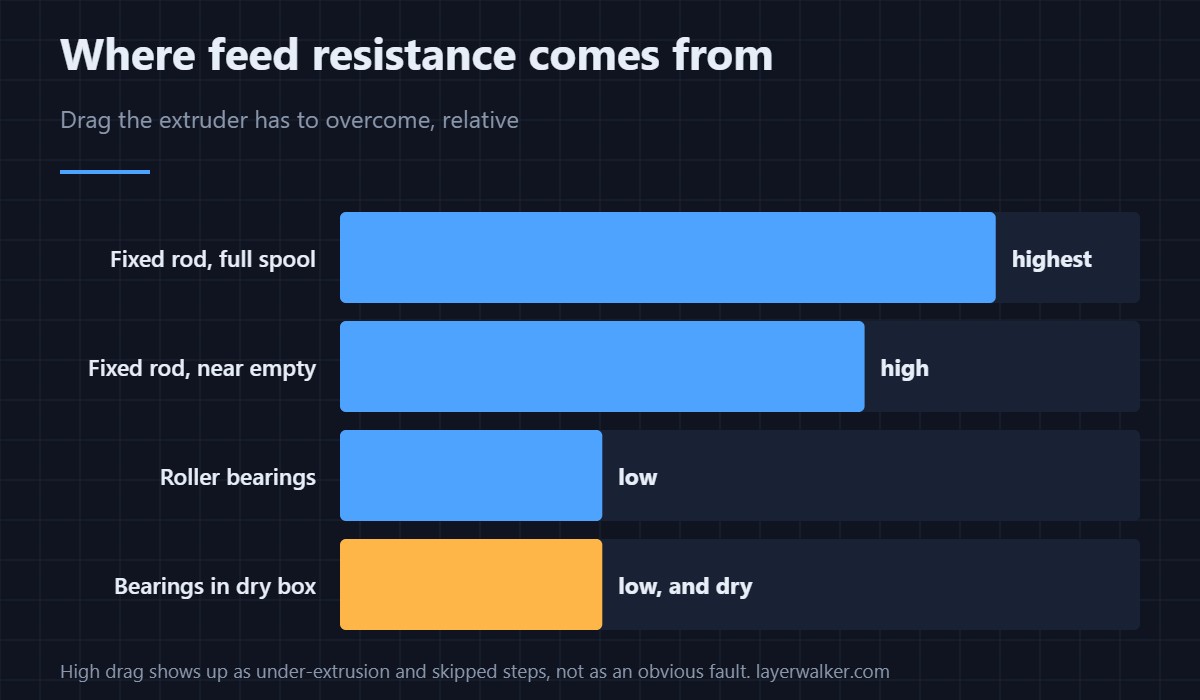
This is an unglamorous part that causes glamorous-looking faults. Excess feed resistance shows up as thin walls, skipped steps and clicking from the extruder — all of which people diagnose as a hotend or extruder problem before they ever look at the spool.
Where to buy


Rod against bearings
A fixed rod means the spool rotates against a stationary bar. Friction is highest when the spool is full and heaviest, drops as it empties, and rises again when a loose winding binds. A roller holder puts the spool on two bearing-mounted rollers so it spins almost freely, and the extruder feels essentially nothing. On a Bowden setup, where the extruder is already fighting 500 mm of tube, this matters more than on direct drive.
Height and path
Feed from above the printer where you can. A spool sitting on the desk beside the machine makes the filament climb, which adds drag and lets the strand rub on the frame. Keep the path short and free of sharp bends, and make sure the spool can pay out without the filament catching under itself — the commonest cause of a print failing at hour nine. It is also worth ruling out before you blame retraction settings.
The version worth building
Put the roller holder inside an airtight box with rechargeable desiccant and run a PTFE bulkhead fitting through the wall. That gives you free rotation and dry filament at once, which between them account for most feed-related print failures. The container options are in dry boxes, and the broader storage routine in filament storage.
Check the core before buying
Spool dimensions are not standardised. Bores vary from about 32 mm on cardboard spools up to 55 mm on some plastic ones, and overall widths differ too. A roller design sidesteps bore size entirely because the spool rests on its rim, which is a good reason to prefer it if you buy from several brands. If you use a printer with an AMS, note that the unit has its own holder and this question applies only to spools you feed externally.
Filament Holder FAQ
Does a filament holder really affect print quality?
Indirectly but genuinely. High drag causes intermittent under-extrusion and extruder skipping, which look like flow problems. Removing the drag removes a whole category of intermittent faults.
Should the spool sit above or beside the printer?
Above, where possible. It keeps the filament path short and stops the strand rubbing on the frame as the spool pays out.
Will a roller holder fit cardboard spools?
Yes, and that is its advantage — the spool sits on its rim, so the bore size does not matter. Rod holders need a bore that matches.
Do I still need a holder if my printer has an AMS?
Only for spools you feed from outside the unit, which is common when you want a material the AMS cannot handle well, such as TPU.

LayerWalker
Print defect diagnosis, calibration procedures and parts that actually fit. Corrections welcome through the contact page.