Deburring a 3D Print: The Tool That Replaces a Knife and a Thumb
A swivel deburring blade follows the edge instead of cutting into it, which is why it removes elephant foot without gouging the face.
Nozzles, build plates, hotends and extruders — with fitment tables that say “not verified” when we have not checked, because a wrong answer here costs you a hotend.
A swivel deburring blade follows the edge instead of cutting into it, which is why it removes elephant foot without gouging the face.
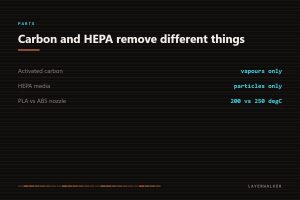
Carbon adsorbs vapours, HEPA catches particles, and neither removes heat. Knowing which is which decides what to buy.
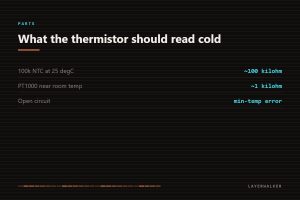
A 100k NTC reads about 100 kilohm at room temperature. Fit the wrong type and the printer will heat confidently to the wrong number.
One fan keeps the hotend from jamming, the other shapes the plastic you just laid down. Replacing the wrong one is the usual mistake.
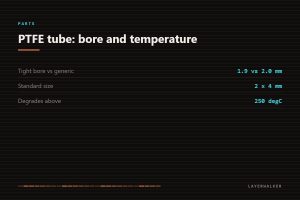
The white tube that guides filament has a temperature ceiling and a bore tolerance. Both decide whether it helps or causes the jam.
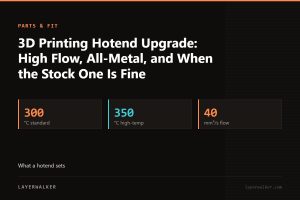
Short answer Upgrade the hotend for one of two reasons: you need 260 °C and above for nylon or polycarbonate, which means…
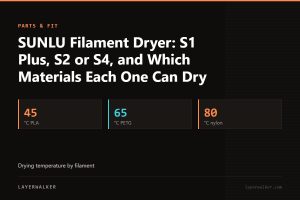
Short answer Buy the SUNLU S2 if you print PETG, ABS or TPU: its higher temperature ceiling dries them properly and the…
Short answer Two IKEA routes work. Stack two Lack side tables with acrylic panels for a 220 mm bed-slinger; that holds about…
Short answer If your printer maker sells an official camera module, buy that: it plugs into the mainboard, shows up in the…
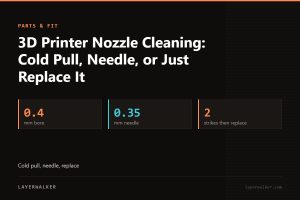
Short answer Clean a clogged nozzle in this order: a cold pull with nylon or cleaning filament, then a 0.35 mm needle…