3D Printer Exhaust and Filtration: What Actually Removes What
LayerWalker is a participant in the Amazon Services LLC Associates Program. We may earn a commission when you buy through links on our site, at no extra cost to you.
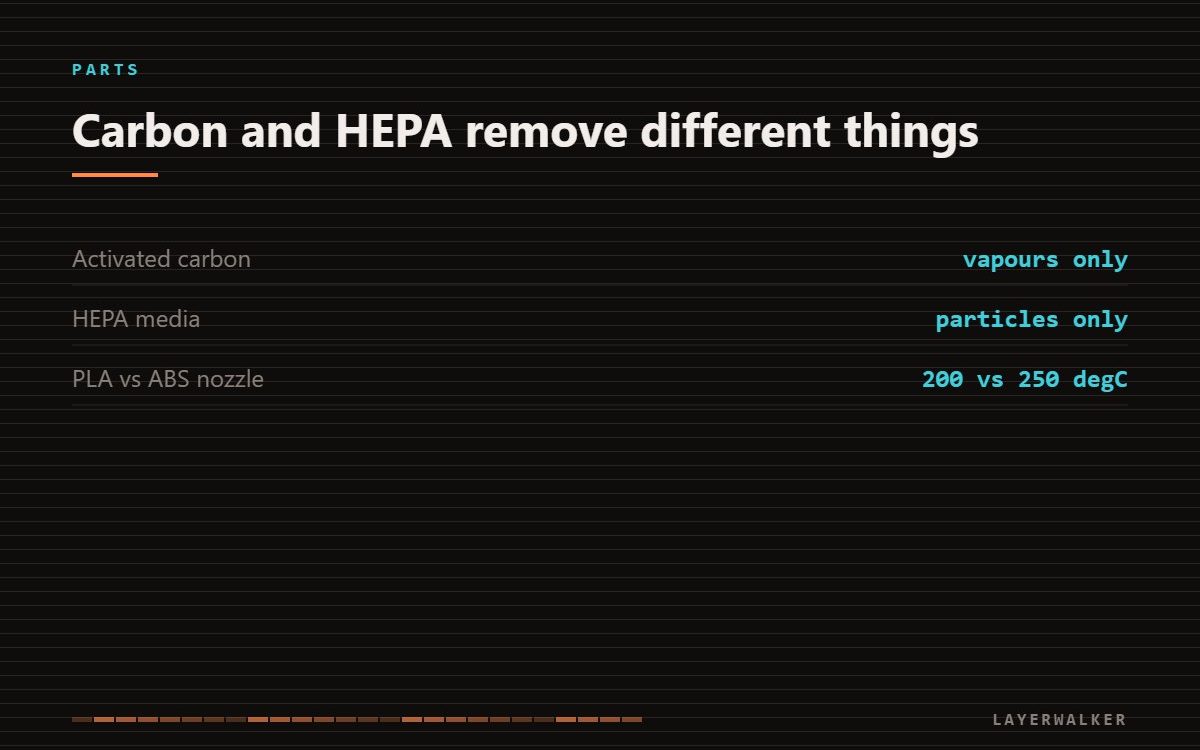
Carbon adsorbs organic vapours. HEPA traps ultrafine particles. Neither removes heat, and neither is a substitute for moving air out of the room. If you print ABS or ASA regularly, plan extraction rather than relying on a filter cartridge alone.
Where to buy

ANYCUBIC Mini Purifier 3D Printer Accessories, Lightweight Ultra Quiet Purifier with High Density Activated Carbon Filter for LCD DLP 3D Printers (Pack of 2)

ELEGOO 2PCS Mini Air Purifier with Activated Carbon Filter and Universal Adaptor for LCD/DLP/MSLA Resin 3D Printer

What to look for
A compact carbon unit inside the chamber is the easy option and handles smell. A larger combined carbon and HEPA purifier handles both emission types. Buy carbon by weight rather than by claim: a thin mesh pad with a dusting of carbon adsorbs very little and saturates within weeks.
Two different emissions, two different filters
Printing releases volatile organic compounds and ultrafine particles, and they need different treatment. Activated carbon adsorbs the vapours that produce the smell; it does nothing for particles. HEPA media captures particles; it does nothing for vapours. A unit advertising only one of the two is solving half the problem, which is why the smell can disappear while the particle count does not. Our note on HEPA filtration covers the particle side in more detail.
The conflict with a heated chamber
High-shrinkage materials want a warm, still chamber, and extraction removes exactly that. This is a real trade-off, not a marketing one. The workable compromise is low continuous filtration during the print to stop build-up, then a stronger purge at the end before you open the door. Machines that hold a managed chamber, covered in our guide to enclosed printers, balance this in firmware.
PLA is not the reason to do this
PLA at 200 C emits far less than ABS at 250 C. If PLA is all you print, filtration is a comfort measure. The materials that make extraction worth planning for are ABS and ASA, which are also the materials that need the enclosure in the first place.
FAQ
Is an open window enough? It dilutes but does not capture, and it destroys chamber temperature, which is the reason you enclosed the machine.
How often do carbon filters need changing? Carbon saturates rather than clogs, so it stops working without looking any different. Replace on a schedule, not on appearance.
Does an enclosure alone help? It contains emissions rather than removing them, and concentrates them where you open the door.

LayerWalker
Print defect diagnosis, calibration procedures and parts that actually fit. Corrections welcome through the contact page.

