3D Printers for Car Parts: Heat, UV and the Materials That Survive an Interior
LayerWalker is a participant in the Amazon Services LLC Associates Program. We may earn a commission when you buy through links on our site, at no extra cost to you.
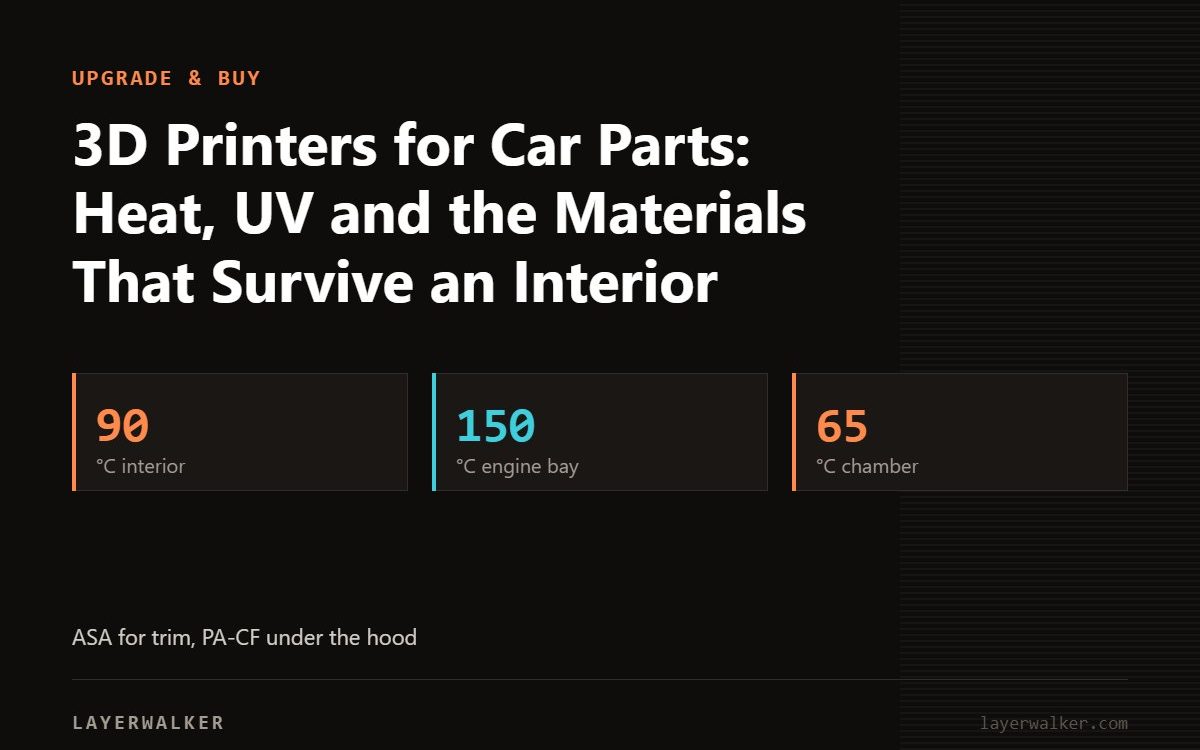
A car interior hits 70 to 90 °C in the sun; PLA sags and PETG softens, so the minimum material for trim, clips and brackets is ASA or ABS, which means an enclosed printer: Creality K1C, Elegoo Centauri Carbon, Bambu P2S. Anything in the engine bay wants PA-CF, PPA-CF or PPS-CF and a heated chamber: Qidi Q2 or Plus 4, Creality K2 Plus, Bambu H2S. Nothing safety-critical, ever.
Where to buy


Where the part lives sets the material
| Location | Temperature | Material | Printer level |
|---|---|---|---|
| Interior trim, clips, phone mounts | Up to 90 °C in sun | ASA, ABS | Passive enclosure |
| Exterior trim, badges, ducts | UV, rain, 80 °C | ASA | Passive enclosure |
| Engine bay brackets, covers | 100 to 150 °C | PA-CF, PPA-CF, PPS-CF | Heated chamber 60 °C+, 300 °C+, hardened nozzle |
| Gaskets, grommets, bushings | Varies | TPU | Direct drive, slow |
| Jigs, templates, test fits | Room | PLA, PETG | Any printer |
Printers
| Printer | Build volume | Chamber | Nozzle | Covers |
|---|---|---|---|---|
| Creality K1C | 220 × 220 × 250 mm | Passive | 300 °C hardened | ASA, ABS, small CF parts |
| Elegoo Centauri Carbon | 256 × 256 × 256 mm | Passive | 320 °C hardened | ASA, ABS, ASA-CF |
| Bambu P2S | 256 × 256 × 256 mm | Passive | 300 °C | ASA, ABS with a hardened nozzle for CF |
| Qidi Q2 | 270 × 270 × 256 mm | 65 °C | 370 °C | PA-CF, PPA-CF, PPS-CF |
| Qidi Plus 4 | 305 × 305 × 280 mm | 65 °C | 370 °C | Same, larger |
| Creality K2 Plus | 350 mm | 60 °C | 350 °C | Large engine-bay and body parts |
| Bambu H2S | 340 × 320 × 340 mm | 65 °C | 350 °C | Full range (Bambu direct) |
Design and process
- Orient layers so load runs along them, not across; see layer cracking.
- Annealing PA and PPA parts raises heat resistance; test the shrink.
- Dry filament is not optional for nylon-family materials; see PA-CF.
- ASA over ABS for anything that sees sun; see ASA.
What not to print
Brake, steering, suspension, fuel or airbag components, or anything whose failure hurts someone. Printed parts are for trim, brackets, ducts, adapters and jigs. See automotive parts for the broader use case.
The units in the box
The listings are the Centauri Carbon, the Qidi Q2 and the Qidi Plus 4.
3D printer for car parts FAQ
Can PETG survive a dashboard?
Usually not in summer; ASA is the floor.
Do I need 350 °C?
Only for PPA and PPS blends; PA-CF prints at 280 to 300 °C.

LayerWalker
Print defect diagnosis, calibration procedures and parts that actually fit. Corrections welcome through the contact page.