Revopoint MetroX Pro: Blue Laser Scanning for Parts That Defeat Structured Light
LayerWalker is a participant in the Amazon Services LLC Associates Program. We may earn a commission when you buy through links on our site, at no extra cost to you.
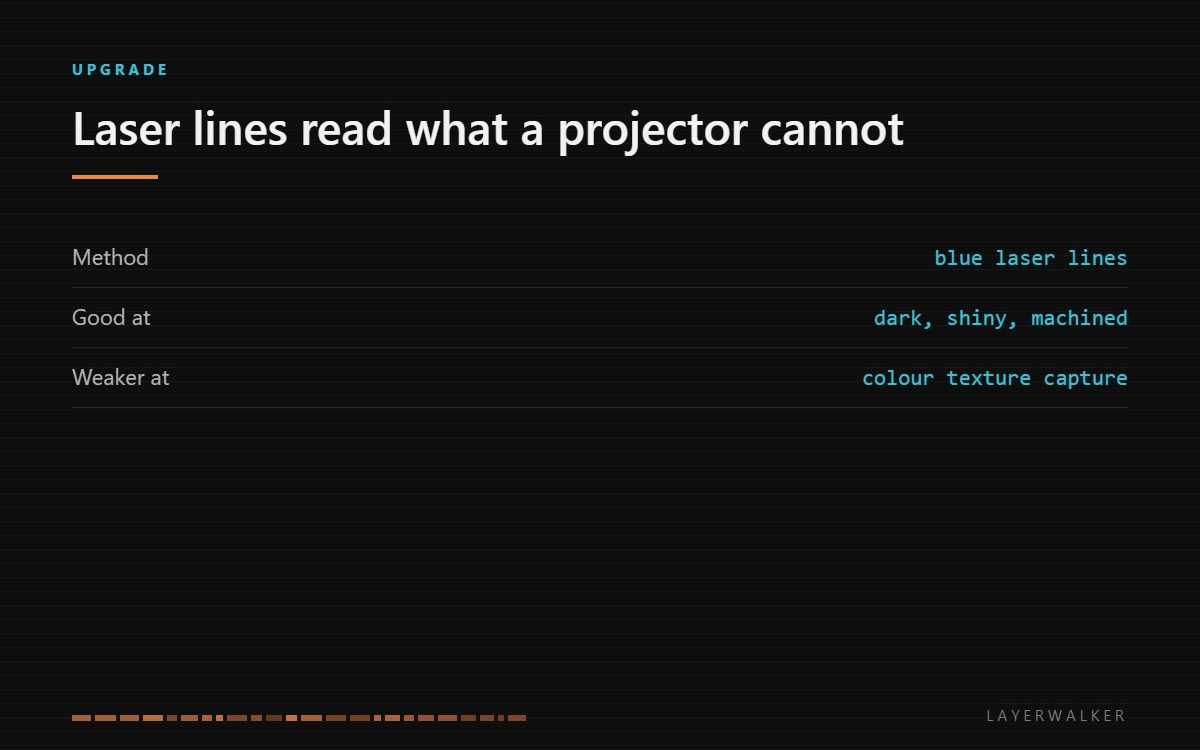
Blue laser scanning projects fine laser lines instead of a light pattern, and the laser survives on surfaces that scatter or absorb a projector. That makes it the tool for machined metal, dark plastic and anything you would otherwise have to spray. It captures shape better than colour.
Where to buy


The problem it solves
Structured light works by projecting a known pattern and measuring how the surface distorts it. That requires the surface to return the pattern cleanly, which is exactly what dark, glossy and machined surfaces refuse to do. The standard workaround is matte developer spray, which works, adds a step, adds a thickness, and cannot be used on parts you are not allowed to coat.
A blue laser is far more concentrated than a projected pattern, and short-wavelength blue scatters less inside the material than red does. The result is a line the sensor can still find on a shiny black housing or a milled aluminium bracket, with no spray.
When the extra capability is worth paying for
Reverse engineering is the clear case: you have a part, you need the geometry, the part is metal or dark plastic, and you want to print or machine a replacement. Our page on printing car parts covers that workflow, and the scanning step is where most people get stuck.
Inspection-adjacent work is the second case: comparing a made part against its model. The accuracy class here is not certified metrology, but it is enough to see where a part deviates and by roughly how much.
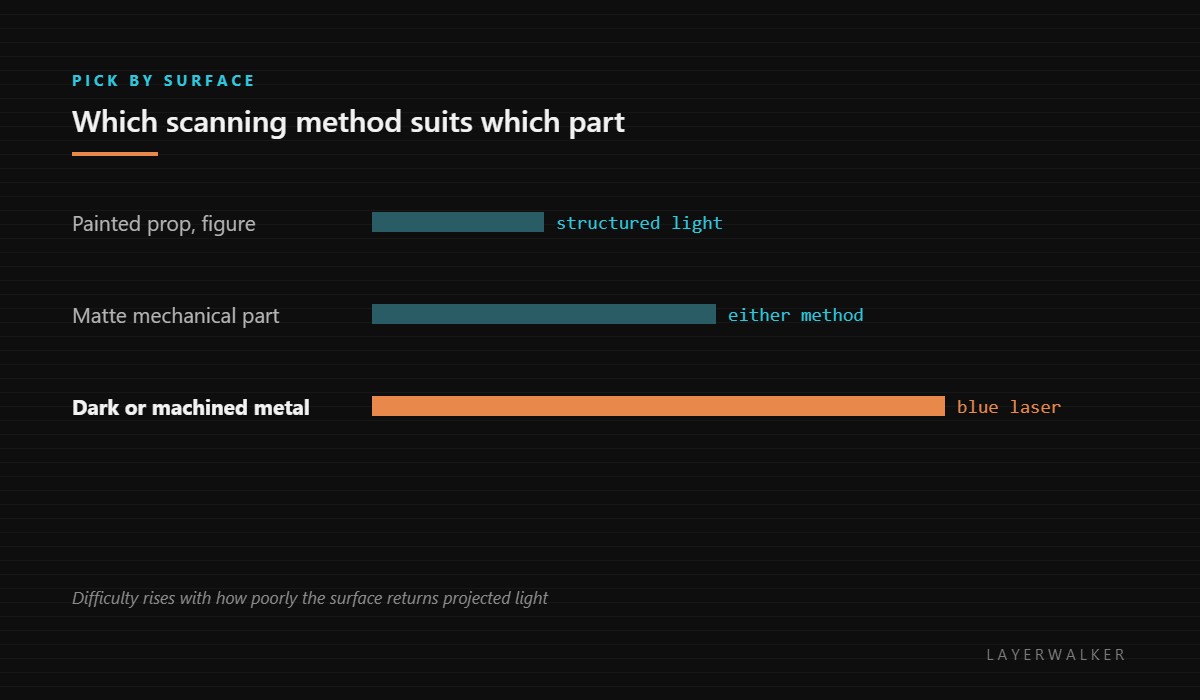
If your subjects are painted props, figures and organic shapes, none of this applies. Those surfaces suit structured light, and you will also want colour texture, which is the thing laser scanning is weaker at. The cheaper models in the range are the right buy and the range overview sets out which.
What still limits it
Featureless geometry. A laser reads the surface, but the software still has to align frames, and a smooth flat panel offers nothing to align on. Markers remain necessary on large simple shapes.
Transparency. Glass and clear plastic let the laser through rather than returning it, and that is a material problem no scanner class solves.
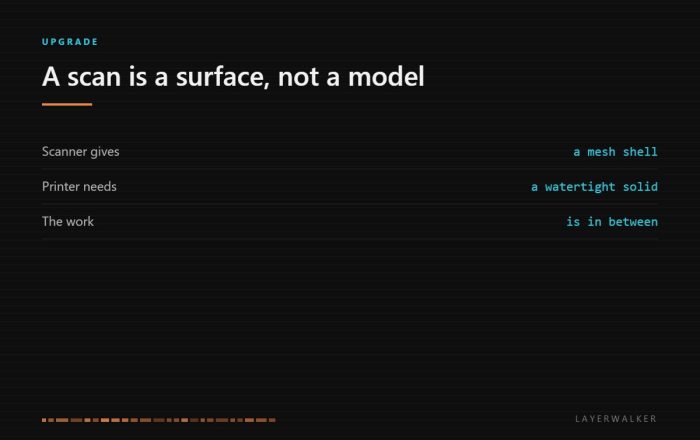
And the mesh still needs work afterwards. Scanning produces a surface, not a model; turning that into something printable or editable is a software job, and our page on scanning for 3D printing covers how much cleanup to expect.
FAQ
Does blue laser mean I never need spray? Usually on dark and shiny surfaces, yes. On transparent ones, no.
Is it more accurate than structured light? On difficult surfaces, in practice yes, because it actually captures them. On easy surfaces the difference narrows.
Can it capture colour? Less well. If texture matters more than geometry, choose a structured-light model.
Is this metrology grade? No. It is good enough to reverse engineer and to compare, not to certify.

LayerWalker
Print defect diagnosis, calibration procedures and parts that actually fit. Corrections welcome through the contact page.