Bambu P1S vs P2S: What the Successor Actually Fixed
LayerWalker is a participant in the Amazon Services LLC Associates Program. We may earn a commission when you buy through links on our site, at no extra cost to you.
The P2S fixes the P1S complaints: tool-less hotend, 1080p 30 fps camera, touchscreen, 110 °C bed, 600 mm/s toolhead, vision-based pre-print checks and the AMS 2 Pro with drying. Same 256 mm bed, same plates, same first-gen AMS compatibility. Buy the P2S at similar prices; buy the P1S only at a clear discount.
Where to buy


Side by side
| Spec | P1S | P2S |
|---|---|---|
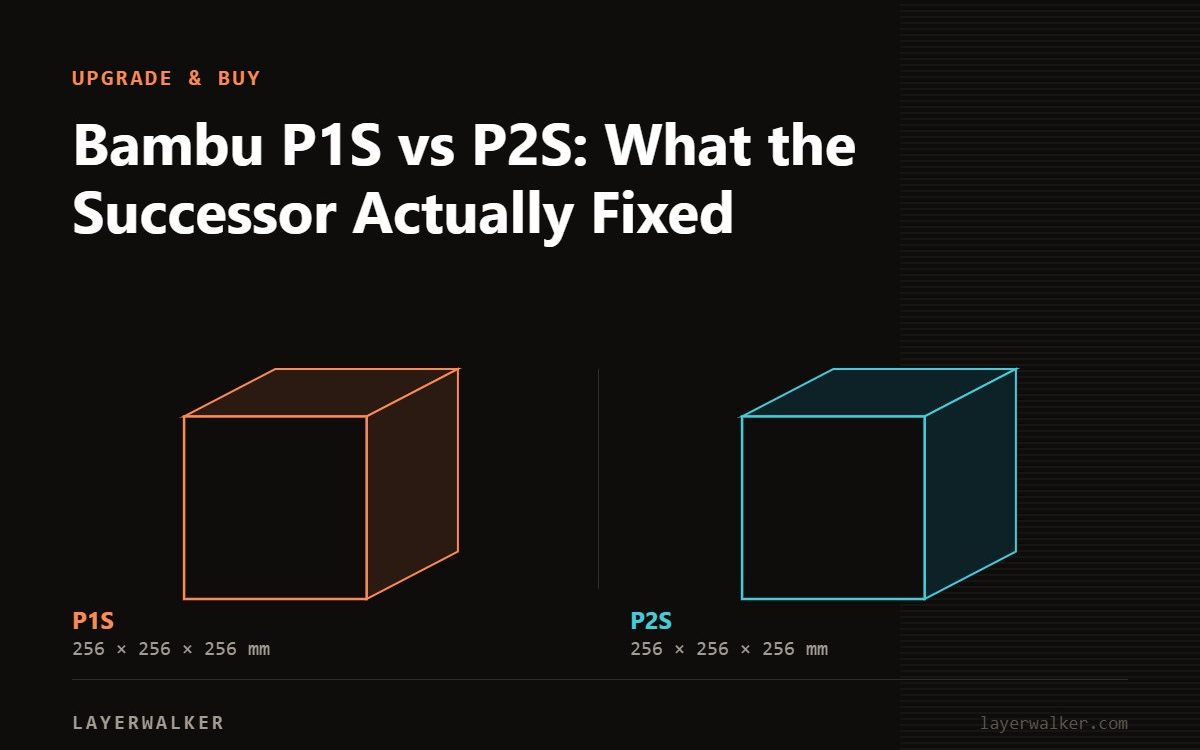
| Build volume | 256 × 256 × 256 mm | 256 × 256 × 256 mm |
| Max nozzle temperature | 300 °C | 300 °C |
| Max bed temperature | 100 °C | 110 °C |
| Toolhead speed | 500 mm/s | 600 mm/s |
| Acceleration | 20000 mm/s² | 20000 mm/s² |
| Max flow (standard hotend) | Approx. 32 mm³/s | 40 mm³/s |
| Hotend | Screw-fixed, P1 family | Tool-less, H2 family |
| Camera | 720p, low frame rate | 1080p, 30 fps |
| Screen | Monochrome, buttons | 5-inch touchscreen |
| Chamber | Passive, carbon filter | Regulator fan, VOC and particulate filter |
| Pre-print inspection | No | Vision: plate type, nozzle, debris |
| Multi-material | AMS | AMS 2 Pro (65 °C drying) / AMS HT; first-gen AMS still works |
| Weight | About 13 kg | 14.9 kg |
What actually changes day to day
- Fewer failed first layers. The P2S checks which plate is installed and whether the bed has debris before it starts. On the P1S, the wrong plate profile is a common cause of poor adhesion.
- Hotend swaps in seconds. Changing nozzle size per job becomes realistic; on the P1S most owners settle on one size.
- Dry filament without a separate dryer. The AMS 2 Pro heats to 65 °C. PETG and nylon owners on the P1S usually end up buying a dryer anyway.
- Remote monitoring you can actually use. 30 fps at 1080p versus a slideshow.
What does not change
Print quality on PLA and PETG at normal speeds is close to identical. Both are passive enclosures, so neither is a heated-chamber machine for PC or PA-CF. Both use 256 mm plates, and a P1S owner’s plate collection moves across. The extra 10 °C of bed temperature is useful but not decisive.
The compatibility trap
P1S hotends, nozzles and spare parts do not fit the P2S. If you are upgrading from a P1S and have a drawer of hotends, they stay with the P1S. The P2S shares its hotend with the H2D, H2S and X2D; see P2S upgrades.
When the P1S still makes sense
At a substantial discount, as a second machine in a farm already standardised on P1S spares, or when a first-gen AMS is included in the deal. Otherwise the P2S is the machine to buy.
The units in the box
The listings are the P1S Combo with a first-generation AMS and the P2S Combo with the AMS 2 Pro.
Bambu P1S vs P2S FAQ
Does a first-gen AMS work with the P2S?
Yes.
Is the P2S enclosure heated?
No.
Is the P2S faster in practice?
Modestly, mainly on large parts with a 0.6 mm nozzle where the 40 mm³/s flow ceiling matters.

LayerWalker
Print defect diagnosis, calibration procedures and parts that actually fit. Corrections welcome through the contact page.