Best Filament Dryer for a Bambu Lab Printer: Feeding the AMS From a Dryer, or Replacing It
LayerWalker is a participant in the Amazon Services LLC Associates Program. We may earn a commission when you buy through links on our site, at no extra cost to you.
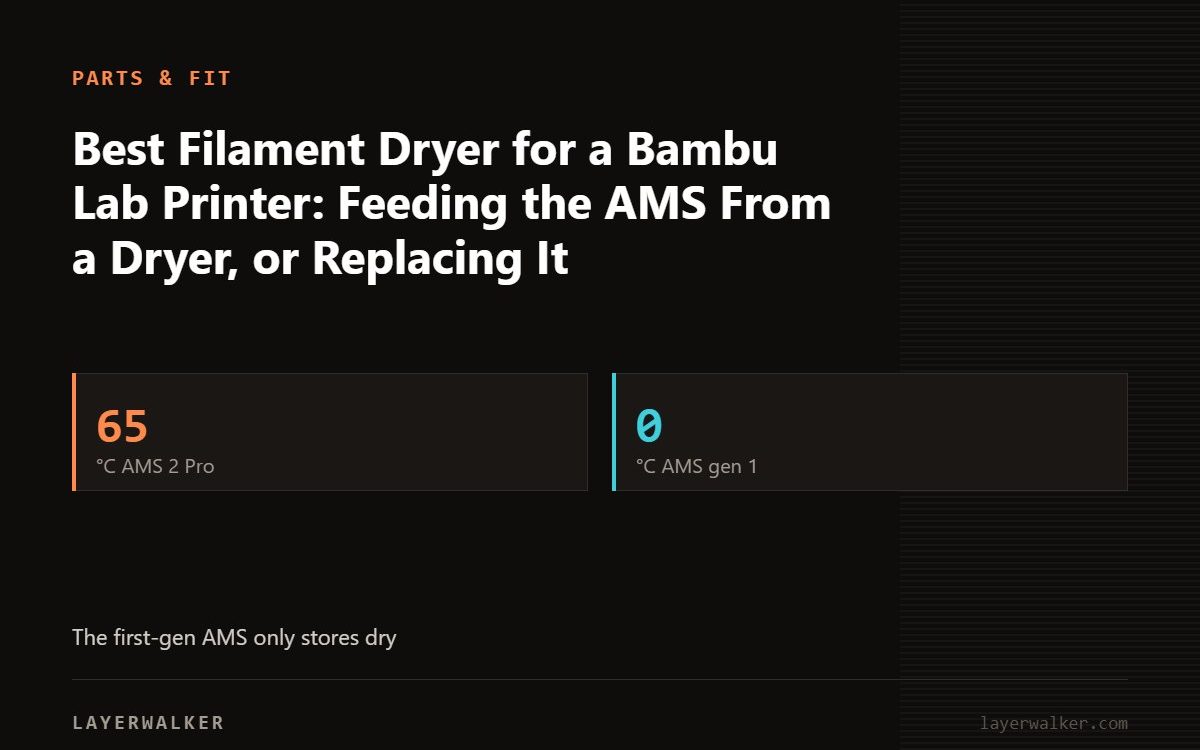
The original Bambu AMS stores filament with desiccant but does not heat it, so PETG, TPU and nylon still need a dryer. The two working setups are a single-spool dryer with a print-through outlet feeding the external spool port, or a multi-spool heated dryer whose outlets run into the AMS inlets. Buy for 65 °C minimum so PETG dries properly.
The AMS solved multi-colour and it half-solved moisture: a sealed-ish box with desiccant keeps dry filament dry for a while, but it cannot dry a wet spool, and PETG that sits in an AMS for a week in a humid room strings on the next print. Bambu’s newer heated AMS variants address this; owners of the original AMS or AMS lite add a dryer. There are two ways to do that, and the right one depends on how many materials you actually print hygroscopic.
Where to buy


Setup 1: single-spool dryer on the external port
A dryer with a print-through PTFE outlet sits beside the printer and feeds the external spool inlet. Put your PETG or TPU in it, leave PLA in the AMS. Simple, cheap, and it covers the two materials that need drying most. The dryer must reach 65 °C for PETG and stay there while printing at a holding temperature.
Setup 2: multi-spool dryer feeding the AMS
A four-spool heated dryer with PTFE outlets routes each spool into an AMS inlet, so every slot holds dry filament and the AMS handles switching. This is the setup for a printer that runs PETG in several colours or a small farm. It needs a heater strong enough for four spools, which means 150 W or more, and outlets positioned so the PTFE runs are short and smooth.
What to check
- Maximum temperature 65 °C or more, 70 °C or more for nylon.
- PTFE outlets with pneumatic fittings that accept the AMS tubes.
- A fan, so the spool core dries, not just the outer wraps.
- Spool fit. Bambu spools are standard 1 kg size; refill coils on the reusable spool fit too.
- Hygrometer so you know when a spool is done.
The dryers in the box
SUNLU’s S1 Plus is the single-spool, fan-equipped dryer for the external-port setup with PLA and PETG. The Comgrow dryer is the same idea at the entry level. Creality’s Space Pi X4 is the four-spool, 200 W dryer for feeding a full AMS; check that its outlets line up with your AMS tubing run.
Using it well
- Dry a new spool 6 hours at 65 °C for PETG before loading; see the drying guide.
- Print from the dryer at a 55 °C hold for PETG so it stays dry through long jobs.
- Recharge the AMS desiccant monthly regardless; it protects PLA.
- If PETG from the AMS strings, it has taken on water; move it to the dryer.
Best filament dryer for Bambu FAQ
Does the heated AMS replace a dryer?
For holding dry filament dry, largely. For drying a wet spool quickly, a dedicated dryer is still faster and hotter.
Can I dry TPU and feed the AMS?
Dry it, yes; feed it through the external port, because the AMS is not rated for TPU.
Do I need this for PLA only?
No. AMS desiccant is enough for PLA; see when PETG is worth the extra care.

LayerWalker
Print defect diagnosis, calibration procedures and parts that actually fit. Corrections welcome through the contact page.