Bambu Lab Build Plates: Which Plate Fits Which Printer, and Textured vs Smooth vs Cool Plate
LayerWalker is a participant in the Amazon Services LLC Associates Program. We may earn a commission when you buy through links on our site, at no extra cost to you.
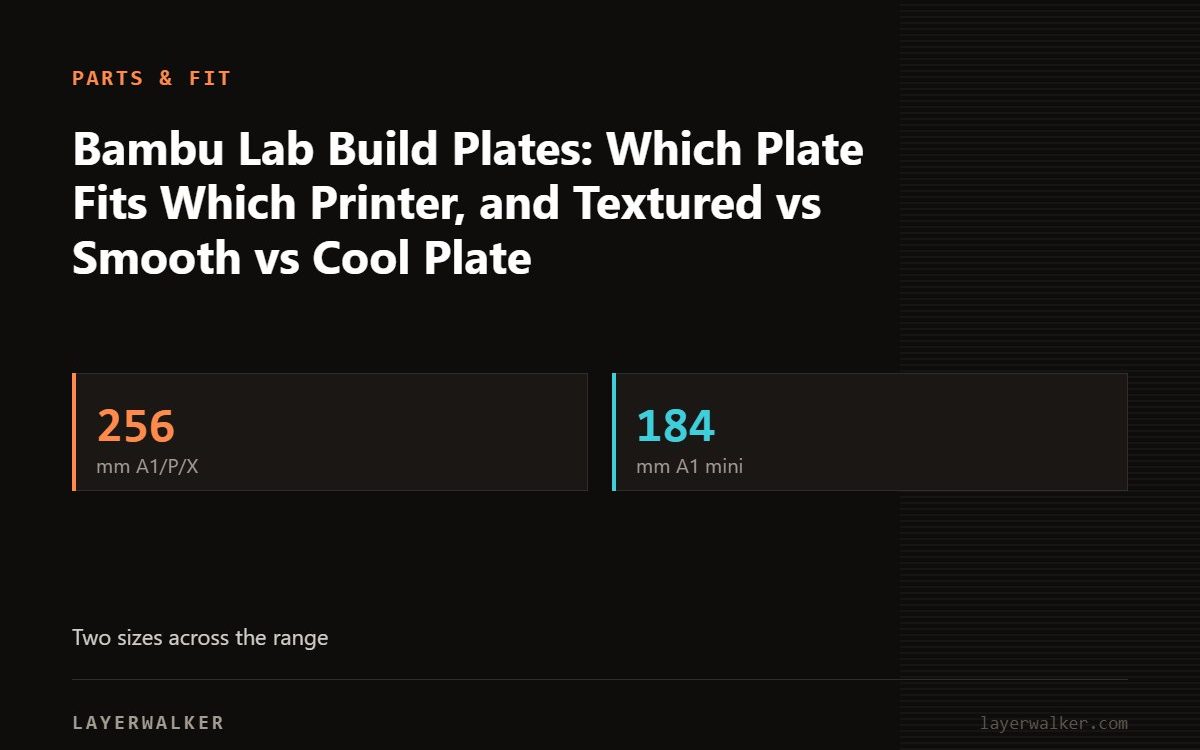
Bambu Lab printers use three plate sizes: 256 by 256 mm on the P1P, P1S, X1C, A1 and P2S; about 184 by 184 mm on the A1 mini; and a larger plate on the H2 series. Any third-party plate must match the size, the front tabs and the rear cut-out. For most filaments buy the textured PEI plate; add a smooth PEI plate for glossy PLA bottoms.
Bambu ships a plate with every printer and sells several more, and third-party makers sell dozens. They all bolt to the same magnetic bed, so the confusion is only about size, tab layout and surface. Get those three right and any plate works; get the tabs wrong and the plate slides or the nozzle hits it during the calibration wipe.
Where to buy


Sizes
- 256 by 256 mm: P1P, P1S, X1 Carbon, A1 and P2S. Plates for these are interchangeable; a plate sold for the X1C fits the A1.
- About 184 by 184 mm: A1 mini. Nothing else fits.
- H2D, H2S and the H2 series: a larger plate around 355 by 346 mm; buy plates listed for the H2.
Surfaces
- Textured PEI. The everyday plate for PLA, PETG, ABS, ASA and TPU. Grips hot, releases cold, needs no glue, matte bottom. See smooth versus textured.
- Smooth PEI (High Temperature Plate). Glossy bottom for PLA and ABS. PETG and TPU need a glue-stick release layer or they damage it.
- Cool Plate and Cool Plate SuperTack. Bambu’s low-temperature PLA plates; SuperTack holds PLA at a cool bed and releases when cold. PLA only.
- Engineering Plate. Bambu’s older smooth plate for ABS and PA with glue; largely superseded.
What a third-party plate must have
- Exact size for your model.
- The two front tabs and the rear notch, so it locates on the bed and the toolhead’s calibration routine clears it.
- A QR code or a plate-type selection in the slicer that matches; Bambu Studio warns when the plate type in the slicer disagrees with what the camera reads.
- Thick spring steel, 0.5 mm or more, with a stated coating thickness.
The plates in the box
The thicker textured PEI plate with a QR code is the 256 mm everyday plate for the P1, X1, A1 and P2S. The double-sided smooth PEI plate is the glossy-bottom option for the same printers. The UniTak3D plate is the A1 mini size.
Swapping plates
- Wash the new plate with dish soap and water; do not touch the surface after.
- Set the plate type in Bambu Studio to match, so the bed temperature preset is right.
- Let the printer’s lidar or first-layer calibration run; the Z-offset is handled automatically on Bambu printers, but it re-measures per plate.
- If the first layer will not stick on a new plate, it is grease from handling; wash again.
Bambu build plate FAQ
Do I need Bambu’s own plate?
No. A third-party plate with the right size and tabs works; the QR code only sets the plate type automatically.
Does an A1 plate fit a P1S?
Yes; both are 256 mm with the same tabs.
Textured or smooth first?
Textured. Add smooth when you want gloss.

LayerWalker
Print defect diagnosis, calibration procedures and parts that actually fit. Corrections welcome through the contact page.