Bambu A1 vs P1S: Open Bedslinger or Enclosed CoreXY
LayerWalker is a participant in the Amazon Services LLC Associates Program. We may earn a commission when you buy through links on our site, at no extra cost to you.
If you will print ABS, ASA, nylon or anything abrasive regularly, buy the P1S: enclosed, CoreXY, 20000 mm/s² and the sealed AMS. If you print PLA, PETG and TPU, the A1 gives the same 256 mm bed, better noise, easier hotend swaps and a lower price, and the print quality difference is small.
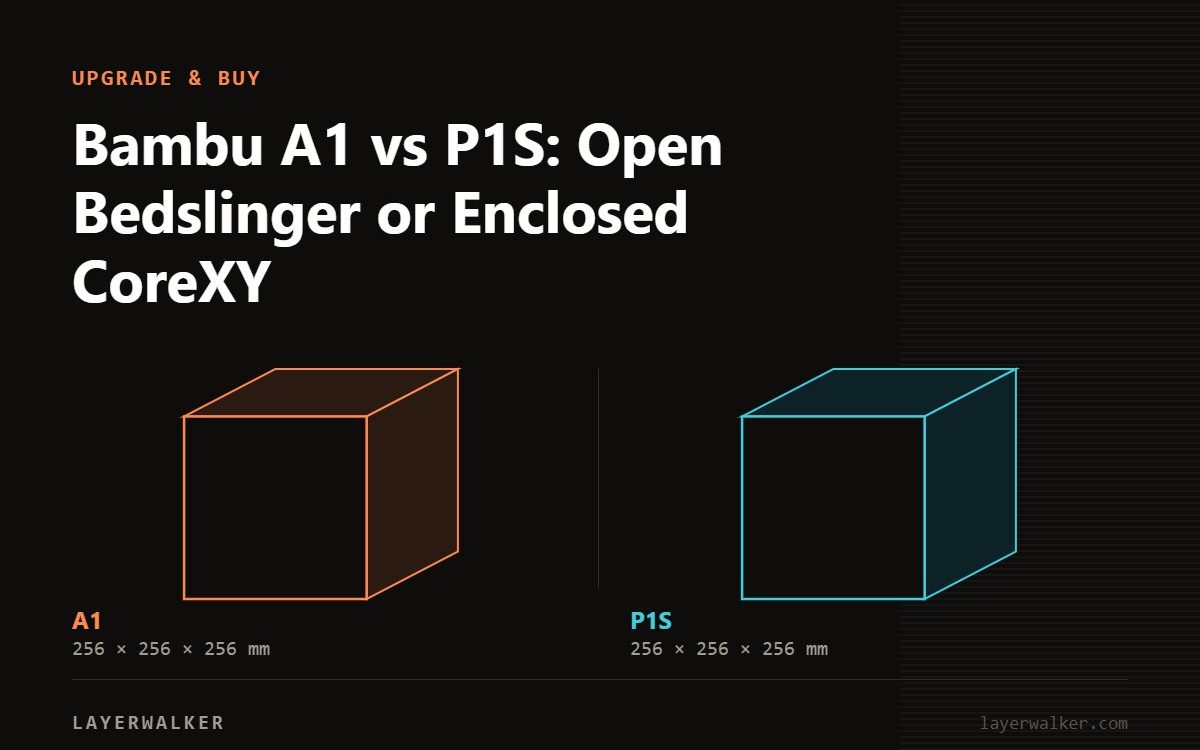
The A1 and P1S share the plate size and the ecosystem, then diverge on almost everything mechanical. One moves the bed, one moves the head in two axes inside a box. That decides materials, noise, footprint and how tall parts behave.
Where to buy

Side by side
| Spec | A1 | P1S |
|---|---|---|
| Build volume | 256 × 256 × 256 mm | 256 × 256 × 256 mm |
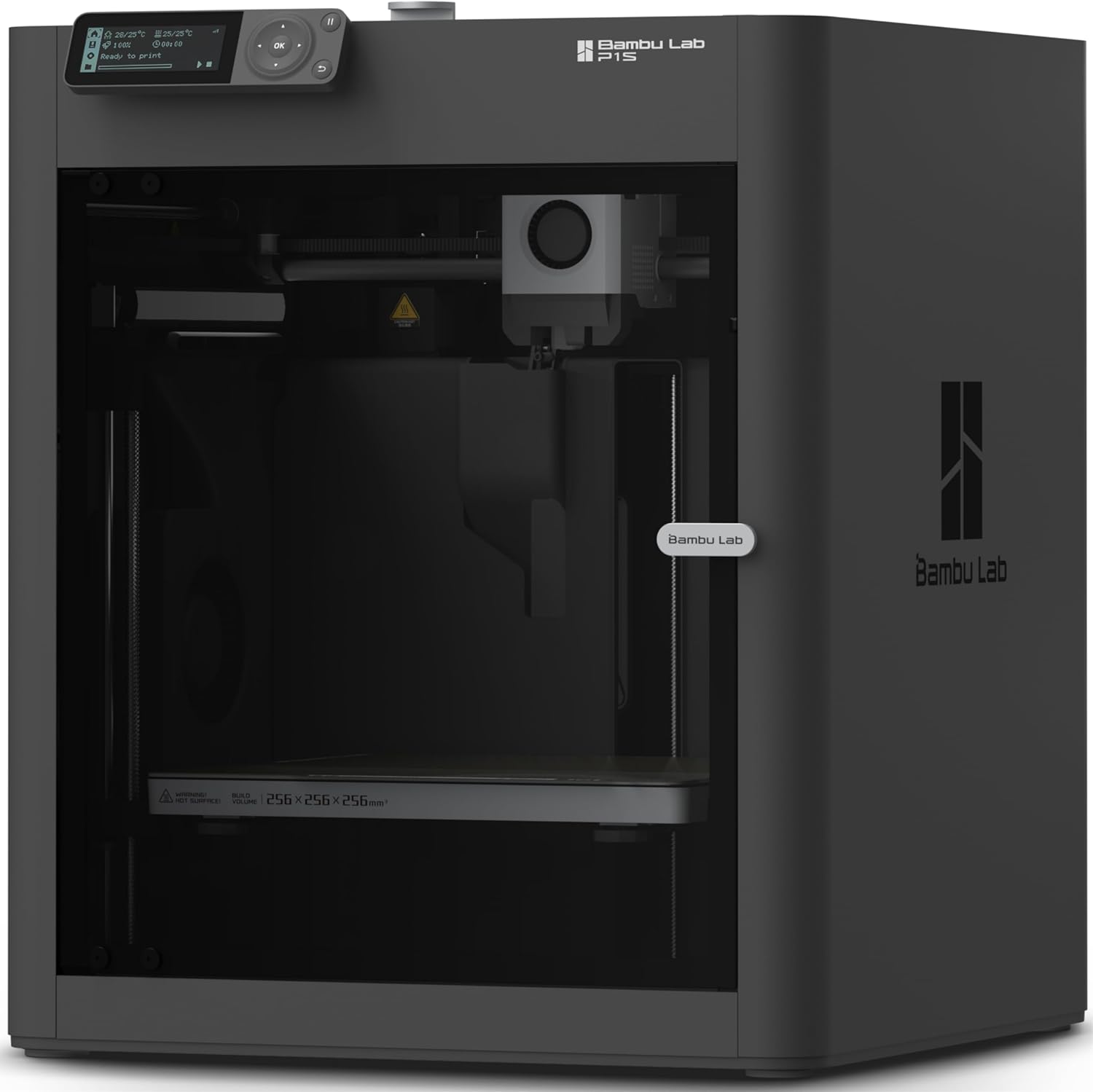
| Kinematics | Bedslinger | CoreXY, enclosed |
| Max nozzle temperature | 300 °C | 300 °C |
| Max bed temperature | 100 °C | 100 °C |
| Acceleration | 10000 mm/s² | 20000 mm/s² |
| Enclosure | None (optional third-party) | Yes, passive, carbon filter |
| Multi-material | AMS lite (open) | AMS (enclosed, up to 16 spools) |
| Camera | 1080p | 720p, low frame rate |
| Hotend swap | Tool-less clip | Screwdriver |
| Noise | Lower, silent mode | Higher; chamber and aux fans |
Where the P1S wins
- Materials. ABS and ASA hold their corners inside a warm chamber; on an open bedslinger they lift. The enclosed AMS also keeps four spools dry, which matters for nylon and PETG-CF.
- Tall and heavy parts. The bed only moves in Z, so a 1 kg vase does not get flung back and forth. On the A1 tall thin prints show more ringing.
- Throughput. Twice the acceleration shows up on small detailed parts and in multi-colour jobs with many travel moves.
Where the A1 wins
- Price and simplicity. Less to go wrong, no chamber fans, fewer panels to remove for maintenance.
- Hotend swaps and clogs. One clip. A clog is a two-minute job.
- Camera and noise. The A1 camera is better and the machine is quieter in a shared room.
- PLA overhangs. Open air is actually an advantage for PLA cooling; the P1S wants the door open or top off for PLA to avoid heat creep.
The filament test
Write down the three filaments you expect to use most. If they are all PLA, PETG and TPU, the A1 is the right printer and the P1S premium buys little. If one of them is ABS, ASA, PC or a carbon-fibre blend, the P1S is the cheaper path because an A1 plus an aftermarket enclosure still lacks the CoreXY frame and the sealed AMS. The PETG and enclosures article covers the middle ground.
The units in the box
The listings are the A1 alone and the P1S alone. Both have Combo versions with their respective AMS; the P1S Combo is the more common way to buy the P1S.
Bambu A1 vs P1S FAQ
Do they share plates?
Yes, both 256 mm.
Is the P1S better at PLA?
Marginally on tall parts; otherwise no.
Should I consider the P2S instead of the P1S?
Yes if the price gap is small; see P1S vs P2S.

LayerWalker
Print defect diagnosis, calibration procedures and parts that actually fit. Corrections welcome through the contact page.