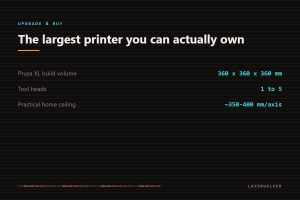
The Largest 3D Printer in the World, and the Largest You Can Own
The record holders are construction gantries that print buildings. Nothing about them transfers to a machine you can own, so here is where the line actually falls.
Which printer, which upgrade, and whether it is worth it: one-to-one comparisons and narrow buying questions. Never a generic best-of list.
The record holders are construction gantries that print buildings. Nothing about them transfers to a machine you can own, so here is where the line actually falls.
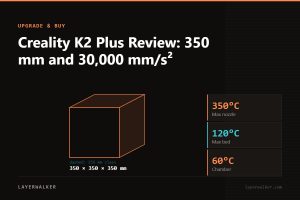
Short answer The K2 Plus is the biggest enclosed CoreXY Creality makes and the numbers back it up: 350 x 350 x…
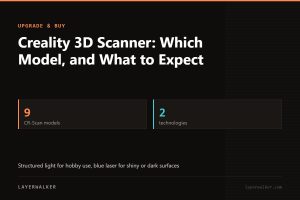
Short answer Creality’s scanner range is broad and confusingly named: CR-Scan Ferret and Ferret Pro, CR-Scan Lizard, CR-Scan Otter and Otter Lite,…
Short answer Photon is Anycubic’s resin line, and the name now spans several generations, so it is not a single machine. The…
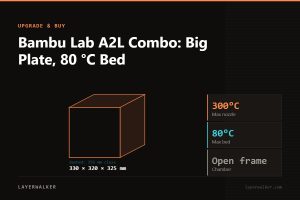
Short answer The A2L Combo pairs Bambu’s largest open machine with a changer. The printer gives 330 x 320 x 325 mm,…
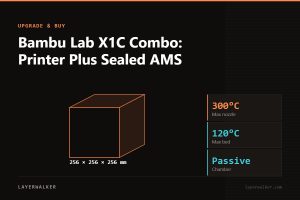
Short answer The X1C Combo is the X1 Carbon bundled with the sealed AMS. You get 256 x 256 x 256 mm,…
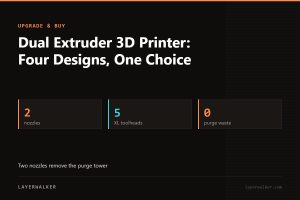
Short answer “Dual extruder” now covers four different designs, and picking the wrong one is the usual mistake. A filament changer feeds…
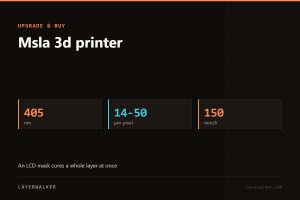
Short answer MSLA means masked stereolithography: a monochrome LCD sits between a UV light source and the resin tank and masks each…
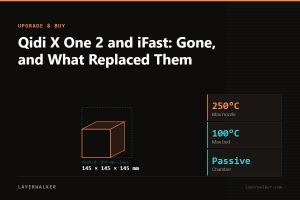
Short answer The X One 2 and the iFast are both gone from Qidi’s product catalogue, along with the Plus 4 on…
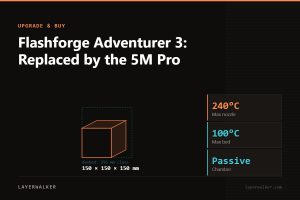
Short answer The Adventurer 3 is discontinued. Flashforge’s Adventurer line is now the Adventurer 5M and 5M Pro: 220 x 220 x…