Anycubic Photon: How to Pick Between the Models
LayerWalker is a participant in the Amazon Services LLC Associates Program. We may earn a commission when you buy through links on our site, at no extra cost to you.
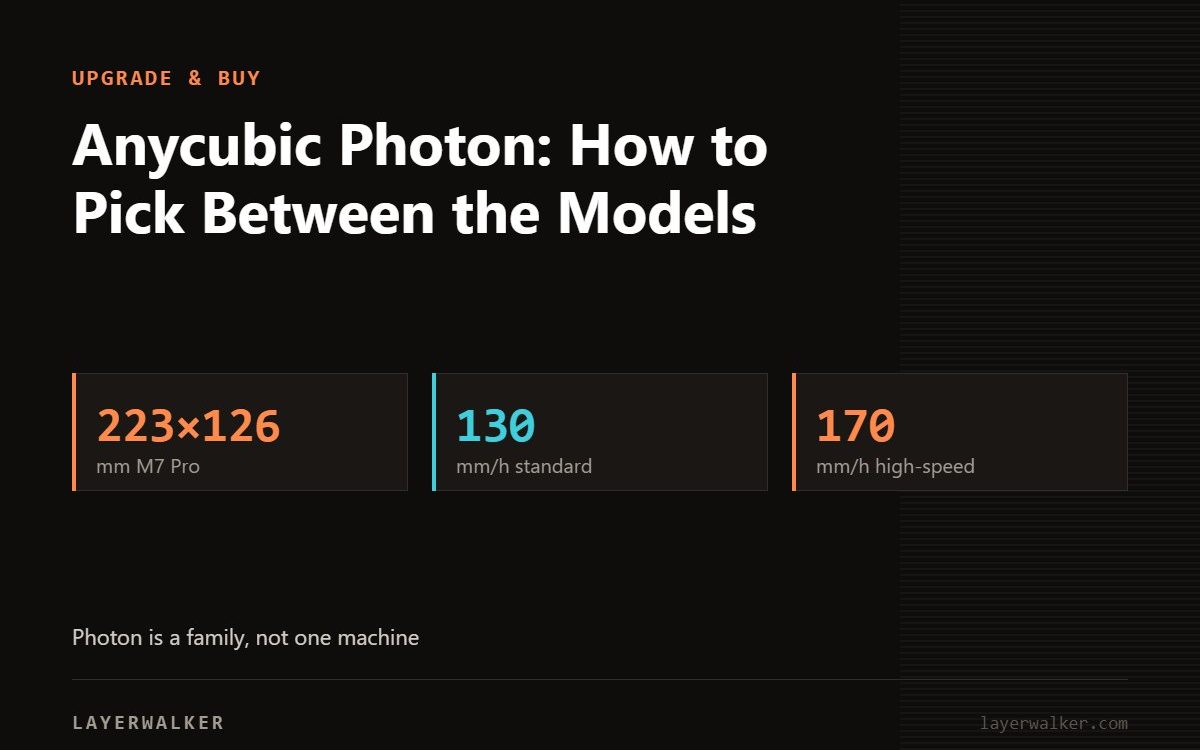
Photon is Anycubic’s resin line, and the name now spans several generations, so it is not a single machine. The current family is built on large monochrome LCD panels: the Photon Mono M7 Pro gives 223 x 126 x 230 mm (6.5 litres) at up to 130 mm/h with standard resin and 170 mm/h with high-speed resin, at 12.8 kg, and there are larger M7 MAX panels at 13.6 inches and a Photon P1 with auto-levelling. Pick by panel size and pixel pitch, not by the model name.
The original Photon was one of the machines that made desktop resin printing affordable. A decade of revisions later, “Anycubic Photon” in a search box does not narrow anything down, so here is how to read the range.
Where to buy


How to compare Photon models
Every current Photon is an MSLA machine: a monochrome LCD masks UV light and cures a whole layer in one exposure. That means three numbers decide the machine, and the model name decides none of them.
Panel size and resolution together. A pixel count on its own is marketing. Divide resolution by screen width to get pixel pitch, which is the real detail figure. A 13.6-inch 7K panel spreads its pixels over far more area than a 7-inch 9K panel, so the bigger screen is not automatically the finer one.
Build volume, which follows directly from panel size. The Mono M7 Pro’s 223 x 126 x 230 mm is 6.5 litres; the M7 MAX class is larger again.
Vertical speed, quoted in mm per hour because area is free in MSLA. Anycubic publishes two figures for the M7 Pro, up to 130 mm/h with standard resin and up to 170 mm/h with high-speed resin, which is the honest way to do it. Treat single-figure claims elsewhere as best case.
Our MSLA explainer covers what those specs mean in practice.
What the current generation added
Two things separate a current Photon from an early one. Monochrome LCDs replaced RGB panels, which cut exposure times dramatically and extended panel life. And light engines moved to COB sources with collimating optics, which gives more even, more parallel light so detail at the edge of the plate matches the middle.
Auto-levelling, as on the Photon P1, is the third convenience. On a resin machine, levelling is a once-in-a-while job rather than a per-print one, but getting it wrong ruins a whole tank.
What owning one actually involves
The machine is the cheap part. Every print ends with draining, washing in isopropyl alcohol, UV curing, support removal and disposal of contaminated alcohol, in nitrile gloves throughout, because uncured resin is a sensitiser and repeated skin contact is how people develop a lasting allergy to it.
Two consumables are unavoidable: the tank film, and eventually the LCD panel itself, which sits in the light path and degrades. Ventilation is not optional either. See our notes on starting with resin and resin enclosures.
Which Photon to buy
For miniatures and detailed models, favour pixel pitch over volume: a smaller, finer panel beats a big coarse one. For terrain, busts and larger props, take the bigger panel and accept slightly coarser pixels. Our resin for miniatures page and Anycubic resin overview cover the choice, and the M7 Pro page has that model in detail.
Whatever you choose, check the generation in the listing. Anycubic’s naming reuses Photon, Mono, M7, Pro and MAX in combination, and marketplace listings are not always precise.
Anycubic Photon FAQ
Is Photon one printer?
No, it is Anycubic’s resin line across several generations.
How do I compare two Photon models?
Compute pixel pitch from panel resolution and size, then compare build volume and mm/h.
Does a bigger screen mean better detail?
No. A larger panel with the same pixel count has coarser pixels.
What wears out?
The tank film and, over time, the LCD panel.

LayerWalker
Print defect diagnosis, calibration procedures and parts that actually fit. Corrections welcome through the contact page.