Creality 3D Scanner: Which Model, and What to Expect
LayerWalker is a participant in the Amazon Services LLC Associates Program. We may earn a commission when you buy through links on our site, at no extra cost to you.
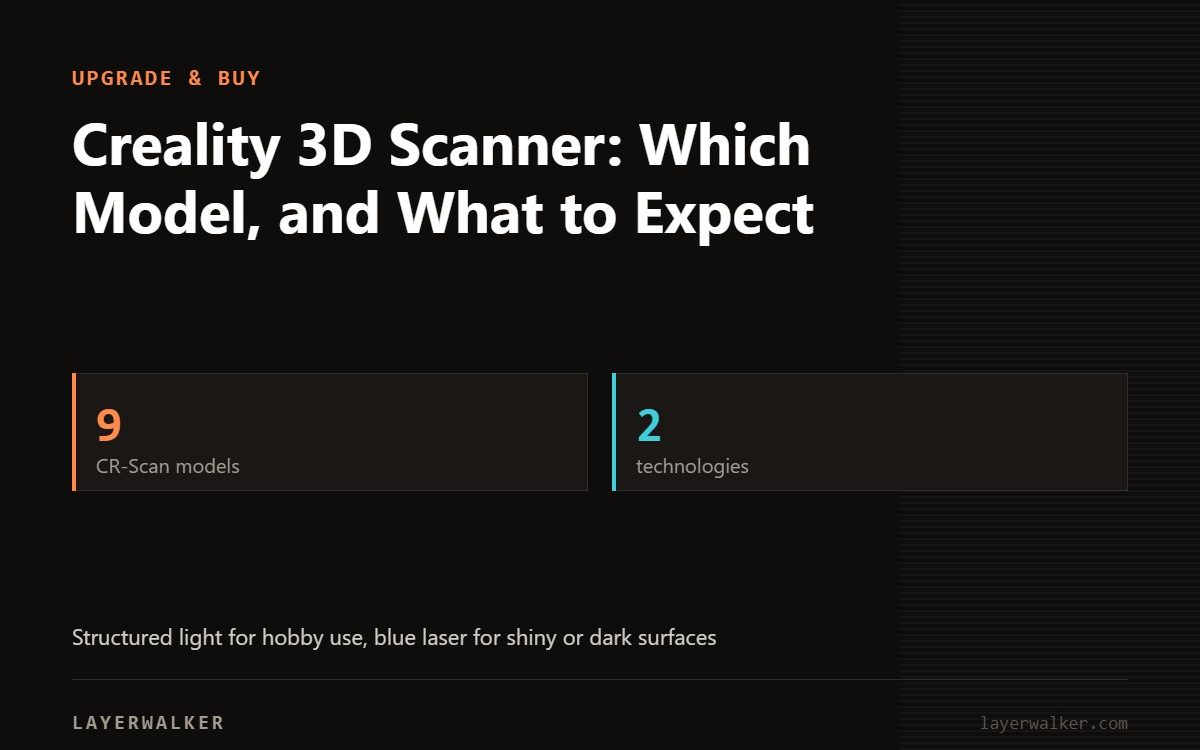
Creality’s scanner range is broad and confusingly named: CR-Scan Ferret and Ferret Pro, CR-Scan Lizard, CR-Scan Otter and Otter Lite, CR-Scan Raptor and RaptorX, CR-Scan 01 and the Scan Bridge. They split into structured-light handhelds for hobby use and blue-laser models for shiny or dark surfaces. Before buying any of them, be clear that a scan is a starting point for modelling, not a printable file, and check what the software licence includes.
Scanning is the most oversold part of desktop 3D printing. The hardware works better than it used to; the workflow still requires patience and a modelling step afterwards. This page is about choosing sensibly inside Creality’s line-up and knowing what to expect.
Where to buy


Revopoint MetroX Pro 3D Scanner, Blue Laser Scan, for 3D Printing, Advanced
The range, and how it splits
Creality currently lists the CR-Scan Ferret and Ferret Pro, CR-Scan Lizard, CR-Scan Otter and Otter Lite, CR-Scan Raptor and RaptorX, CR-Scan 01, a Scan Bridge accessory, and a scanner version of the Sermoon S1.
The practical division is by light source. Structured-light scanners project a pattern and read its deformation; they are cheaper, quicker on medium-sized matte objects, and they struggle with anything shiny, dark or transparent. Blue-laser scanners handle those difficult surfaces much better and generally resolve finer detail, at a higher price.
That surface problem is the single biggest cause of disappointment. A black plastic bracket or a chrome part will simply not scan on a structured-light unit without matting spray, and that is physics rather than a fault.
What a scan gives you, and what it does not
A scan produces a mesh, typically a dense triangle soup with holes where the scanner could not see. It is not a solid model, it has no clean edges, and it is not printable without work.
What you do next depends on the goal. For an organic shape, a figurine or a face, cleaning and reprinting the mesh directly is reasonable. For a mechanical part, the mesh is a reference you model over in CAD, because a printed copy of a scan of a bracket will not have flat faces, true holes or correct dimensions.
Set expectations accordingly. Scanning is excellent for capturing shape you cannot measure and poor at replacing a caliper and a sketch. Our page on scanners for 3D printing covers the workflow in more depth.
Choosing between Creality and the alternatives
Creality’s advantage is breadth and price, plus the convenience of one ecosystem if you already own their printers. Revopoint is the other name you will see constantly in this bracket, with the POP series for general handheld scanning and blue-laser models such as the MetroX Pro for reflective and dark surfaces.
Compare on three things rather than headline resolution: the light source, whether the software licence is perpetual or subscription, and whether a turntable is included, because a turntable is what makes small-object scanning tolerable. See our Revopoint page and handheld scanner guide for the comparison.
Practical advice before you buy
Scan a test object like the one you actually care about, if you can find footage of it. Matte, mid-tone, textured objects scan easily on anything; featureless, shiny or dark objects separate the cheap units from the capable ones.
Check the computer requirement. Scanning is processor and memory hungry, and a laptop that runs a slicer comfortably may not keep up with live capture.
And budget for matting spray, a turntable and time. Those three things determine whether a scanner becomes a tool or a drawer ornament.
Creality 3D Scanner FAQ
Which Creality scanners are current?
CR-Scan Ferret and Ferret Pro, Lizard, Otter and Otter Lite, Raptor and RaptorX, CR-Scan 01, plus the Scan Bridge accessory.
Can I print a scan directly?
Rarely. Meshes need cleaning, and mechanical parts should be remodelled in CAD over the scan.
Why will my black part not scan?
Structured-light scanners need to see their projected pattern. Dark, shiny and transparent surfaces defeat that; blue-laser models cope better.
Do I need a turntable?
For small objects, yes in practice. Check whether one is included.

LayerWalker
Print defect diagnosis, calibration procedures and parts that actually fit. Corrections welcome through the contact page.