Flashforge Adventurer 3: Replaced by the 5M Pro
LayerWalker is a participant in the Amazon Services LLC Associates Program. We may earn a commission when you buy through links on our site, at no extra cost to you.
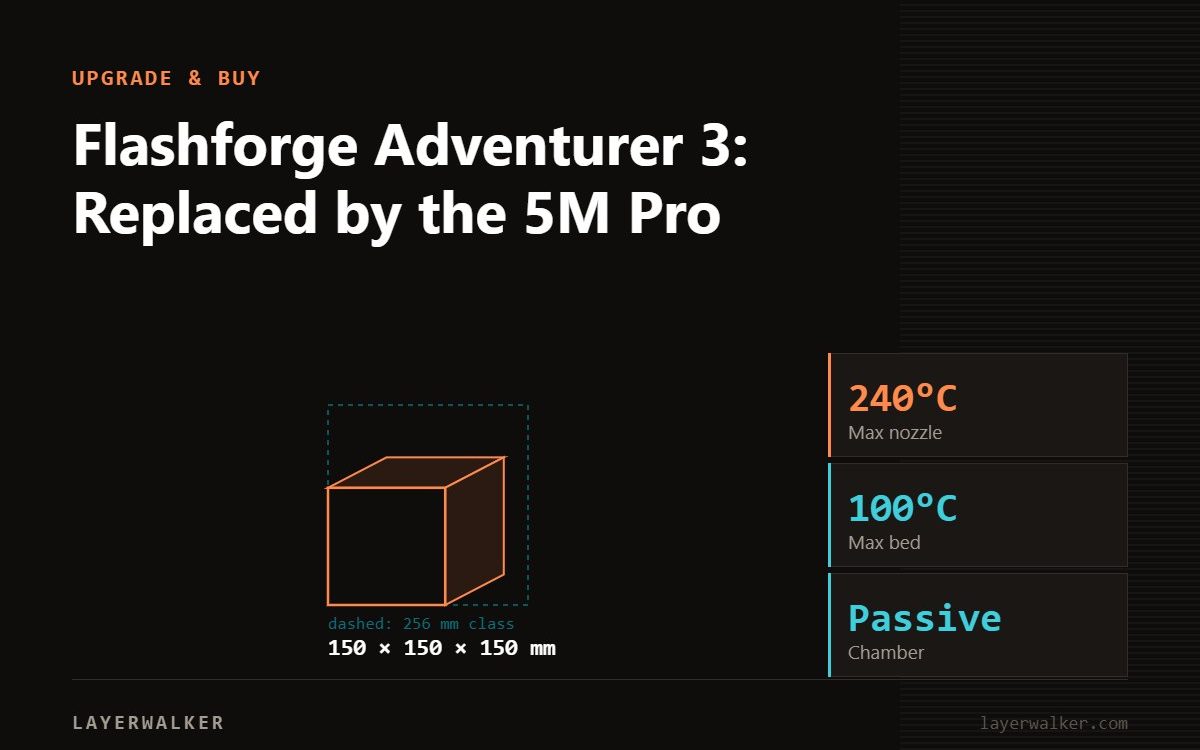
The Adventurer 3 is discontinued. Flashforge’s Adventurer line is now the Adventurer 5M and 5M Pro: 220 x 220 x 220 mm, a 280 degC nozzle, direct drive, up to 600 mm/s travel and 20,000 mm/s2, with quick-release nozzles in 0.25, 0.4, 0.6 and 0.8 mm. If you liked the Adventurer 3 for being a closed, simple, no-assembly box, the 5M Pro is the direct descendant, and it is faster in every respect.
The Adventurer 3 was a good answer to a specific question: give me a printer that works out of the box, has no exposed mechanism, and does not need me to level a bed. It sold well to families and schools for exactly that reason. The question is still a good one; the answer has changed.
Where to buy


What the line looks like now
| Spec | Adventurer 5M / 5M Pro |
|---|---|
| Build volume | 220 x 220 x 220 mm |
| Max nozzle temp | 280 degC |
| Max travel speed | 600 mm/s |
| Max acceleration | 20,000 mm/s2 |
| Extruder | Direct drive |
| Nozzles | Quick-release 0.25, 0.4, 0.6, 0.8 mm |
| Display | 4.3 inch |
| 5M Pro adds | Enclosure and filtration |
The 5M Pro is the one that matches the Adventurer 3’s brief, because the enclosure is what made the older machine feel safe around children and quiet on a shelf. Filtration is a genuine addition rather than a bullet point if the printer shares a room.
What changed most
Speed and the extruder. 20,000 mm/s2 of acceleration is a generational leap over the Adventurer 3 era, and direct drive means TPU and other flexibles are usable rather than a fight. Quick-release nozzles across four diameters is the third change, and it matters more than it sounds: a 0.8 mm nozzle halves the time on chunky parts, and people only actually swap nozzles when swapping is easy.
What has not changed is the philosophy: closed box, no assembly, automatic levelling, one-click start. Our Adventurer 5M assessment and 5M Pro notes cover both versions.
The one number to check against your needs
280 degC. It is enough for PLA, PETG, TPU and PLA-CF, and tight for ABS and ASA, which are usually printed at the top of that range. If engineering filament is on your list, look at machines quoting 300 degC or more, or Flashforge’s own Creator 5 at 320 degC with a 120 degC bed and a materials list that extends to PPS-CF.
Any filled filament needs a hardened nozzle whichever machine you pick.
Buying an Adventurer 3 used
It will still print PLA happily and it is a tidy machine, so as a cheap second printer or a first machine for a child it is not a bad object. Just be clear about the speed difference and check the nozzle and build plate, since those are the wear items. And confirm the software situation, because older Flashforge models used their own workflow rather than the current Orca-Flashforge slicer.
Our Flashforge range page covers what is current.
Flashforge Adventurer 3 FAQ
Is the Adventurer 3 still made?
No. The line is now the Adventurer 5M and 5M Pro.
What is the closest current model?
The Adventurer 5M Pro, which keeps the enclosed, no-assembly design and adds filtration.
Is the 5M much faster?
Yes: 20,000 mm/s2 and up to 600 mm/s travel, a generation ahead.
Can either print ABS?
The 5M tops out at 280 degC, which makes ABS marginal. Look at the Creator 5 at 320 degC for engineering materials.

LayerWalker
Print defect diagnosis, calibration procedures and parts that actually fit. Corrections welcome through the contact page.