Flashforge Adventurer 5M Review: The 280 °C Limit
LayerWalker is a participant in the Amazon Services LLC Associates Program. We may earn a commission when you buy through links on our site, at no extra cost to you.
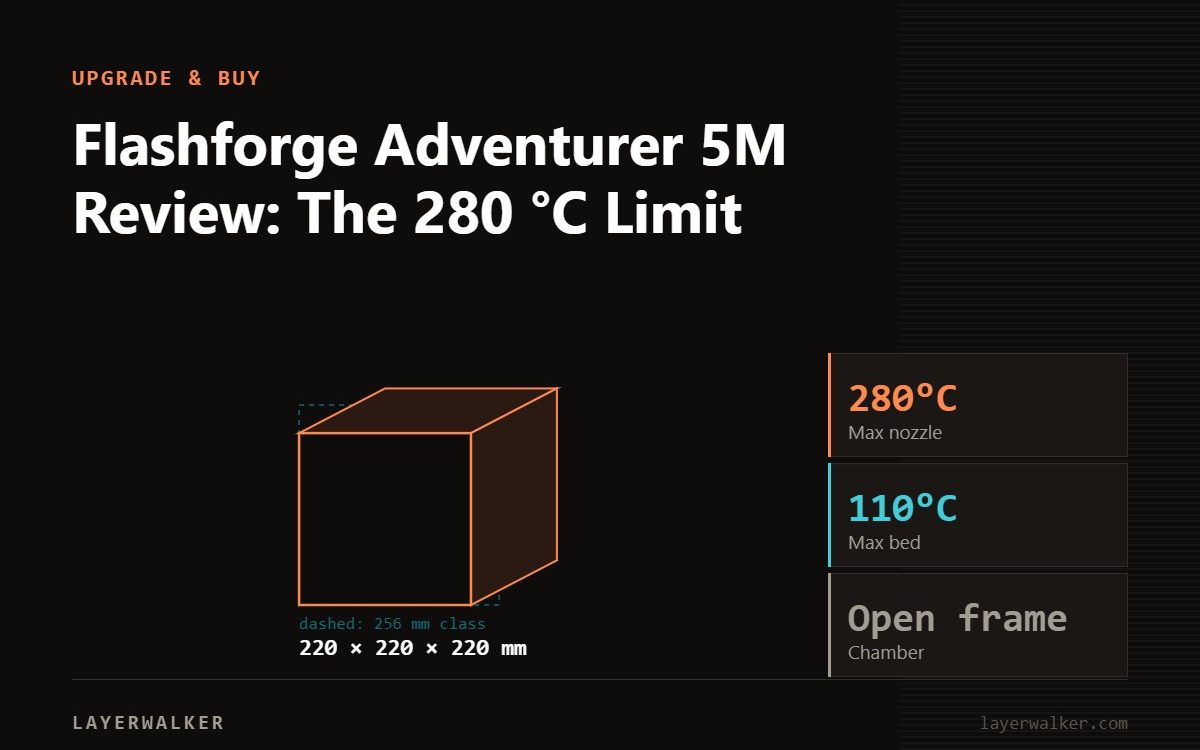
The Adventurer 5M is a 220 x 220 x 220 mm direct-drive machine with a 280 degC nozzle, travel speeds to 600 mm/s and 20,000 mm/s2 of acceleration, quick-release nozzles in 0.25, 0.4, 0.6 and 0.8 mm, and a 4.3 inch screen. The Pro version adds enclosure and filtration. The 280 degC nozzle is the number that defines it: fine for PLA, PETG and PLA-CF, tight for ABS and ASA, and short of the 300 to 350 degC machines if engineering filament matters.
This assessment is from Flashforge’s published specification rather than a workshop test. The 5M’s pitch is one-click setup and genuinely fast motion at a low price, and it delivers that; the question is whether its material ceiling suits you.
Where to buy


Specification
| Spec | Adventurer 5M / 5M Pro |
|---|---|
| Build volume | 220 x 220 x 220 mm |
| Max nozzle temp | 280 degC |
| Max travel speed | 600 mm/s |
| Max acceleration | 20,000 mm/s2 |
| Extruder | Direct drive |
| Nozzles | Quick-release 0.25, 0.4, 0.6, 0.8 mm |
| Display | 4.3 inch |
| 5M Pro adds | Enclosure and filtration |
What it does well
Quick-release nozzles across four diameters is the underrated feature. A 0.8 mm nozzle turns a slow big print into a fast one, and a 0.25 mm nozzle gets you detail a 0.4 cannot. On most printers changing nozzle diameter is a chore, so people never do it; here it is designed to be routine. Our page on nozzle choice covers when each size earns its place.
Direct drive at this price is the other real advantage, because it makes TPU and other flexibles genuinely usable rather than a fight.
And the motion figures are honest ones: Flashforge quotes 600 mm/s as a travel speed rather than pretending it is a printing speed, which is the correct way to publish that number.
The 280 degC ceiling
This is the constraint to think hardest about. 280 degC handles PLA, PETG, TPU and PLA-CF comfortably. ABS and ASA sit near the top of that range rather than in the middle of it, and the more demanding engineering blends are out.
For comparison within Flashforge’s own range, the Creator 5 reaches 320 degC on a 256 x 256 x 256 mm plate with a 120 degC bed, 30,000 mm/s2 and a Full HD camera, and its supported list with the enclosure extends to ABS, ASA, HIPS, PA-CF, PET-CF and PPS-CF. That is a materially different machine. Elsewhere, the Bambu P2S and Creality K1C reach 300 degC, and the Qidi Q1 Pro reaches 350 degC with a heated chamber.
If your list is PLA and PETG with the occasional flexible, none of that matters. If you expect to grow into engineering materials, buy for that now.
5M or 5M Pro
The Pro adds the enclosure and filtration. Given the 280 degC ceiling, the enclosure’s value is mostly noise, dust and a small improvement in ABS reliability rather than unlocking new materials. If the printer lives in a room you use, that is still worth having. Our AD5M Pro notes cover the difference.
Who should buy it
Buy the 5M if you want fast, quiet-enough PLA and PETG printing with easy nozzle changes and one-click setup, and 220 mm cubed is enough space. Compare against the Bambu A1, which offers full automatic calibration in the same bracket, and see AD5M vs Bambu A1 for that call. Step up to the Creator 5 or a 300 degC-plus machine if engineering filament is coming.
Flashforge Adventurer 5M Review FAQ
How hot does the Adventurer 5M nozzle get?
280 degC, lower than the 300 degC common in this class.
Is 600 mm/s the printing speed?
No, that is the maximum travel speed. Acceleration is up to 20,000 mm/s2.
Can I change nozzle sizes easily?
Yes, quick-release in 0.25, 0.4, 0.6 and 0.8 mm.
What does the Pro add?
An enclosure and filtration.

LayerWalker
Print defect diagnosis, calibration procedures and parts that actually fit. Corrections welcome through the contact page.