Qidi Q1 Pro Review: A Real Heated Chamber
LayerWalker is a participant in the Amazon Services LLC Associates Program. We may earn a commission when you buy through links on our site, at no extra cost to you.
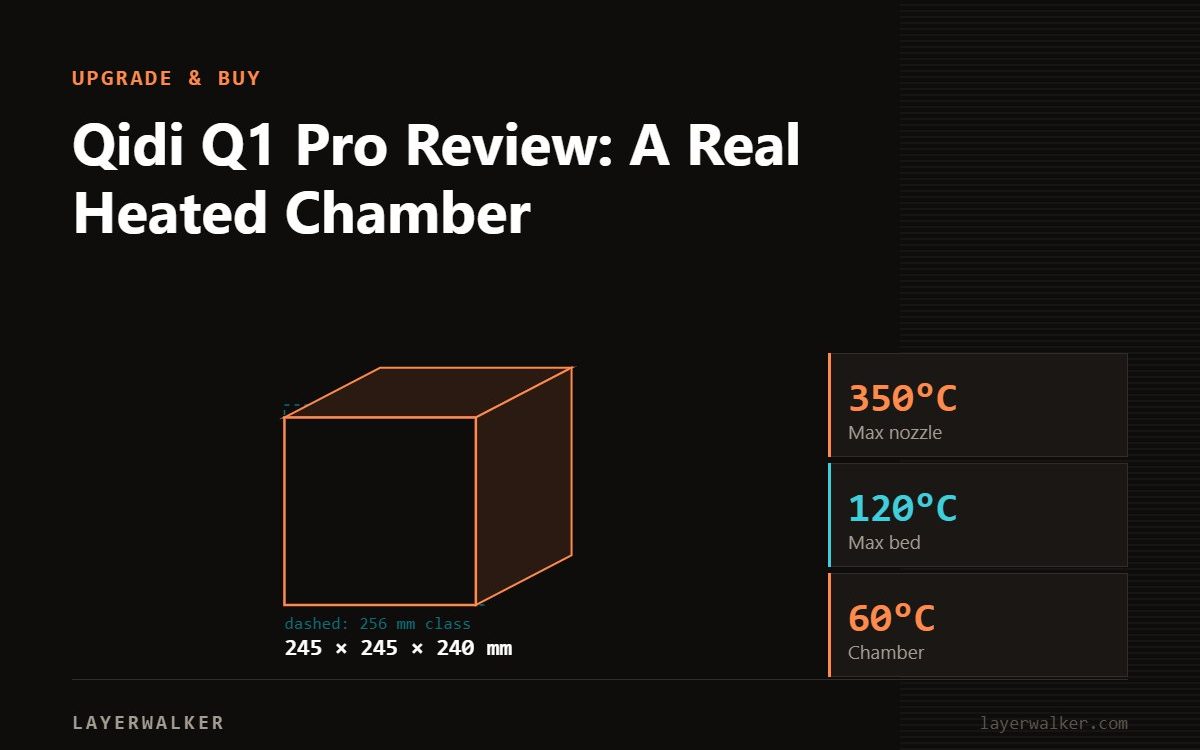
The Q1 Pro’s selling point is independent chamber heating to 60 degC, which very few machines at its price offer, alongside a 350 degC nozzle and a 120 degC bed on a 245 x 245 x 240 mm plate at 600 mm/s and up to 20,000 mm/s2. That combination is what makes ABS, ASA and nylon genuinely comfortable rather than merely possible. It is compact for its capability at 477 x 467 x 489 mm. Note that Qidi’s current line-up has moved on to the Q2, Plus4 and Plus5, so check what a listing is actually offering.
This assessment is from Qidi’s published specification rather than a workshop test. The Q1 Pro is the machine that made actively heated chambers a mainstream expectation, and that is the feature worth focusing on.
Where to buy


Specification
| Spec | Qidi Q1 Pro |
|---|---|
| Build volume | 245 x 245 x 240 mm |
| Max nozzle temp | 350 degC |
| Max bed temp | 120 degC |
| Chamber | 60 degC, independent heating |
| Max speed / acceleration | 600 mm/s / up to 20,000 mm/s2 |
| Size | 477 x 467 x 489 mm |
| Display | 4.3 inch, 272 x 480 touchscreen |
Independent chamber heating is the whole point
Most enclosed printers do not heat their chamber; they trap the heat the bed gives off. That gets you to maybe 35 or 40 degC, which helps a little with ABS and not much with anything harder. An independently heated chamber holds a target temperature regardless of what the bed is doing.
60 degC is the number that matters, because it is warm enough that a printed part cools slowly and evenly. That is what stops ABS and ASA lifting at the corners and what makes layer bonding hold in nylon. Combined with 350 degC at the nozzle and 120 degC at the bed, this is a genuine engineering-materials machine rather than a PLA machine in a box.
The trade is that PLA does not enjoy a hot chamber, so you turn the heater off for it. That is fine, and it is why independent control is better than a passively hot box.
Size versus capability
245 x 245 x 240 mm is modest, slightly under the 256 mm cube that dominates this class. What you get in exchange is a compact overall footprint at 477 x 467 x 489 mm for a machine with a heated chamber, which is not a common combination.
If you need more volume with the same chamber capability, Qidi’s own range has grown: the Plus4 lists 65 degC chamber heating and a 370 degC integrated nozzle, and there are Q2, Plus5 and Max4 machines above it. See our Q1 Pro overview and Plus 4 page.
What to watch
Two things. First, abrasive filament: a 350 degC nozzle invites filled materials, and filled materials destroy brass, so confirm the nozzle material and keep a hardened spare.
Second, generation. Qidi iterates quickly and older models drop off the product pages, which makes listings ambiguous. Check the exact model name against the current catalogue before buying, especially on marketplace listings.
Who should buy it
Buy the Q1 Pro if engineering materials are the reason you are buying a printer and you want the smallest machine that does them properly. Buy a 256 mm class machine such as the P2S or Centauri Carbon if PLA and PETG are your staples and you would rather have plate size and ecosystem. Buy up Qidi’s own range if you need the same chamber capability with more volume.
Qidi Q1 Pro Review FAQ
Does the Q1 Pro really heat its chamber?
Yes, independently, to 60 degC. That is different from a passively enclosed machine.
Can it print nylon and ASA?
Yes. 350 degC nozzle, 120 degC bed and a 60 degC chamber are the right combination.
How big is the plate?
245 x 245 x 240 mm, slightly smaller than the common 256 mm cube.
Is it still the current model?
Qidi’s range now includes the Q2, Plus4, Plus5 and Max4, so verify what a listing is selling.

LayerWalker
Print defect diagnosis, calibration procedures and parts that actually fit. Corrections welcome through the contact page.