P1P AMS: Fits Fine, but Enclose the Printer First
LayerWalker is a participant in the Amazon Services LLC Associates Program. We may earn a commission when you buy through links on our site, at no extra cost to you.
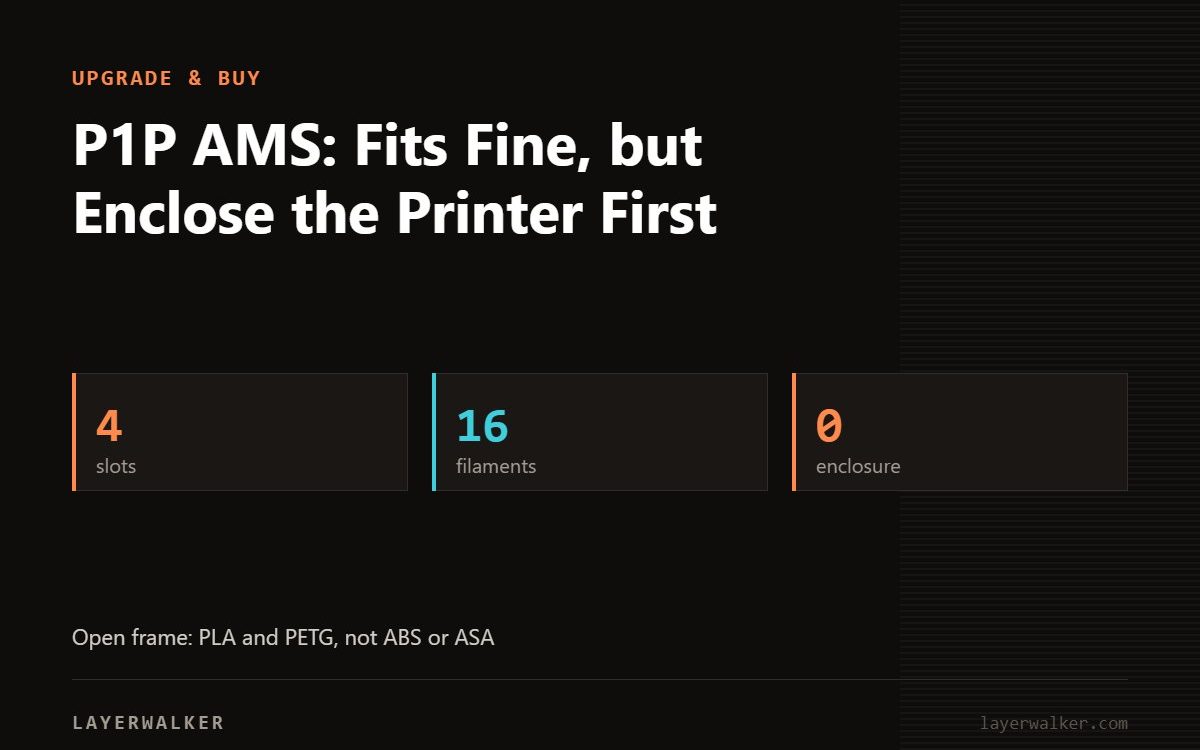
The P1P takes the same enclosed four-slot AMS as the P1S, and up to four units chain for sixteen filaments on a P1 or X1 series printer. The catch is not the changer, it is the printer: the P1P is open-framed, so multi-colour ABS and ASA will warp. Add the AMS for PLA and PETG work, and if you want engineering materials, put the money into enclosing the machine first.
The P1P and P1S are the same CoreXY underneath: 256 x 256 x 256 mm, 300 degC nozzle, 110 degC plate, 500 mm/s and 20,000 mm/s2, direct drive. The P1S is the P1P plus an enclosure and stronger part cooling. So an AMS behaves identically on both, and the question of whether it is worth adding comes down to what you print.
Where to buy


SUNLU AMS Heater, Compatible with Bambu lab AMS Gen 1
Which AMS, and how many
The sealed AMS, not the open AMS lite that belongs to the A1 series. Four spools sit in an airtight shell with desiccant, RFID tags on Bambu filament are read automatically, and a P1 or X1 series printer accepts up to four units for sixteen filaments.
The AMS 2 Pro also works across the range, but on a P1 series machine a single AMS 2 Pro needs an AMS Hub (part SA002-N), and each AMS 2 Pro needs its own switching adapter before the drying function will run. That is worth knowing before you order, because those parts are easy to leave out of a basket.
The open frame is the real constraint
An AMS does not change what your printer can print. On an open P1P, PLA and PETG multi-colour is excellent. ABS and ASA are a different story: without an enclosure the part cools unevenly, corners lift, and layer bonding suffers. Multi-colour makes that worse, not better, because colour changes add purge, travel and dwell time during which the part sits cooling.
So the sequence matters. If your goal is multi-colour toys, models and PLA prints, add the AMS and enjoy it. If your goal is functional ABS parts, enclose the machine first, whether that is the official conversion or a separate enclosure, and then think about colour.
What the sealed AMS will not feed
Treat TPU and TPE as unsupported: the path has tight bends and soft filament buckles rather than feeding. Wet PVA and BVOH are out. Carbon and glass filled filaments are abrasive and wear the path, so run them sparingly if at all, and fit a hardened nozzle when you do. Flexibles should come off an external spool holder straight into the extruder.
Spool shape matters as much as chemistry. Warped cardboard spools and out-of-spec widths cause most of the load failures people blame on the changer.
Drying, and the Gen 1 gap
The Gen 1 AMS is airtight with desiccant. It slows moisture pickup and does not reverse it. On an open-framed printer in a normal room that gap is more noticeable than you might expect, particularly with PETG and PA. The options are a heater accessory for the Gen 1 unit, a standalone dryer, or the AMS 2 Pro with its 65 degC cycle and auto-rotating spools.
Whichever route you take, the habit matters more than the hardware. See drying filament for what wet spools actually do to a print.
P1P AMS FAQ
Does the AMS fit a P1P?
Yes, the same sealed AMS as the P1S, up to four units.
Should I buy an AMS or an enclosure for my P1P first?
Enclosure, if you want ABS, ASA or nylon. AMS, if you print PLA and PETG and want colour.
Can the AMS feed TPU on a P1P?
No. Use an external spool holder.
Is the P1P otherwise the same printer as the P1S?
Mechanically yes: 256 mm cubed, 300 degC, 110 degC, 500 mm/s, 20,000 mm/s2. The P1S adds the enclosure and better cooling.

LayerWalker
Print defect diagnosis, calibration procedures and parts that actually fit. Corrections welcome through the contact page.