Bambu Lab P1S Review: The Enclosed Value Pick
LayerWalker is a participant in the Amazon Services LLC Associates Program. We may earn a commission when you buy through links on our site, at no extra cost to you.
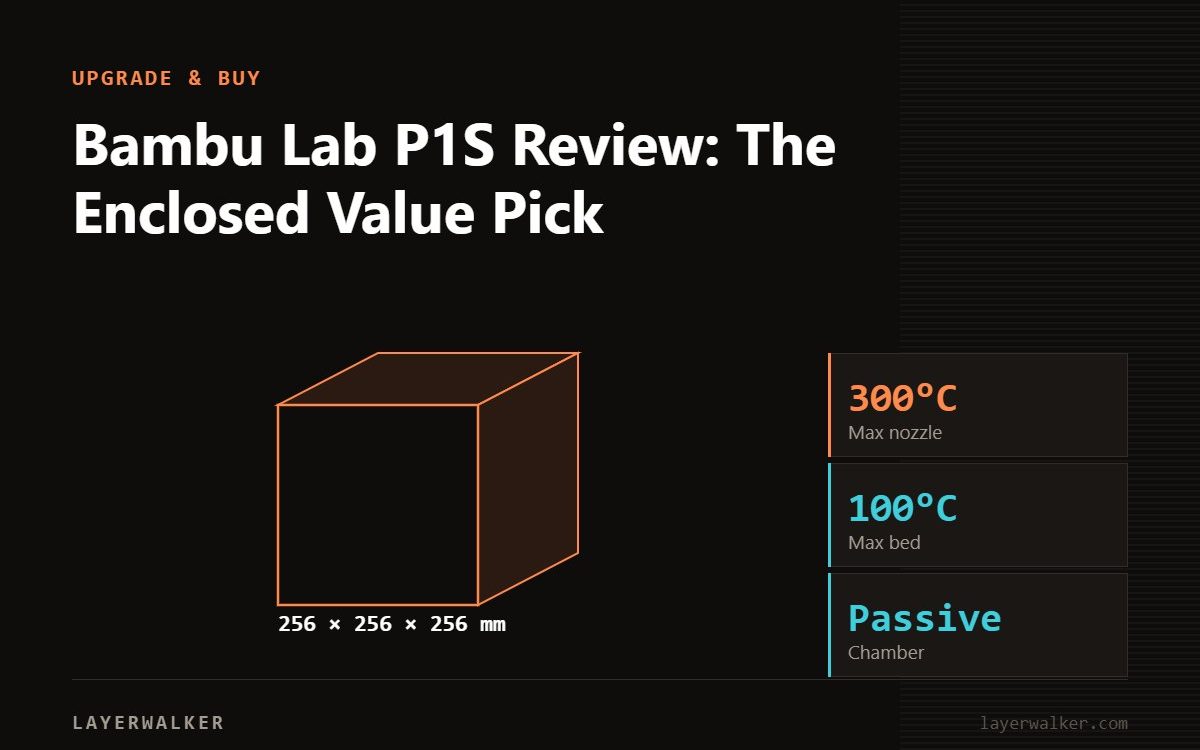
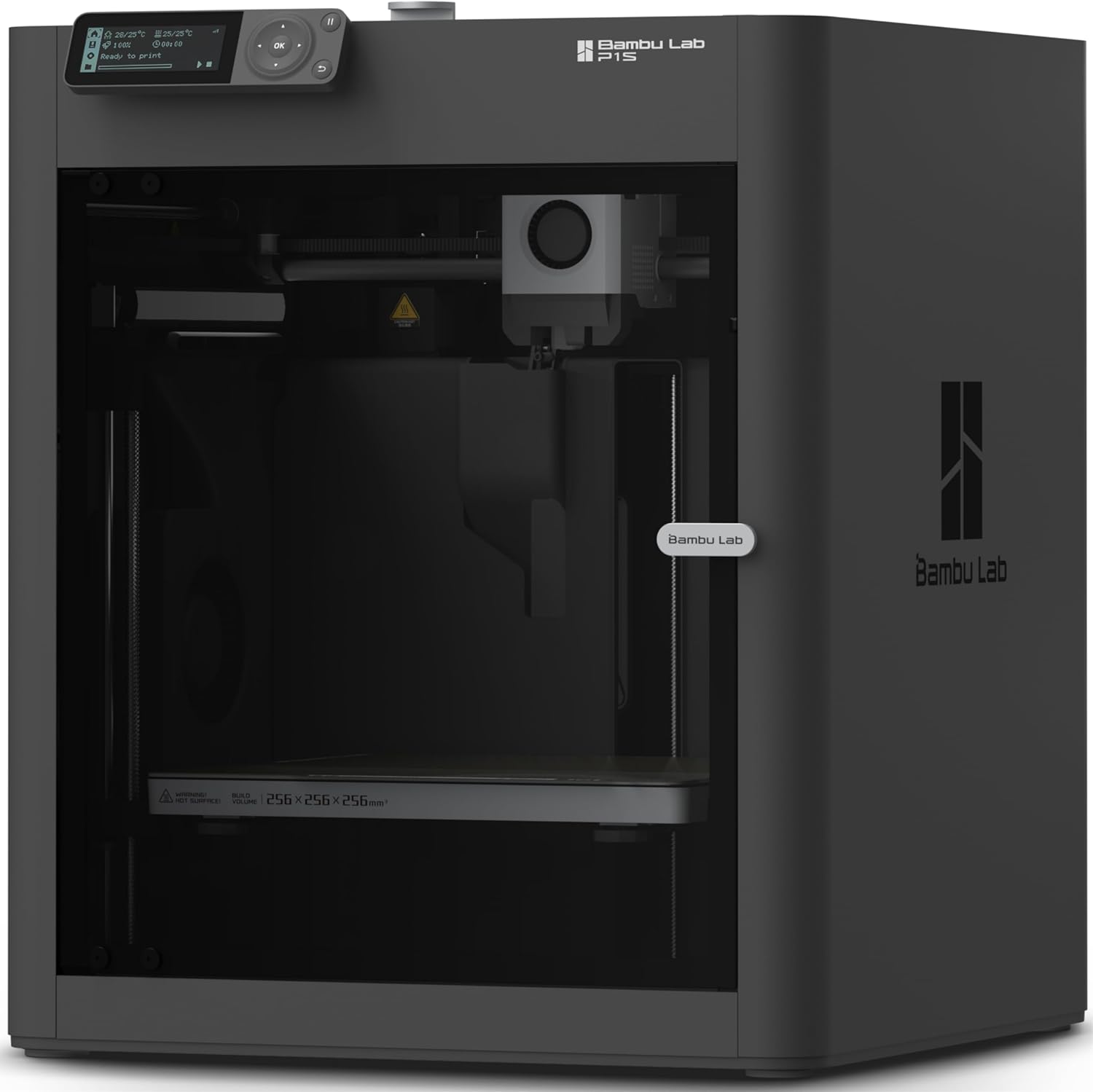
The P1S is the value workhorse of the Bambu range: enclosed CoreXY, 256 x 256 x 256 mm, 300 degC nozzle, 110 degC plate, 500 mm/s and 20,000 mm/s2, direct drive, and the sealed AMS chains to four units for sixteen filaments. It is a P1P plus an enclosure and stronger cooling, which is exactly what ABS and ASA need. Its documented ceiling is glass-fibre filament, which Bambu does not recommend printing directly on it.
This assessment is built from Bambu’s published specifications and from how the P1S sits against its siblings, not from a hands-on test in our workshop. Every figure below comes from the manufacturer.
Where to buy

Specification
| Spec | P1S |
|---|---|
| Build volume | 256 x 256 x 256 mm |
| Motion | Enclosed CoreXY, direct drive |
| Max nozzle temp | 300 degC |
| Max plate temp | 110 degC |
| Max speed / acceleration | 500 mm/s / 20,000 mm/s2 |
| Air filter | Activated carbon |
| Multi-material | Sealed AMS, up to 4 units, 16 filaments |
| Not recommended | Direct printing of glass-fibre reinforced filament |
What the enclosure buys you
Three things, and they are the whole reason to pick the P1S over the P1P. Warm, still air so ABS and ASA do not lift at the corners or delaminate between layers. Noise containment, which matters if the printer lives in a room you use. And an activated carbon filter path for the fumes those materials give off.
The enclosure is not just walls: Bambu pairs it with stronger part cooling, which is the part people forget when they price up enclosing a P1P themselves. If you are weighing that, our P1P assessment covers the trade in the other direction.
Where it sits in the range
Above it, the X1 Carbon adds the 7 micron Micro Lidar for first-layer inspection and flow calibration, a 120 degC plate and a 60 degC chamber. Those are reliability and materials upgrades rather than speed ones; the X1C is actually rated 500 mm/s as well. The P2S, meanwhile, is the newer value machine at the same 256 mm cubed with a 600 mm/s rating and a built-in 1080p camera.
Below it sits the A1, a bed-slinger with the same plate size, easier hotend swaps and 10,000 mm/s2 acceleration, but no enclosure. Our A1 vs P1S and P1S vs P2S comparisons are the two you want if you are shortlisting.
Materials, honestly
PLA, PETG and TPU are straightforward, though TPU needs to come off an external spool holder rather than through the AMS. ABS and ASA are the reason to own this machine. Carbon-filled blends work with a hardened nozzle, and you should treat the nozzle as a consumable once you start running them.
Glass-fibre filament is the documented limit: Bambu states it is not recommended to print it directly on the P1S. If glass-filled engineering material is your requirement, that points up the range rather than at this machine.
Who should buy it
Buy the P1S if you want one enclosed machine that handles the common materials plus ABS and ASA, and you value a mature software stack over the last few percent of print quality. Buy up to the X1C if calibration should be the printer’s job rather than yours. Buy the A1 if you print PLA and PETG only and want the easiest maintenance in the range.
If multi-colour is part of the plan, read our P1S AMS notes first, because the sealed changer has real material limits.
Bambu Lab P1S Review FAQ
Is the P1S faster than the X1C?
Both are rated 500 mm/s and 20,000 mm/s2. The X1C’s advantage is calibration and materials, not speed.
Can the P1S print ABS?
Yes. The enclosure and cooling are what make it viable.
Can it print carbon fibre filament?
Yes with a hardened nozzle. Glass fibre is not recommended for direct printing.
How many colours can it run?
Sixteen, chaining four sealed AMS units.

LayerWalker
Print defect diagnosis, calibration procedures and parts that actually fit. Corrections welcome through the contact page.