Bambu Lab P2S Review: 600 mm/s and a Real Camera
LayerWalker is a participant in the Amazon Services LLC Associates Program. We may earn a commission when you buy through links on our site, at no extra cost to you.
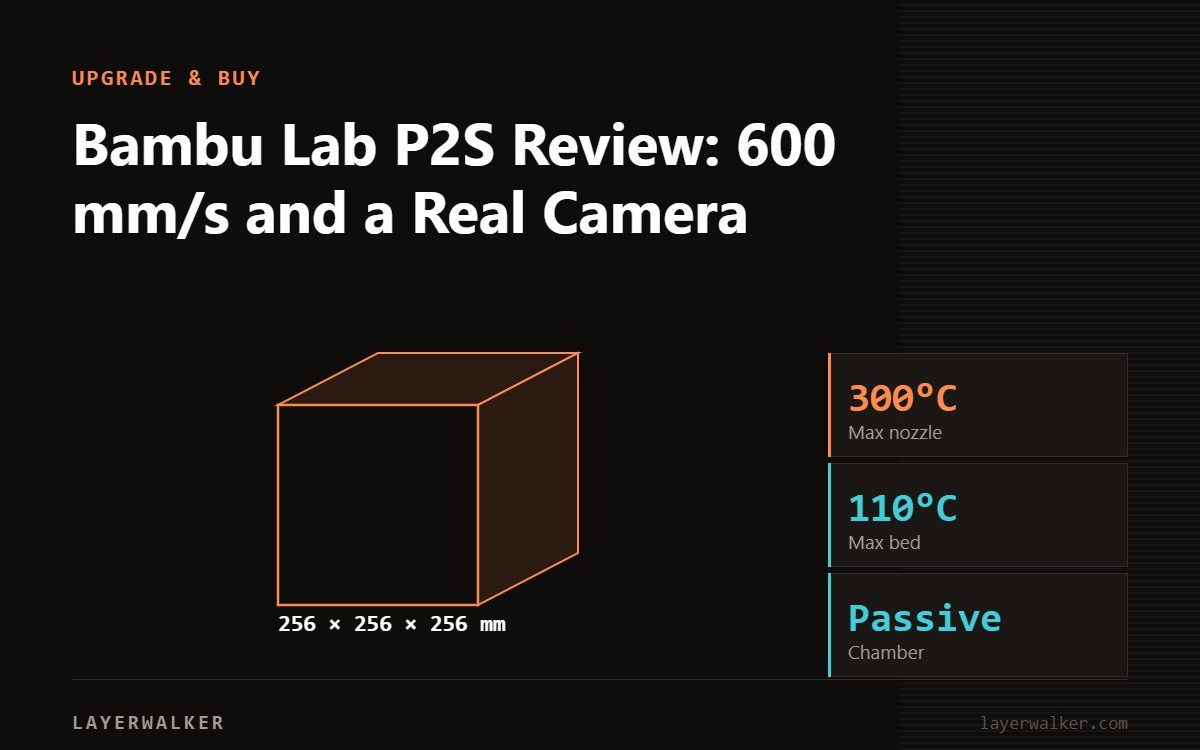
The P2S is Bambu’s current all-round value machine: 256 x 256 x 256 mm, 300 degC nozzle, 110 degC plate, 600 mm/s and 20,000 mm/s2, 14.9 kg, with a built-in 1080p 30 fps camera and a 5-inch 854 x 480 touchscreen. The combo ships with the AMS 2 Pro, which dries filament to 65 degC. Software support is guaranteed for bug and feature updates until October 2030 and security patches until October 2032.
This is an assessment from Bambu’s published specifications rather than a workshop test. The P2S replaces the P1S as the sensible default in the range, and the interesting question is what actually changed.
Where to buy

Specification
| Spec | P2S |
|---|---|
| Build volume | 256 x 256 x 256 mm |
| Max nozzle temp | 300 degC |
| Max plate temp | 110 degC |
| Max speed / acceleration | 600 mm/s / 20,000 mm/s2 |
| Weight | 14.9 kg |
| Camera | Built-in, 1080p 30 fps, timelapse |
| Display | 5-inch 854 x 480 touchscreen |
| Air filter | Activated carbon |
| Body | Plastic and steel chassis, plastic, glass and metal outer frame |
| Storage | Built-in 8 GB eMMC plus USB port |
| Updates | Features to Oct 2030, security to Oct 2032 |
What changed against the P1S
The headline is speed: 600 mm/s against 500 mm/s, with acceleration unchanged at 20,000 mm/s2. The camera is the more useful change day to day, because the P2S has a proper 1080p 30 fps live view built in rather than the low-rate camera of the earlier generation, and it does timelapse.
Everything that made the P1S the value pick carries over: enclosed body, 256 mm cubed plate, 300 degC nozzle, 110 degC plate, activated carbon filter, and the sealed changer ecosystem. See P1S vs P2S for the direct comparison.
The AMS 2 Pro is the real upgrade
If you buy the combo, the changer that arrives is the AMS 2 Pro, and that is a bigger practical jump than 100 mm/s. It dries filament to 65 degC with the spools rotating so heat is even, vents automatically and reseals, reads RFID to pick the drying profile, and lets you clear a snapped strand from the top without tools. The Gen 1 AMS needed every spool removed and two screws undone, three to five minutes by Bambu’s own account.
The unit is 372 x 280 x 226 mm and 2.5 kg, and chains as four AMS 2 Pro units plus eight AMS HT units for twenty-four filaments. Our P2S AMS notes go through the material list.
Where it stops
300 degC and 110 degC place the P2S in the same materials bracket as the P1S: PLA, PETG, TPU, ABS, ASA, and carbon-filled blends with a hardened nozzle. It is not the machine for PPS-CF or the very high temperature engineering blends, which in this range means the H2D with its 350 degC nozzle, 120 degC plate and 65 degC heated chamber.
It is also not a large printer. If the parts are big, 256 mm cubed will be the thing you notice, and the answer is a different machine rather than a different setting.
Who should buy it
Buy the P2S if you want one enclosed machine that covers almost everything a hobbyist or small workshop prints, with a camera that actually works and the option of a drying changer. Buy the H2D if dual-nozzle printing or high-temperature materials are the requirement. Buy an A1 if you print PLA and PETG on a budget and do not need an enclosure. Our P2S overview has more on the machine.
Bambu Lab P2S Review FAQ
Is the P2S faster than the P1S?
Yes, 600 mm/s against 500 mm/s. Acceleration is the same at 20,000 mm/s2.
Does the P2S have a camera?
Yes, built in, 1080p at 30 fps, with timelapse.
Which AMS comes with the combo?
The AMS 2 Pro, with 65 degC drying.
How long is it supported?
Bug and feature updates to October 2030, security patches to October 2032.

LayerWalker
Print defect diagnosis, calibration procedures and parts that actually fit. Corrections welcome through the contact page.