Bambu Lab X1C Review: You Are Buying the Lidar
LayerWalker is a participant in the Amazon Services LLC Associates Program. We may earn a commission when you buy through links on our site, at no extra cost to you.
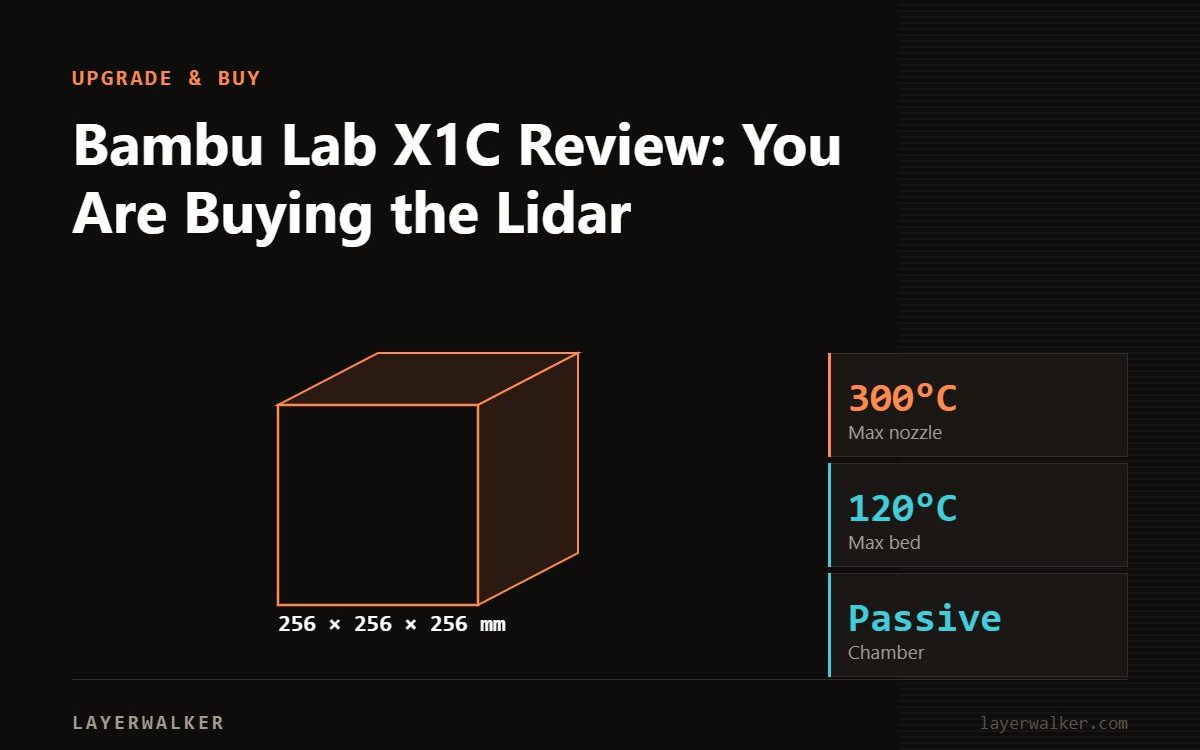
The X1 Carbon is the machine you buy when you want the printer to handle calibration instead of you. It has the 7 micron Micro Lidar, which no other Bambu family gets, in a 256 x 256 x 256 mm enclosed CoreXY with a 300 degC nozzle, a 120 degC plate, a 60 degC chamber, 500 mm/s and a hardened steel nozzle as standard. It is 14.13 kg. If you do not need lidar-grade first-layer inspection, the P2S covers the same envelope for less.
This assessment comes from Bambu’s published specifications and the way the X1C differs from the rest of the range, not from a hands-on test here. The X1 Carbon is the printer that built the company’s reputation, and the reason is narrower than most reviews suggest.
Where to buy


Specification
| Spec | X1 Carbon |
|---|---|
| Build volume | 256 x 256 x 256 mm |
| Max nozzle temp | 300 degC |
| Max plate temp | 120 degC |
| Chamber | 60 degC |
| Max speed | 500 mm/s |
| Nozzle | Hardened steel as standard |
| Calibration | Bambu Micro Lidar, 7 micron |
| Weight | 14.13 kg |
| Multi-material | Sealed AMS, up to 4 units, 16 filaments |
The lidar is the product
Micro Lidar is exclusive to the X series. It scans the first layer at 7 micron resolution and measures extrusion flow, which means the two things most likely to ruin a print, a bad first layer and wrong flow, get checked by the machine before they cost you eight hours. That is what people mean when they say the X1C simply works.
Everything else in the spec list is matched or beaten elsewhere in the range. The P2S hits 600 mm/s at the same 256 mm cubed. The H2D reaches 350 degC and heats its chamber to 65 degC. If you want the fastest, or the hottest, the X1C is not it. If you want the one that measures itself, it is the only choice.
Materials and the chamber
120 degC at the plate and a 60 degC chamber put ABS, ASA and nylon firmly in scope, and the hardened steel nozzle means carbon-filled filament does not require a first purchase before you can use the machine. That combination is why the X1C ended up in so many small workshops.
Abrasive filament still wears the nozzle; hardened steel slows that down rather than stopping it, so keep a spare. For the very high temperature blends such as PPS-CF, the range points at the H2D instead; see X1C vs H2D.
Multi-colour
Four sealed AMS units chain for sixteen filaments, and unlike an open machine the 60 degC chamber makes multi-colour ABS and ASA realistic rather than a warping experiment. The AMS 2 Pro can be used too, with 65 degC drying, but on an X1 series printer that needs an AMS Hub (part SA002-N) and a switching adapter per unit for the drying function. Our X1C with AMS page covers the wiring and material limits.
Who should buy it
Buy the X1C if your time is worth more than the price difference and you would rather print than calibrate, or if you run a mix of materials where automatic flow measurement earns its keep. Choose the P2S if 256 mm cubed and 300 degC are enough and you can live without lidar, since it is faster on paper and cheaper. Choose the H2D if dual-nozzle or PPS-class materials are the requirement. And note one buying practicality: Bambu sells the A1, P1S and P2S through Amazon, while the X1 Carbon is generally a direct purchase.
See our X1 Carbon overview for the full picture, or P1S vs X1C if you are comparing down the range.
Bambu Lab X1C Review FAQ
What does the Micro Lidar actually do?
Inspects the first layer at 7 micron resolution and measures extrusion flow, so the printer catches the two most common causes of failure itself.
Is the X1C faster than the P2S?
No. 500 mm/s against 600 mm/s.
Does it need a hardened nozzle for carbon fibre?
It ships with one.
Can it print PPS-CF?
No. In this range that is the H2D, with a 350 degC nozzle and a 65 degC heated chamber.

LayerWalker
Print defect diagnosis, calibration procedures and parts that actually fit. Corrections welcome through the contact page.