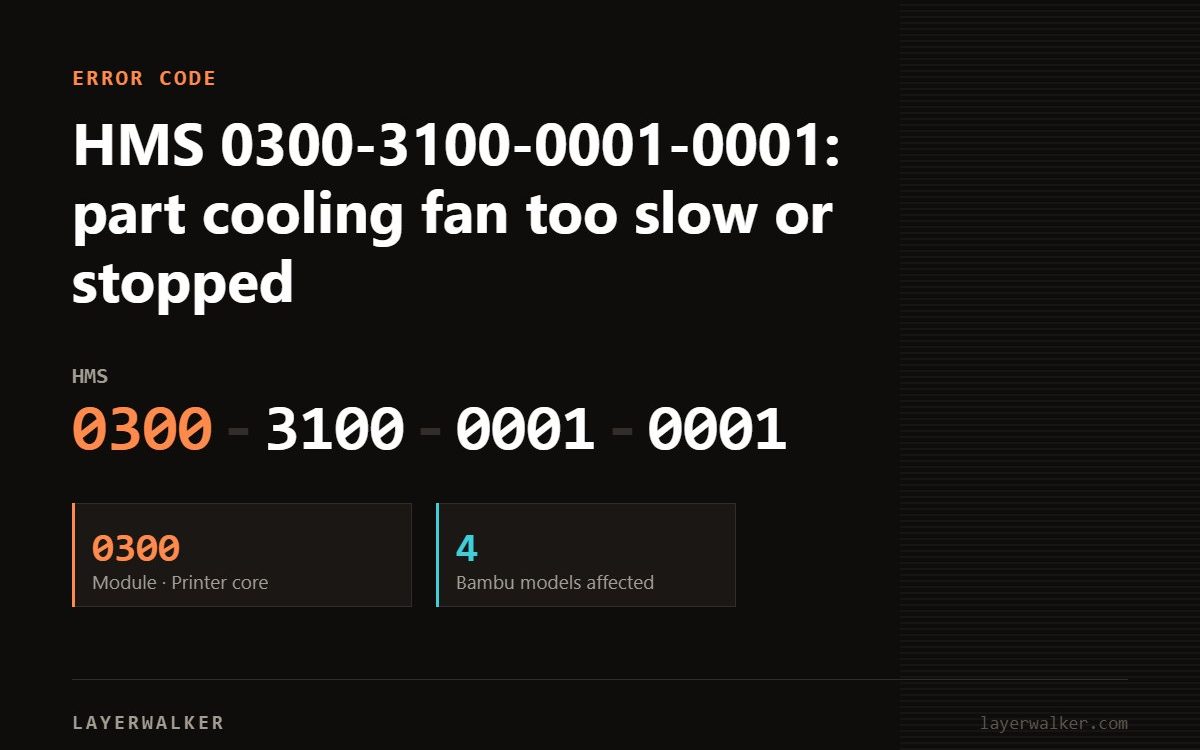
HMS 0300-3100-0001-0001: part cooling fan too slow or stopped
LayerWalker is a participant in the Amazon Services LLC Associates Program. We may earn a commission when you buy through links on our site, at no extra cost to you.
The part cooling fan is turning too slowly or not at all. Look at the blades first — a fragment of purged filament or packed dust stops a fan long before the motor fails.
Bambu reports the part cooling fan speed as too slow or stopped, possibly stuck or with a connector that is not plugged in properly. The firmware reads the fan tacho signal and compares it against the commanded speed.
Affected machines: H2, H2S, P2S, X2D.
Where to buy


GDSTIME 50mm x 15mm Blower Fan 24V High Speed 5015 Part Cooling 2Pin 2-Pack

HMS 0300-3100-0001-0001: why this one matters for print quality
Part cooling is what makes overhangs and bridges possible on PLA and PETG. If the fan has been degrading for a while you will have seen the symptoms before the error appeared: drooping overhangs, poor bridges, and rounded corners on small parts as each layer went down before the previous one had set.
Fan error, or overhangs and bridges getting steadily worse
Blocked, dusty or disconnected part cooling fan
- Power off and look directly at the fan blades. Purged filament and printed fragments get pulled in and wedge against the housing.
- Clear debris with tweezers. Do not spin the fan with compressed air at high speed; over-spinning generates voltage back through the driver.
- Brush dust off the blades. A fan coated in dust is measurably slower and unbalanced.
- Reseat the fan connector at the toolhead board.
- Spin the fan by hand. Grinding or a rough feel means worn bearings and a replacement fan.
| Property | Value |
|---|---|
| PLA | 100 percent after the first layers |
| PETG | 30-50 percent |
| ABS / ASA | 0-20 percent, enclosure closed |
| TPU | 30-60 percent |
| PA / Nylon | 0-20 percent |
Two fans, two jobs
Do not confuse the part cooling fan with the hotend heatsink fan. The part fan blows on the print and is under slicer control. The heatsink fan cools the cold side of the hotend and must run whenever the hotend is hot — if that one stops, you get heat creep and a jam, and a different error.
Wrong code? The full Bambu HMS code index lists all 588 codes with the subsystem each one points to and which printers show it.

LayerWalker
Print defect diagnosis, calibration procedures and parts that actually fit. Corrections welcome through the contact page.