Prusa Error 13305: Homing Error on the Y Axis
LayerWalker is a participant in the Amazon Services LLC Associates Program. We may earn a commission when you buy through links on our site, at no extra cost to you.
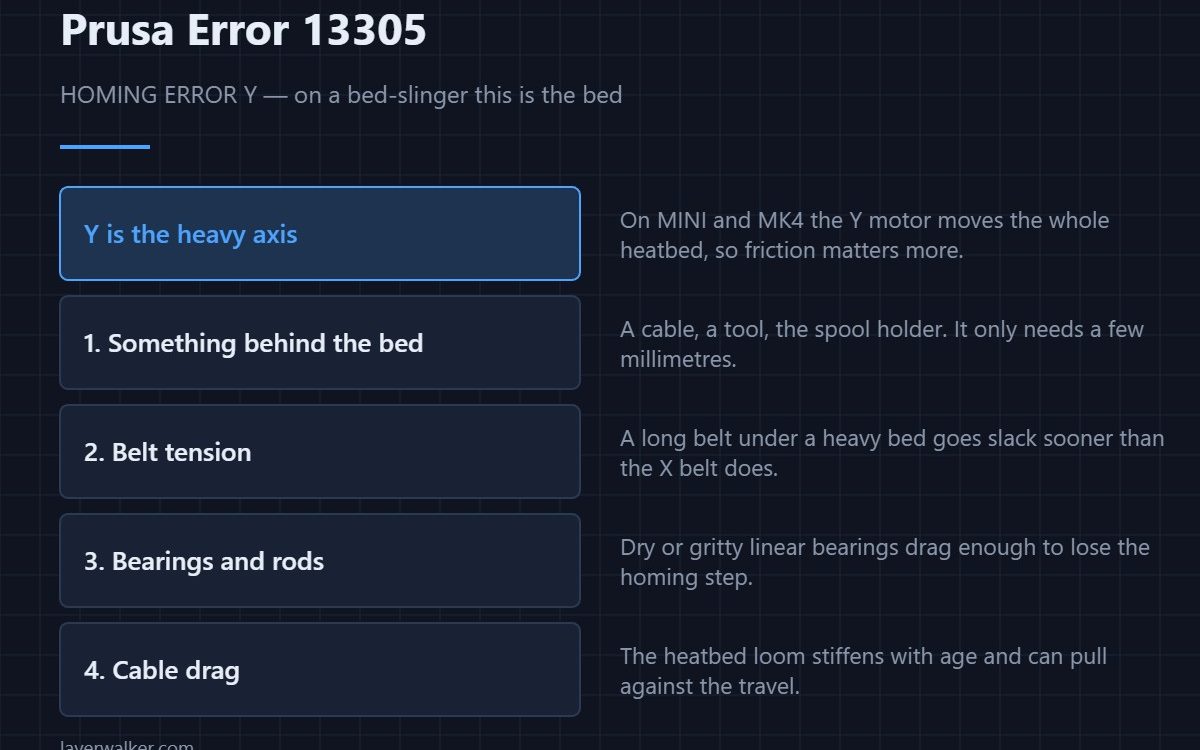
Prusa error 13305 is a homing failure on the Y axis. On a MINI or MK4 that axis moves the entire heatbed, so it carries far more inertia than X and fails sooner when anything adds drag. Check behind and under the bed for obstructions, then belt tension, then the linear bearings and rods.
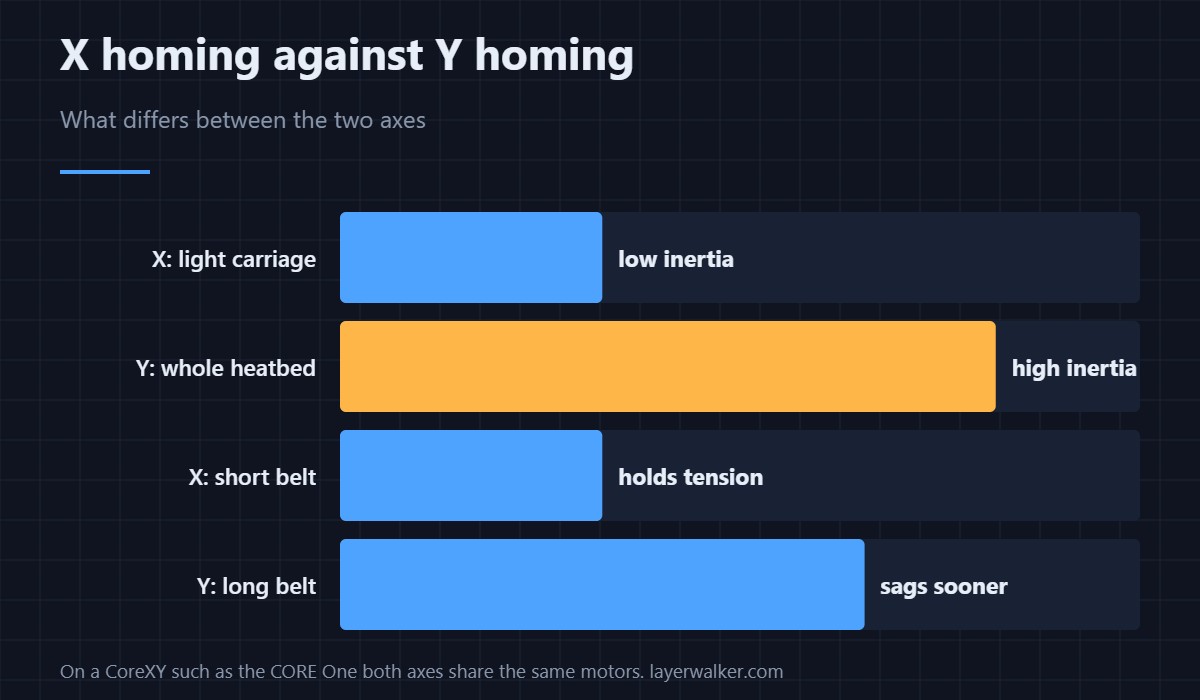
The distinction matters. An X homing failure is usually about the belt or a pulley. A Y failure on a bed-slinger is more often about load: a heavy moving mass on long rods, dragging a stiff cable bundle behind it.
Where to buy


Check in this order
- Behind and under the bed. Power off and slide the bed fully back and forward by hand. A tool, a spool holder leg, or a cable looped under the frame only needs a few millimetres of interference.
- Belt tension. The Y belt is longer and under a heavier load than X, so it sags sooner. Tension to specification.
- Bearings and rods. Dry or gritty linear bearings drag enough to lose the homing step even when the bed still feels smooth by hand, and the same drag shows up as ringing at speed.
- Heatbed cable. The loom stiffens with age and heat cycles. A cable that has taken a set can pull against the travel at one end.
- Motor or driver. Last, and testable by swapping X and Y motor cables to see whether the fault follows.
On a CoreXY machine this is different
The CORE One is CoreXY: both motors contribute to both axes, and neither moves the bed. A 31305 there points at the same belts and pulleys as an X fault, not at bed mass. It is worth knowing which architecture you have before you start looking — the X-axis version is in 13304.
What it predicts
Y-axis drag that is bad enough to fail homing is bad enough to cause layer shifts under acceleration. If you have been chasing shifts that always run in the same direction, this is the axis to look at. Where axis work sits against other improvements is in upgrade order.
The same error reads 12305 on MINI, 31305 on CORE One, 35305 on CORE One L and 23305 on MK3.5.
Prusa Error 13305 FAQ
Why does Y fail more often than X?
On a bed-slinger the Y motor moves the heatbed, the sheet and the print. That is several times the mass of the X carriage, so any added friction shows up there first.
Should I lubricate the Y rods?
Lightly, with a grease intended for linear motion, after cleaning them. Too much attracts dust and recreates the problem within weeks.
Can a heavy print cause 13305?
Not on its own, but a large heavy part plus marginal belt tension can be enough to tip an axis into failing. It is a useful clue that tension is borderline.
Is the bed supposed to move freely by hand?
With the printer off, yes — smoothly, with light even resistance from the belt, and no tight spots at either end of travel.

LayerWalker
Print defect diagnosis, calibration procedures and parts that actually fit. Corrections welcome through the contact page.