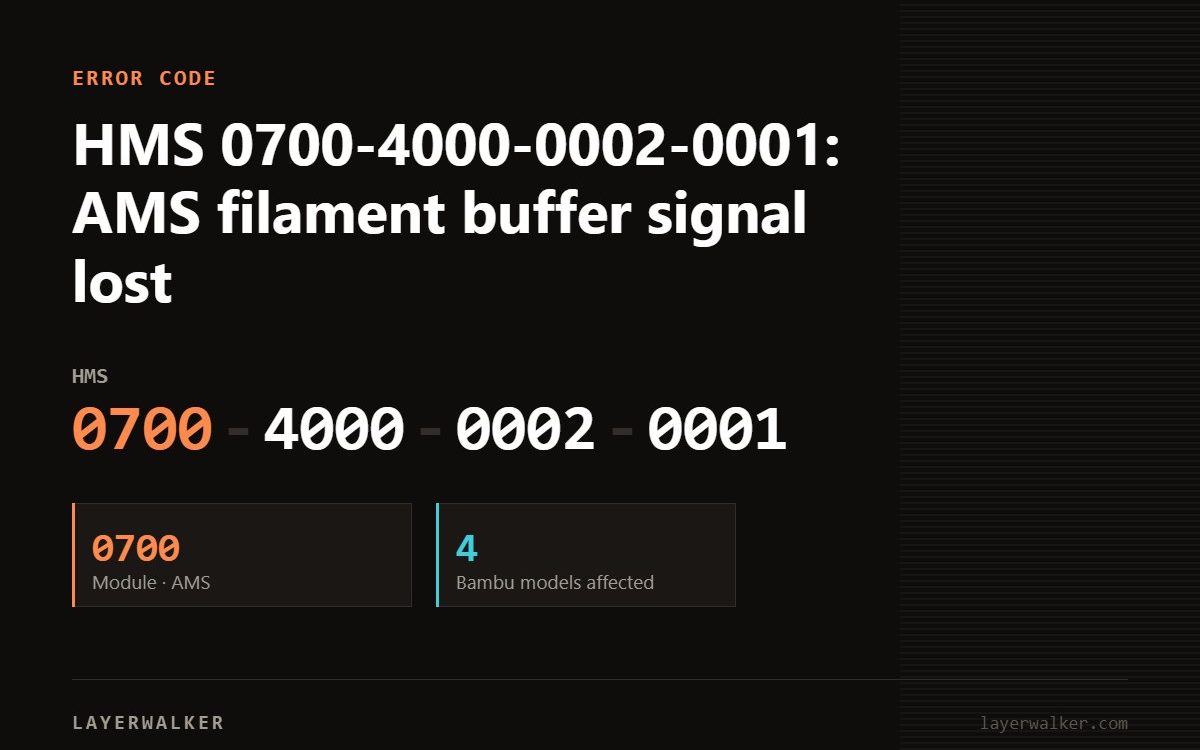
HMS 0700-4000-0002-0001: AMS filament buffer signal lost
LayerWalker is a participant in the Amazon Services LLC Associates Program. We may earn a commission when you buy through links on our site, at no extra cost to you.
The AMS buffer tells the system how much slack is in the filament path. When its position signal disappears, the AMS cannot coordinate feeding with the extruder. Check the buffer cable and whether the spring mechanism is jammed.
Bambu reports the AMS filament buffer position signal as lost, with the cable or position sensor possibly malfunctioning. The buffer is the sprung box between the AMS and the toolhead that takes up slack as the head moves.
Affected machines: H2, P2S, X1 series, X2D.
Where to buy


Capricorn Bowden PTFE Tubing XS Series 1 Meter for 1.75mm Filament (Genuine Capricorn Premium Tubing)
HMS 0700-4000-0002-0001: what the buffer actually does
The extruder pulls filament at a rate that changes constantly as the toolhead moves around the plate. The AMS feed motor cannot track that in real time, so the buffer stores a small loop of filament and reports how full it is. The AMS uses that signal to decide when to push more. Lose the signal and the system is feeding blind.
AMS errors during or just before a filament load
Buffer position sensor not reporting
- Power off. Open the buffer and check the sprung carriage slides freely through its full travel.
- Look for filament dust packed at the ends of the travel. It builds up slowly and eventually stops the carriage short.
- Check for a broken filament fragment jammed inside the buffer path.
- Reseat the buffer cable at both ends. On machines where the cable runs alongside moving parts, check it along its whole length for chafing.
- Watch the buffer during a manual load. The carriage should move visibly as filament feeds.
A related fault worth knowing
A separate code covers the buffer signal being abnormal rather than absent, with a stuck spring or tangled filament as the cause. If your error is intermittent rather than constant, look at the spool for a crossed wrap — a tangle upstream loads the buffer unevenly and produces erratic readings without any hardware fault at all.
Wrong code? The full Bambu HMS code index lists all 588 codes with the subsystem each one points to and which printers show it.

LayerWalker
Print defect diagnosis, calibration procedures and parts that actually fit. Corrections welcome through the contact page.