HMS 0300-1800-0001-0007: eddy current sensor frequency too high
LayerWalker is a participant in the Amazon Services LLC Associates Program. We may earn a commission when you buy through links on our site, at no extra cost to you.
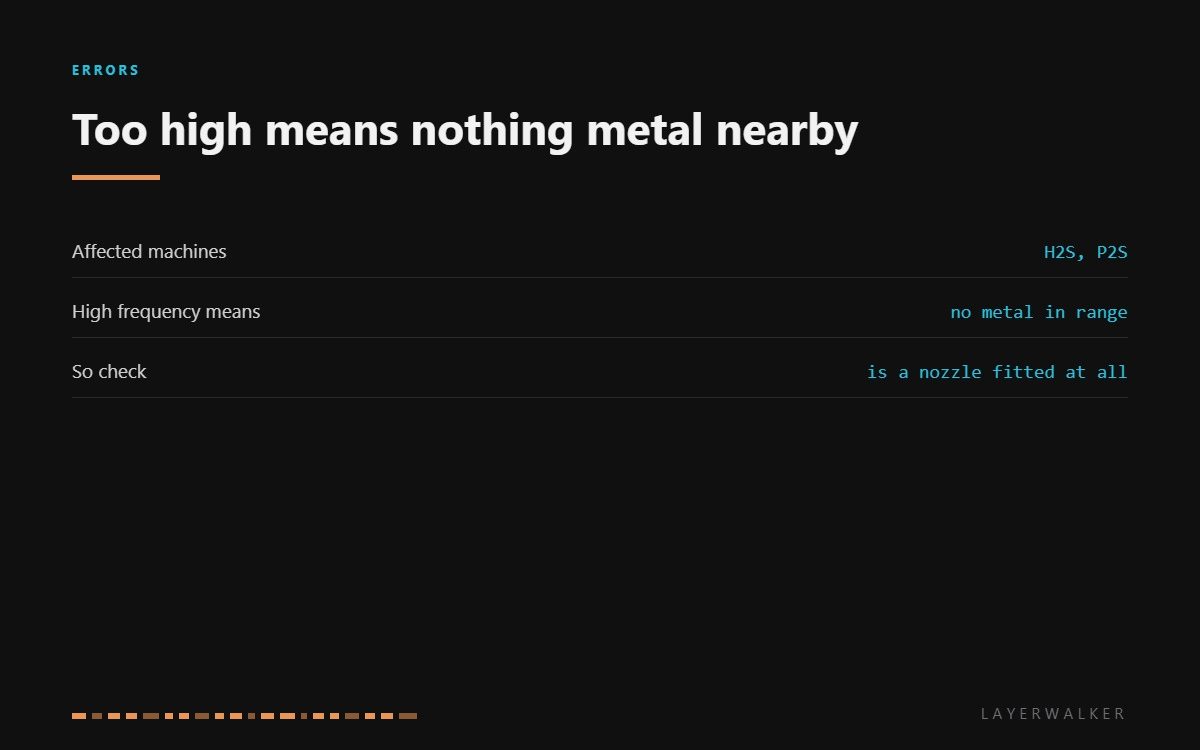
HMS 0300-1800-0001-0007 means the eddy current sensor is oscillating at a higher frequency than it should. The physics is simple: the sensor slows down when metal is near it, so a frequency that is too high means the sensor cannot see metal. Either there is genuinely no nozzle fitted, or the sensor has been damaged and is no longer reading properly.
Affected machines: H2S and P2S. This code is the opposite end of the same scale as the low-sensitivity fault: one says the signal is weak, this one says the sensor is behaving as though there is nothing in front of it at all.

Where to buy


Check the obvious thing first
Is a nozzle actually fitted? It sounds insulting and it is the correct first question, because this code appears most often after a nozzle change that was interrupted, or after a hotend was removed for cleaning and not refitted before the machine was powered up.
If a nozzle is fitted, the next question is whether the sensor can see it. Purge residue baked onto the sensor face, or a nozzle sitting proud of its seat, both push the reading in this direction. Clean gently and refit the nozzle square and fully home.
Only after those two is the sensor itself a reasonable suspect. It has no moving parts, so outright failure is uncommon, but a knock during maintenance or a crash that drove the head into a part can damage it.
Printer reports the eddy current sensor frequency is too high, and nozzle detection or levelling fails
No nozzle fitted, a nozzle not seated, residue on the sensor face, or a damaged sensor
- Power off and let the hotend cool completely.
- Confirm a nozzle is fitted, and that it is the right one for the machine.
- Remove it, clean the seat, and refit it fully home and square.
- Clean the sensor face with isopropyl alcohol on a soft cloth, without scraping it.
- Reseat the toolhead connector and run the machine’s calibration.
- If the frequency is still high with a clean, correctly fitted nozzle, the sensor has failed and the hotend assembly is the replacement.
If you recently swapped between a brass and a hardened steel nozzle, recalibrate before drawing conclusions. The two materials give the sensor different readings, and the machine expects the one it was last calibrated against.
The opposite reading is covered in low sensor sensitivity, and the intermittent version in the signal jump code. Our page on the hotend covers the assembly, and the troubleshooting index covers the rest.
HMS 0300-1800-0001-0007 FAQ
Does a high frequency mean the sensor is dead?
Not necessarily. It means it sees no metal, and a missing or badly seated nozzle explains that just as well.
Can I print with this code?
No. Without nozzle detection the machine cannot level the bed reliably, so the first layer is a lottery.
Why did it appear after cleaning the hotend?
Because cleaning usually means removing the nozzle. Refit it fully home and recalibrate.
Is the sensor replaceable on its own?
No. On these machines it is part of the toolhead, so a confirmed sensor failure means a hotend or a service visit.

LayerWalker
Print defect diagnosis, calibration procedures and parts that actually fit. Corrections welcome through the contact page.