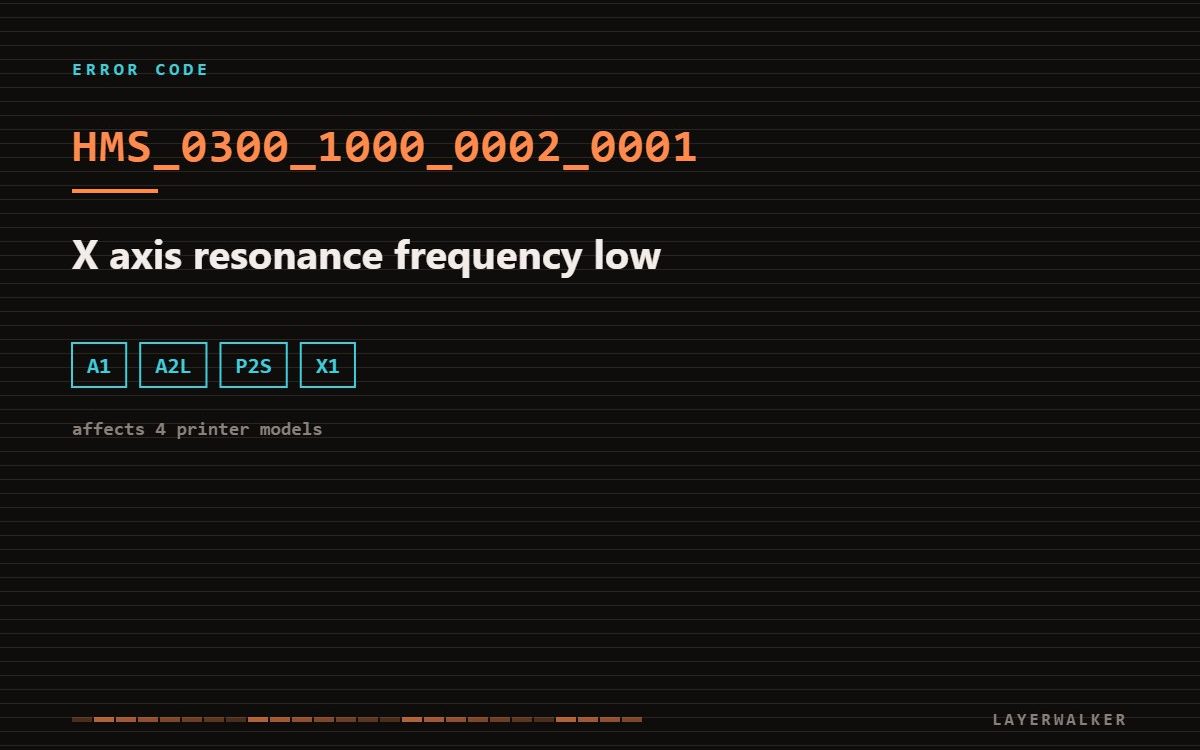
HMS 0300-1000-0002-0001: X axis resonance frequency low
LayerWalker is a participant in the Amazon Services LLC Associates Program. We may earn a commission when you buy through links on our site, at no extra cost to you.
The printer measured how the X axis rings and got a lower frequency than it expects. Resonance falls when tension drops, so treat this as a belt tension reading rather than a fault report. Tension the belt and re-run the calibration.
Bambu machines measure their own resonance before printing so that input shaping can cancel it. That measurement is also a diagnostic. A belt behaves like a string: its natural frequency rises with tension and falls as tension is lost. When the measured frequency drops out of the expected band, the mechanics have changed.
Affected machines: A1, A2L, P2S, X1 series.
Where to buy


HMS 0300-1000-0002-0001: what a falling frequency actually tells you
Frequency scales with the square root of tension, so the reading is sensitive early. A belt does not have to be visibly slack to move the number. That is what makes this code useful: it catches a belt that has relaxed slightly long before you would notice ringing on a print, and long before it starts skipping teeth and shifting layers.
Code appears during the calibration phase at the start of a print, before any plastic is laid down
Belt tension lost over time, a loosened idler, or a pulley grub screw that has backed off
- Power off and pluck the X belt like a guitar string. It should give a clear note rather than a dull thud.
- Check the idler and tensioner for a fastener that has worked loose.
- Verify the pulley grub screws are tight on the motor shafts. A pulley slipping on its flat mimics low tension exactly.
- Re-run the printer resonance calibration after any adjustment so input shaping uses the new figures.
Do not overtighten to push the number up. Excess tension loads the motor bearings and the idler pulleys continuously, and a belt tensioned to remove all compliance will wear its teeth and the pulley faster than a correctly tensioned one.
The same measurement drives your print quality
Input shaping uses this resonance figure to cancel ringing. If the belt tension has drifted enough to raise a code, the shaping parameters stored from an earlier calibration no longer match the machine, and the ghosting you may have started to notice on vertical edges has the same root cause.
Wrong code? The full Bambu HMS code index lists all 588 codes with the subsystem each one points to and which printers show it.

LayerWalker
Print defect diagnosis, calibration procedures and parts that actually fit. Corrections welcome through the contact page.