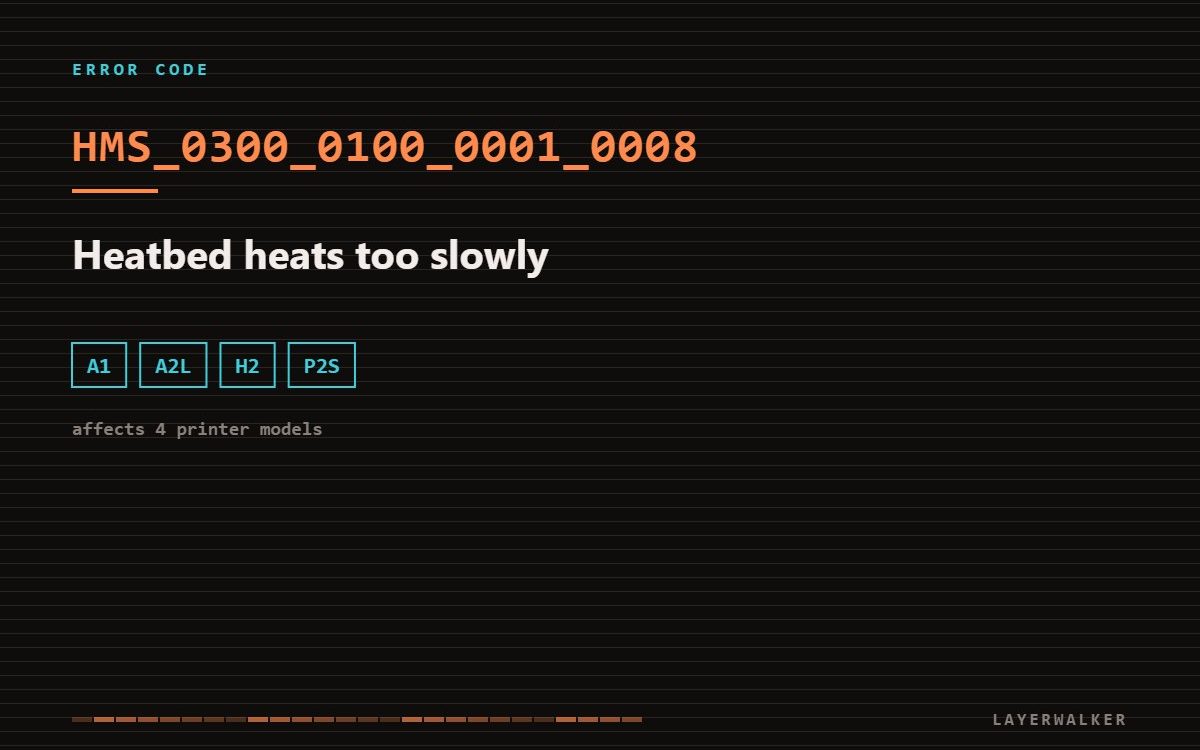
HMS 0300-0100-0001-0008: heatbed heats too slowly
LayerWalker is a participant in the Amazon Services LLC Associates Program. We may earn a commission when you buy through links on our site, at no extra cost to you.
The bed is warming more slowly than the printer allows for. Before suspecting the heater, rule out the boring causes: a cold room, an open window behind the machine, or a target temperature the bed was never going to reach in that environment.
The printer does not only check that the bed reaches temperature, it checks that it gets there at a plausible rate. A bed that climbs too slowly suggests either that heat is being lost as fast as it is added, or that the heater is no longer delivering full power.
Affected machines: A1, A2L, H2, P2S.
Where to buy


HMS 0300-0100-0001-0008: heat loss beats heater failure as an explanation
A print bed is a large flat plate with a lot of surface area, and it sheds heat to the room continuously. Drop the ambient temperature by ten degrees or put the machine in a draught and the time to reach a high bed target rises sharply. This is why the code appears far more often in a garage in winter than in a heated room, and why it often clusters around ABS and ASA targets rather than PLA ones.
Code appears during pre-heat, typically at higher bed targets, and the bed may still reach temperature eventually
Cold or draughty environment, or reduced heater output
- Note the room temperature and the target. A high bed target in a cold room is the ordinary explanation.
- Move the printer out of any draught, and close the enclosure door if the machine has one.
- Try a lower bed target and see whether the code disappears. That result alone separates environment from hardware.
- If the bed is slow even at a modest target in a warm room, the heater circuit needs inspection.
Do not insulate underneath the bed with materials that were not designed for it in order to speed up heating. Trapped heat around the wiring and the bed sensor changes the thermal behaviour the printer is calibrated for, and some foams degrade at bed temperatures.
When the room is the fault, not the bed
If the code only shows up in winter, or only when the printer sits near a window or an outside door, the bed is not failing. A heated bed spends its power fighting the air above it, and on an open-frame machine like the A1 that air is simply the room. Two things fix it without touching the printer: move the machine out of the draught, and put a cover around it so the heat it makes stays where it is useful. The same enclosure is what lets that machine run ABS and ASA later, so it is rarely money spent on this code alone — our A1 enclosure page goes through the options.
On a machine that is already enclosed, check that the door is actually shut and that an exhaust fan is not venting the chamber at full speed during heat-up. Only once the environment is ruled out is it worth measuring the bed itself.
What a genuinely failing bed heater looks like
A heater that has actually degraded is slow at every target, in every room, and consistently so. Environment-driven slowness varies with the weather and the target. Log the behaviour across a few sessions before spending anything, because the two look identical on a single occurrence.
Wrong code? The full Bambu HMS code index lists all 588 codes with the subsystem each one points to and which printers show it.

LayerWalker
Print defect diagnosis, calibration procedures and parts that actually fit. Corrections welcome through the contact page.