HMS 0300-0900-0002-0003: extruder extruding abnormally
LayerWalker is a participant in the Amazon Services LLC Associates Program. We may earn a commission when you buy through links on our site, at no extra cost to you.
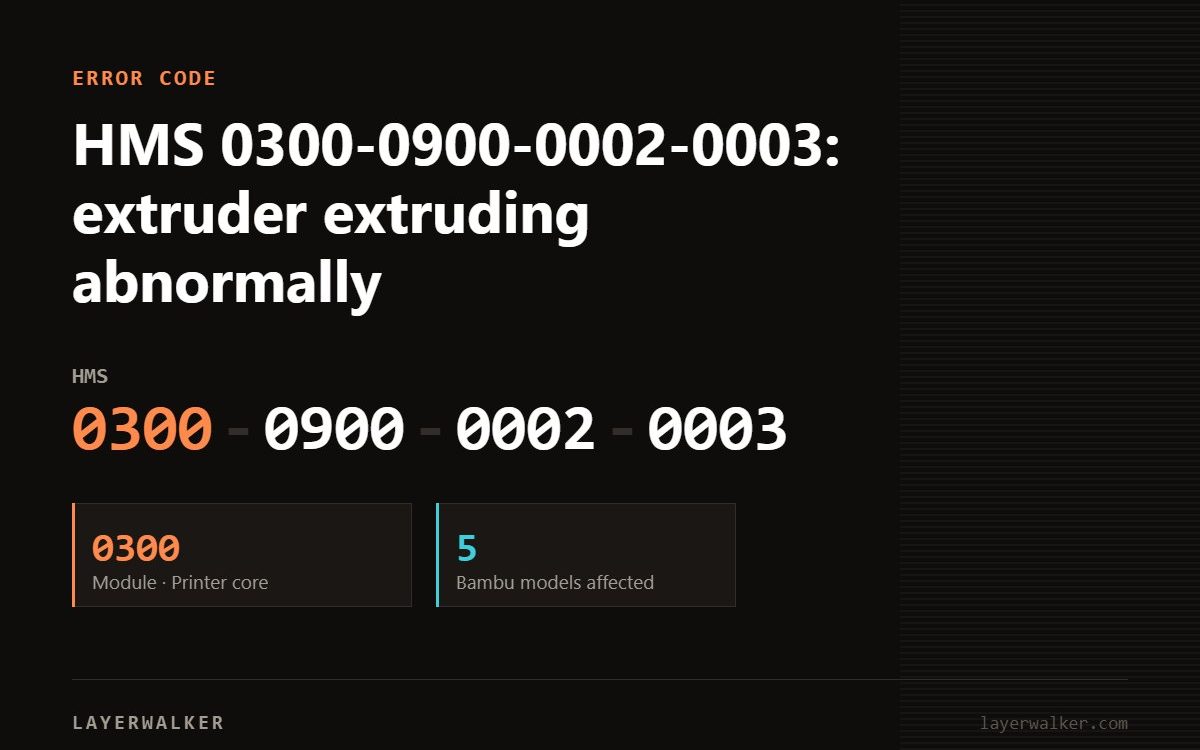
The extruder is turning but the firmware can tell the filament is not keeping up. That is slip, not a hard blockage — check filament diameter and gear tension before you tear down the hotend.
Bambu describes this as abnormal extrusion, with a clog or filament that is too thin causing the extruder to slip. The distinction from a motor overload matters: an overload means the filament is not moving at all, this one means it is moving inconsistently.
Affected machines: A2L, H2, H2S, P2S, X2D.
Where to buy


Clockwise Tools IP54 Grade Digital Caliper, DCLR-0605 0-6" /150mm, Inch/Metric/Fractions Conversion, Stainless Steel, Large LCD Screen
HMS 0300-0900-0002-0003: measure the filament before anything else
Take calipers and measure the filament in three places about 100 mm apart, rotating 90 degrees each time. Good filament sits within a narrow band; cheap filament wanders, and when it drops below the band the extruder gears lose their grip.
| Property | Value |
|---|---|
| Nominal | 1.75 mm |
| Acceptable range | 1.73-1.77 mm |
| Good filament tolerance | plus or minus 0.02 mm |
| Slip likely below | 1.70 mm |
Extrusion errors, inconsistent flow, clicking without a full stop
Extruder gears cannot grip the filament reliably
- Measure the filament in several places. Anything under 1.70 mm will slip regardless of tension.
- Open the extruder and clean the gear teeth. Ground plastic dust packs into the knurling and turns a gripping surface smooth.
- Check the idler tension. Too loose slips, too tight deforms the filament into an oval that jams further down.
- Dry the spool if the filament is soft or squeaky. Wet TPU and nylon deform under the gears instead of feeding.
Why wet filament shows up here
Moisture makes filament softer and slightly larger, and it steams inside the melt zone. Both effects reduce the pressure the extruder can build. Nylon and TPU absorb enough water in a single humid afternoon to trigger this; PLA takes weeks. If the spool has been open on a bench through a wet season, dry it before assuming a hardware fault.
Do not increase idler tension as a first fix. Over-tensioning flattens the filament, which then binds in the PTFE tube and creates the harder fault you were trying to avoid.
Wrong code? The full Bambu HMS code index lists all 588 codes with the subsystem each one points to and which printers show it.

LayerWalker
Print defect diagnosis, calibration procedures and parts that actually fit. Corrections welcome through the contact page.