Elegoo Centauri Carbon vs Creality K1C: Which Budget Enclosed CoreXY
LayerWalker is a participant in the Amazon Services LLC Associates Program. We may earn a commission when you buy through links on our site, at no extra cost to you.
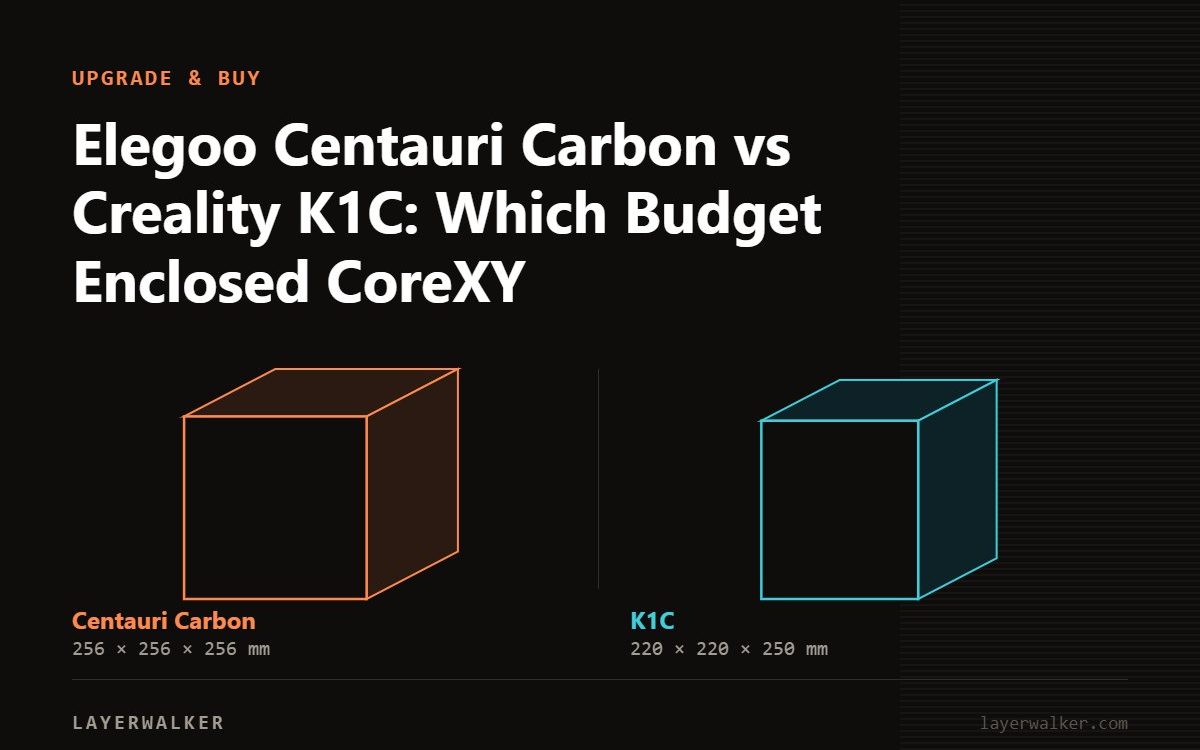
Both are enclosed CoreXY printers with hardened nozzles, cameras and 600 or 500 mm/s motion. The Centauri Carbon is bigger (256 vs 220 mm), hotter (320 vs 300 °C) and usually cheaper. The K1C has rooted Klipper, a far larger mod and spares community, and the CFS multi-colour option on the 2025 revision. Buy the Centauri Carbon for value and size; buy the K1C for openness and multi-colour.
Where to buy


Side by side
| Spec | Centauri Carbon | K1C |
|---|---|---|
| Build volume | 256 × 256 × 256 mm | 220 × 220 × 250 mm |
| Max nozzle temperature | 320 °C | 300 °C |
| Nozzle standard | Hardened steel | Hardened tri-metal |
| Max bed temperature | 110 °C | 100 °C |
| Speed / acceleration | 500 mm/s / 20000 mm/s² | 600 mm/s / 20000 mm/s² |
| Camera | Chamber camera | AI camera |
| Multi-material | None (Carbon 2 Combo: filament system) | CFS on 2025 revision |
| Firmware | Elegoo (Klipper based), limited root | Creality OS (Klipper based), root available |
| Amazon US | Yes | Yes |
Where each wins
- Centauri Carbon: 36 mm more on every axis, 20 °C more at the nozzle and 10 °C at the bed, and typically the lower price. For a single-material enclosed printer it is hard to argue against.
- K1C: a mature Klipper platform with root access, mainline Klipper conversions, and years of upgrade parts. The CFS option matters if multi-colour is likely later.
Print quality and materials
Owner reports put both in the same class for PLA, PETG, ABS and ASA. Both ship hardened nozzles, so abrasive filament is a day-one option on either. Neither has a heated chamber, so nylon and PC at size are marginal on both; the Qidi Q-series is the step up for those.
Decision
If you never plan multi-colour and want the most printer per dollar, Centauri Carbon. If you want to tinker with firmware or expect to add the CFS, K1C. If size is the tiebreaker, remember 220 mm rules out a full-size helmet and 256 mm does not. See the K1C page and the Centauri Carbon page for each in depth.
The units in the box
The listings are the Centauri Carbon and the K1C.
Elegoo Centauri Carbon vs Creality K1C FAQ
Which is quieter?
Both are enclosed; the K1C has a switchable silent mode.
Which has better spares?
The K1C, by a wide margin, in 2026.

LayerWalker
Print defect diagnosis, calibration procedures and parts that actually fit. Corrections welcome through the contact page.