Dental Resin at Home: Model Resin vs Biocompatible Resin, and What a Hobby Printer Can Do
LayerWalker is a participant in the Amazon Services LLC Associates Program. We may earn a commission when you buy through links on our site, at no extra cost to you.
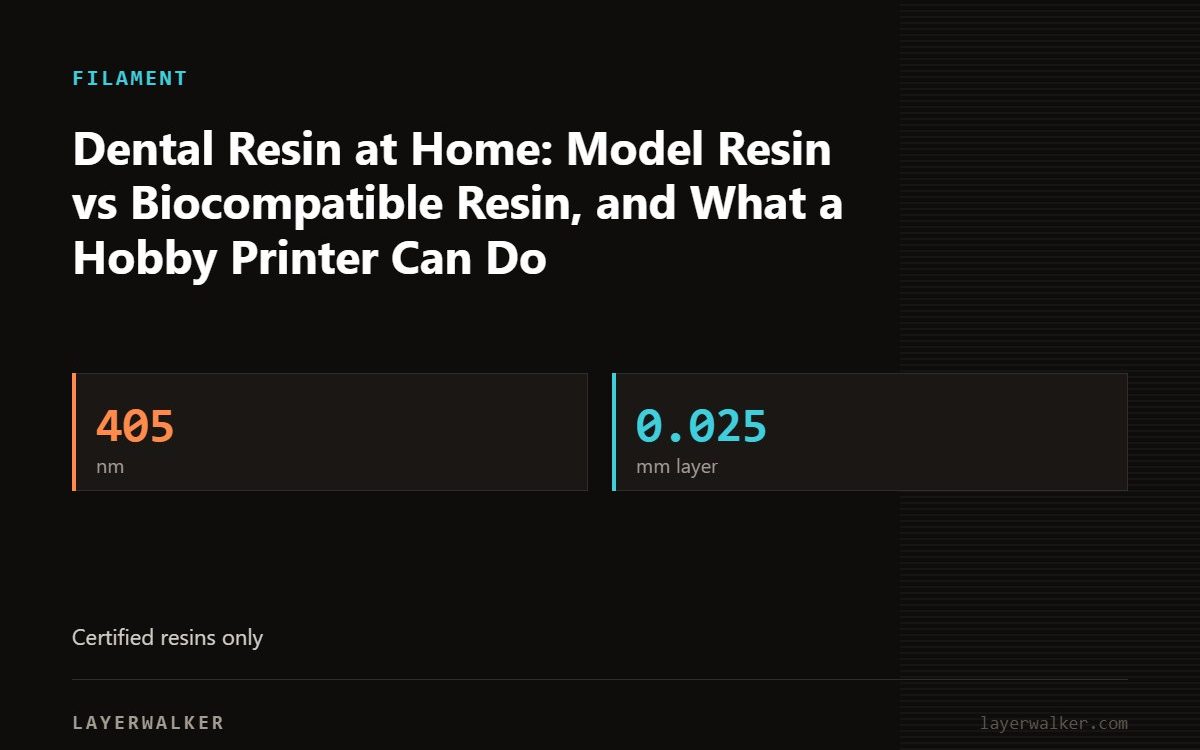
A consumer resin printer can print dental study models, aligner models and teaching models very well with a dental model resin, which is a hard, low-shrinkage, matte resin made for dimensional accuracy. It cannot responsibly print anything that goes into a mouth: that needs a certified biocompatible resin, a validated printer and post-processing workflow, and a licensed professional.
Dentistry adopted resin printing early because the parts are small, detail matters, and accuracy within a tenth of a millimetre is the job. That has produced two very different products under the word dental. Model resins are ordinary photopolymers optimised for hardness, stability and a matte surface that scans well; anyone can buy them and they print on any 405 nm LCD printer. Biocompatible resins for splints, surgical guides and dentures are medical devices with regulatory approval, priced accordingly, and their safe use depends on a controlled workflow, not just the bottle.
Where to buy

What dental model resin is good for
- Study and diagnostic models from intraoral scans.
- Models for thermoforming aligners and retainers.
- Teaching models, demonstration models, and any part where accuracy and a hard surface matter more than toughness.
- Non-dental precision parts that benefit from low shrinkage and a matte, scan-friendly finish.
What to check on the bottle
- Stated shrinkage and accuracy figures. The reason to buy a model resin over a standard one.
- Hardness and matte finish, so models do not deform under a vacuum former and scan without glare.
- 405 nm and presets for your printer.
- Whether it is a model resin or a biocompatible resin. The label says; the price says louder.
The bottle in the box
The listed dental model resin is a hard, low-shrinkage 405 nm resin for models. It is not a biocompatible resin and is not for intraoral use.
Printing models accurately
- Calibrate exposure on a dimensional test, not a detail test; over-exposure grows the model and shows as a spread base.
- Print hollow models with drain holes to cut resin use and internal stress.
- Orient at a slight angle with supports on the base only; support marks on the arch ruin the fit. If supports tear, add exposure to the support layers.
- Wash briefly and cure fully; under-cured models continue to shrink for days.
- Keep the resin at 25 °C and the printer level; model accuracy is sensitive to both.
Where the line is
Anything that touches tissue: night guards, aligners themselves, surgical guides, crowns, dentures. Those require a resin with the relevant biocompatibility certification, a printer and washer-curer validated for that resin by its maker, and a dental professional responsible for the device. A hobby printer and a model resin are not a route to any of them.
Dental resin FAQ
Can I print a night guard for myself?
Not with model resin, and not safely without the certified materials and workflow. See a dentist.
Is dental model resin food safe?
No, and it is not designed to be.
Why is it more expensive than standard resin?
Tighter accuracy control and a harder, more stable formulation.

LayerWalker
Print defect diagnosis, calibration procedures and parts that actually fit. Corrections welcome through the contact page.