3D Printer Filament for Beginners: Start With Plain PLA, and Buy Exactly Two Spools
LayerWalker is a participant in the Amazon Services LLC Associates Program. We may earn a commission when you buy through links on our site, at no extra cost to you.
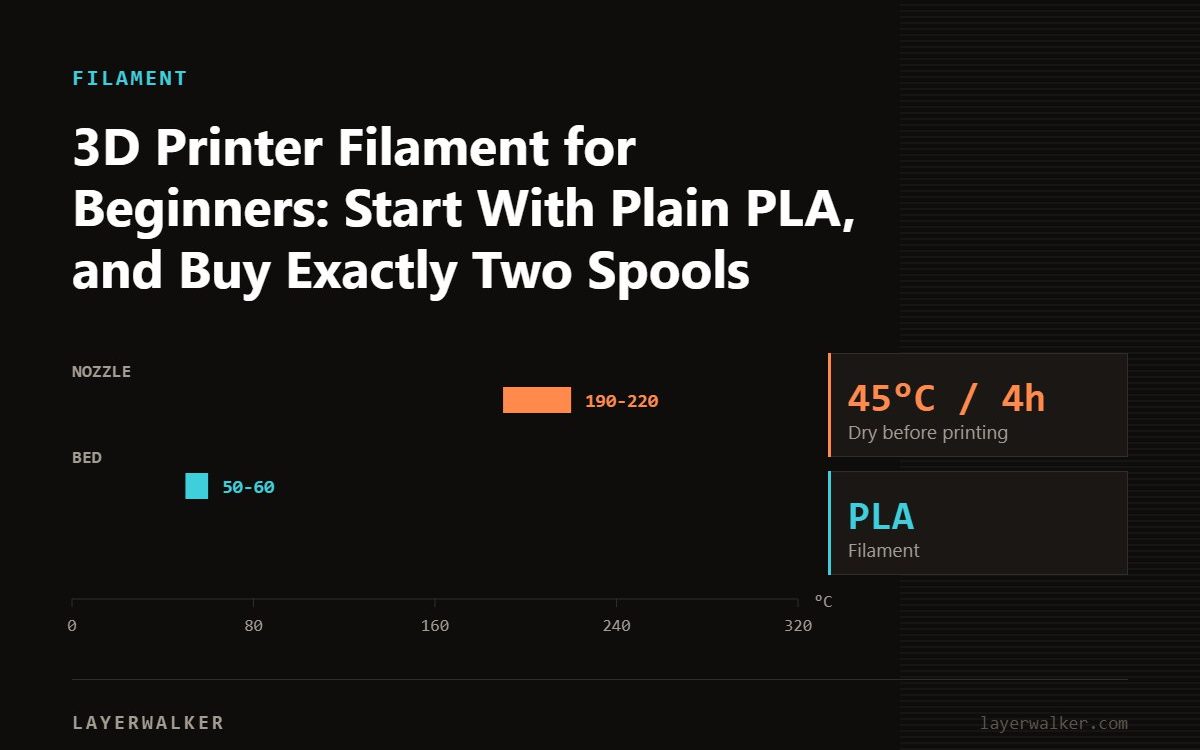
Buy two 1 kg spools of plain PLA from a mid-range brand such as SUNLU, Creality, eSUN or Overture, one light colour and one dark, with a stated tolerance of ±0.03 mm. Skip PETG, silk and anything exotic for the first month. PLA prints on any printer at 200 to 215 °C with no enclosure and forgives most beginner mistakes.
The first month with a printer is about learning bed leveling, first-layer adhesion and slicer basics, and PLA is the material that gets out of the way while you do that. It sticks to a clean plate at 60 °C, does not warp, does not smell, does not need drying for weeks, and shows you what you did wrong without adding problems of its own. Every other material adds at least one new variable. Learn on PLA, then move on when you know what a good print looks like.
Where to buy


SUNLU PLA+ 3D Printer Filament, 16 Color Bundle Multicolor, 1.75mm
What to buy
- Plain PLA. Not PLA+, not silk, not matte, not wood. Additives change behaviour and make troubleshooting harder.
- A reputable mid-range brand with a stated tolerance of ±0.03 mm and a vacuum-sealed bag. That rules out the cheapest unbranded spools.
- Two spools, two colours. A light one, grey or white, shows first-layer problems clearly. A dark one hides layer lines on finished parts.
- 1 kg plastic spools fit every holder and dryer.
The spools in the box
The listed PLA spools are the mid-range workhorses: consistent, sealed, cheap enough to waste a few hundred grams learning. Any of them is a right first spool; pick by colour.
Settings to start with
- Nozzle 205 °C, bed 60 °C. Adjust later with a temperature tower.
- Layer height 0.2 mm, speed whatever the slicer’s default profile for your printer says.
- Full fan after the first layer.
- Clean the plate with dish soap and water before the first print; most early failures are a greasy plate, not the filament. See first layer not sticking.
What to learn in the first month
- How a correct first layer looks: lines touching, slightly flattened, no gaps and no ridges.
- How to tram the bed and set Z-offset.
- What stringing looks like and that drying usually fixes it.
When to move on
When a print of a simple functional part comes out right three times in a row, try PETG for a part that needs heat resistance or toughness. The PLA versus PETG guide covers the change. TPU and ABS come later still.
3D printer filament for beginners FAQ
Should I buy a multi-colour bundle?
Not first. You will not use most of the colours and each spool is a new variable.
Is the filament that came with the printer good?
Usually a small sample of adequate PLA. Use it for the first test prints, then switch to a full spool.
Do I need a dryer?
Not for PLA in the first month. Keep the spool in its bag with the desiccant between sessions.

LayerWalker
Print defect diagnosis, calibration procedures and parts that actually fit. Corrections welcome through the contact page.