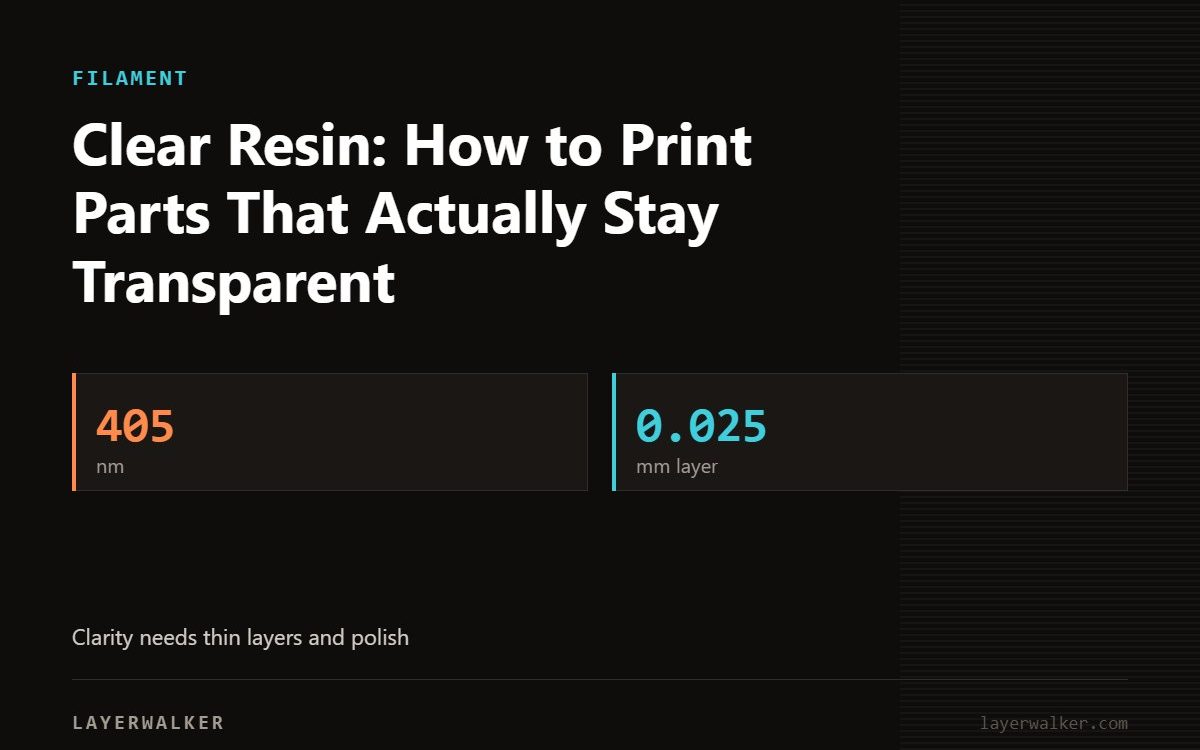
Clear Resin: How to Print Parts That Actually Stay Transparent
LayerWalker is a participant in the Amazon Services LLC Associates Program. We may earn a commission when you buy through links on our site, at no extra cost to you.
Clear resin prints come off the plate frosted, not glass-clear, and standard clear resins yellow if over-cured. For transparent parts, choose a resin sold as water-clear or UV-stable, cure in short passes only until hard, then wet-sand and coat with a clear gloss lacquer; the coating is what turns frosted into transparent.
Transparent resin exists, and it is how printed lenses, light guides and display domes get made. It is also the resin type that disappoints most first-time buyers, because the print comes out translucent white, and the fix is not in the printer. Two things stand between a clear bottle and a clear part: surface texture from the layer process, which scatters light, and the yellowing that UV curing causes in most photopolymers. Both are manageable with technique.
Where to buy


What to look for
- Water-clear or optically clear labelling, not just “clear” or “transparent”; the former are formulated to resist yellowing.
- UV stabiliser or low-yellowing stated in the description.
- Low viscosity. Thin resin drains from surfaces cleanly and leaves fewer streaks to sand.
- Published exposure settings, because clear resin under-exposes easily; without pigment, light passes through and cures deeper than intended, so the numbers differ from coloured resin.
The bottles in the box
The listed clear resins are 405 nm formulations sold for transparent parts. Buy one bottle, run an exposure test, and expect to reduce exposure time compared with pigmented resin from the same maker.
The process that makes it clear
- Expose slightly less than for coloured resin, and orient the part so the clear faces are vertical walls, which print smoother than sloped surfaces. Watch for a spread base, a sign of over-exposure.
- Wash thoroughly in clean alcohol; any residue cures into a haze.
- Cure in short passes, one to two minutes at a time, turning the part, until hard. Stop as soon as it is cured; every extra minute yellows it.
- Cure under water if your curing station allows it: submerging blocks oxygen and gives a harder surface with less yellowing.
- Wet-sand from 400 up to 2000 grit, then polish. This removes the layer texture that scatters light.
- Coat with a clear gloss lacquer or a thin brushed layer of the same resin, cured. The coating fills the remaining micro-texture; this step alone takes a part from frosted to see-through.
Where clear resin is worth it
Lenses and light pipes, display domes, model windows, and anything where a translucent frosted look is itself the goal. For a clear box or cover of any size, cut acrylic is cheaper and clearer; print the frame.
FAQ
Why is my clear print yellow?
Over-cured, or a resin without UV stabiliser. Cure less, or change resin.
Can I tint clear resin?
Yes, with a few drops of resin-compatible dye; exposure times change with pigment.
Does clear resin need different supports?
No, but support marks show more; place them on faces you will sand.

LayerWalker
Print defect diagnosis, calibration procedures and parts that actually fit. Corrections welcome through the contact page.