Bambu Lab Support Filament: Support for PLA, Support for PA/PETG, and the PETG Trick That Costs Nothing
LayerWalker is a participant in the Amazon Services LLC Associates Program. We may earn a commission when you buy through links on our site, at no extra cost to you.
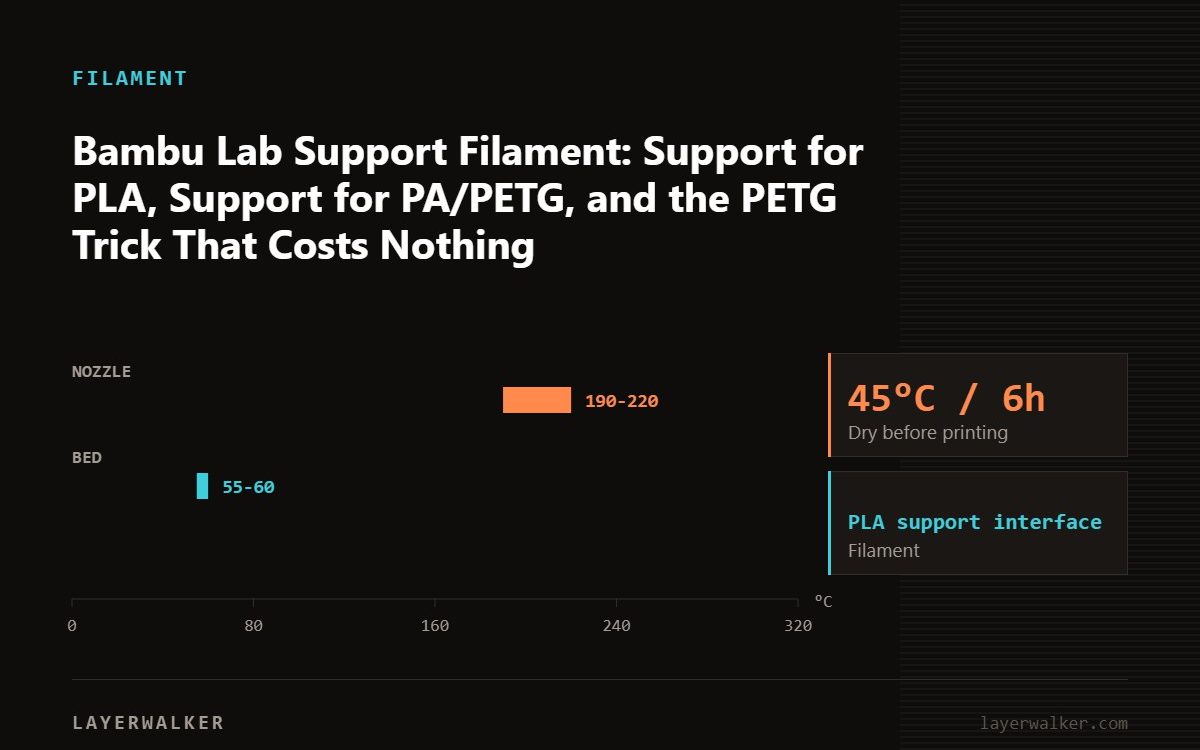
Bambu Lab sells two support filaments: Support for PLA, and Support for PA/PETG. Both print through the AMS as an interface layer and peel away leaving a clean surface. They work well and cost more than ordinary filament. If you print PLA, a cheap spool of PETG as the interface material does almost the same job; buy the dedicated support when you need the cleanest possible surface or you print nylon.
The AMS made support material practical because the printer can swap to it for just the two or three interface layers under an overhang and then swap back, so a spool lasts for months. Bambu’s own support filaments are tuned for that: they stick to the model enough to hold during the print and release cleanly afterwards, and the profiles are already in Bambu Studio. The question is whether the dedicated material is worth the premium over the free alternative.
Where to buy


The two Bambu support filaments
- Support for PLA. A break-away material for PLA models. Peels off by hand, leaves a smooth underside, prints at PLA-like temperatures. Also works under PETG in a pinch.
- Support for PA/PETG. Formulated for PETG and nylon models, which need hotter interfaces. The choice for engineering parts where PLA supports would fuse or fail.
- Both are meant as interface layers only, with the support body printed in the model material or a cheap PLA to save the expensive filament.
The free alternative for PLA
Set the support interface to plain PETG and the support body to PLA. PETG and PLA barely bond, so the interface snaps away almost as cleanly as the dedicated filament. It costs the price of a spool you probably already have. Where the dedicated support wins is on very fine detail and on very large flat overhangs, where its slightly better adhesion during the print avoids sagging.
What to check
- Which model material you are supporting: PLA or PETG/PA. Buying the wrong one gives supports that fuse.
- Spool size. Interface layers use little; the small spool is the right buy.
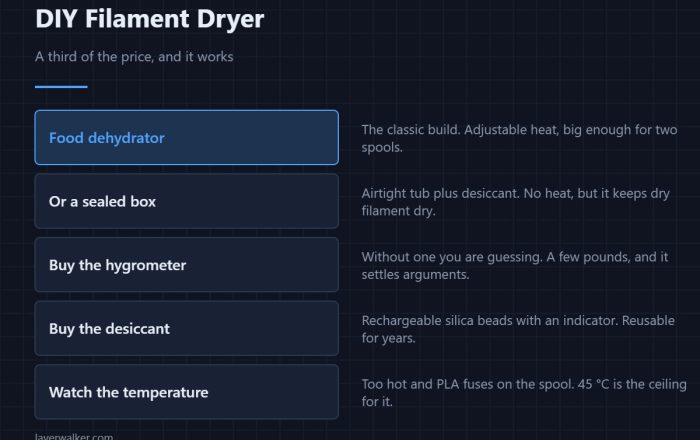
- Dryness. Support filaments are moisture sensitive; keep them in the AMS with fresh desiccant or in a dry box.
The spools in the box
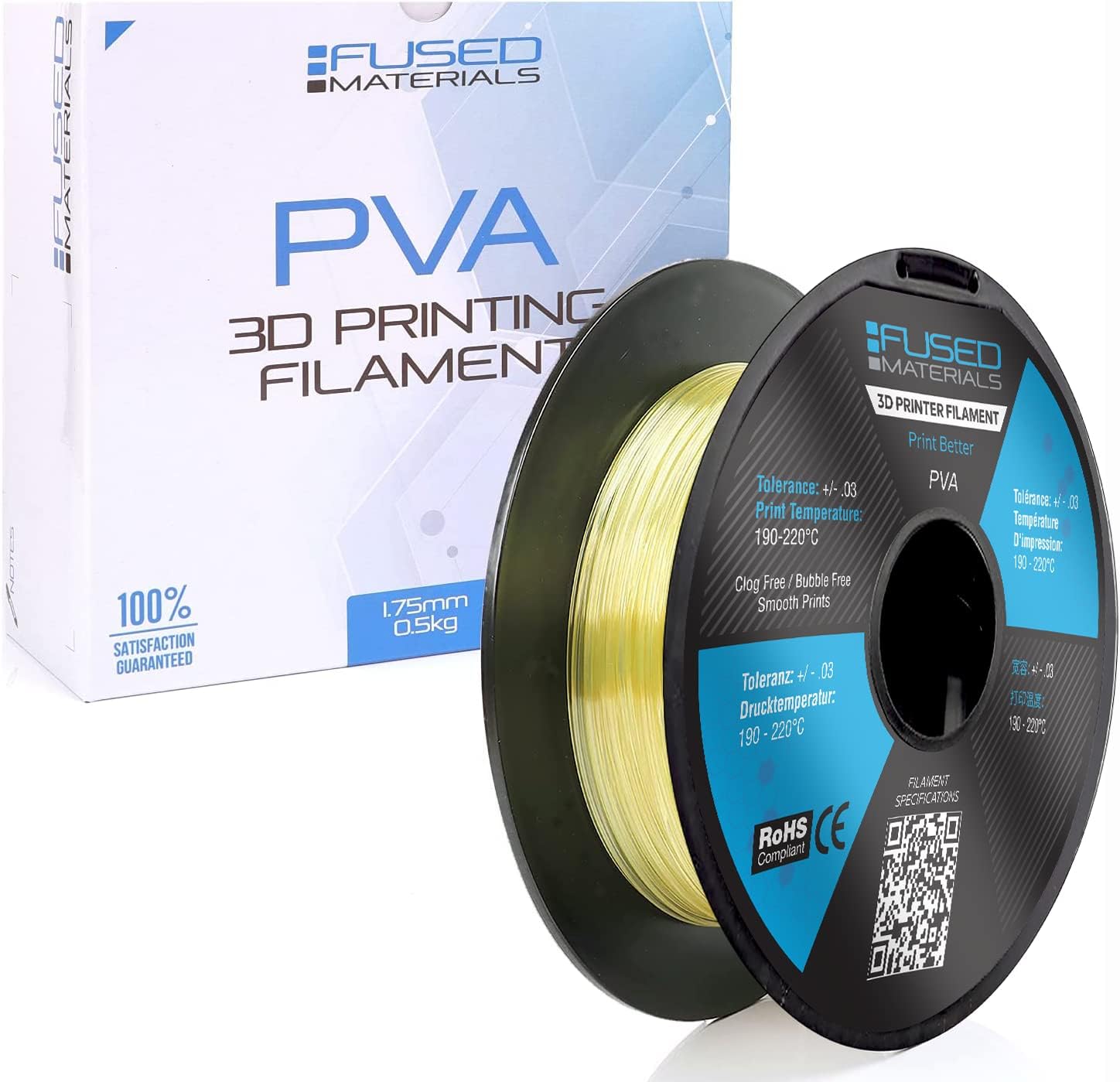
The box lists Bambu’s own support filament and general water-soluble PVA options. For an AMS printer, the Bambu support matched to your model material is the simplest choice; PVA is for enclosed cavities that cannot be reached by hand, and it demands a dry box.
Settings in Bambu Studio
- Choose the support filament as the interface filament only; leave the support body on the model filament or a cheap PLA.
- Two or three interface layers, top Z distance 0, because the material provides the release.
- Use tree supports for organic shapes and normal supports for flat overhangs.
- Enable prime tower; the swaps need it.
FAQ
Can I use Bambu support filament on a non-Bambu printer?
Yes, on any multi-material setup; it is standard 1.75 mm filament.
Does it dissolve in water?
No; it is break-away. PVA dissolves, at the cost of moisture fussiness.
Why do my supports still stick? Interface Z distance set above zero with a break-away material, or the wrong support type for the model material.

LayerWalker
Print defect diagnosis, calibration procedures and parts that actually fit. Corrections welcome through the contact page.