Bambu Lab Nozzles: Why You Replace the Hotend, Not Just the Tip
LayerWalker is a participant in the Amazon Services LLC Associates Program. We may earn a commission when you buy through links on our site, at no extra cost to you.
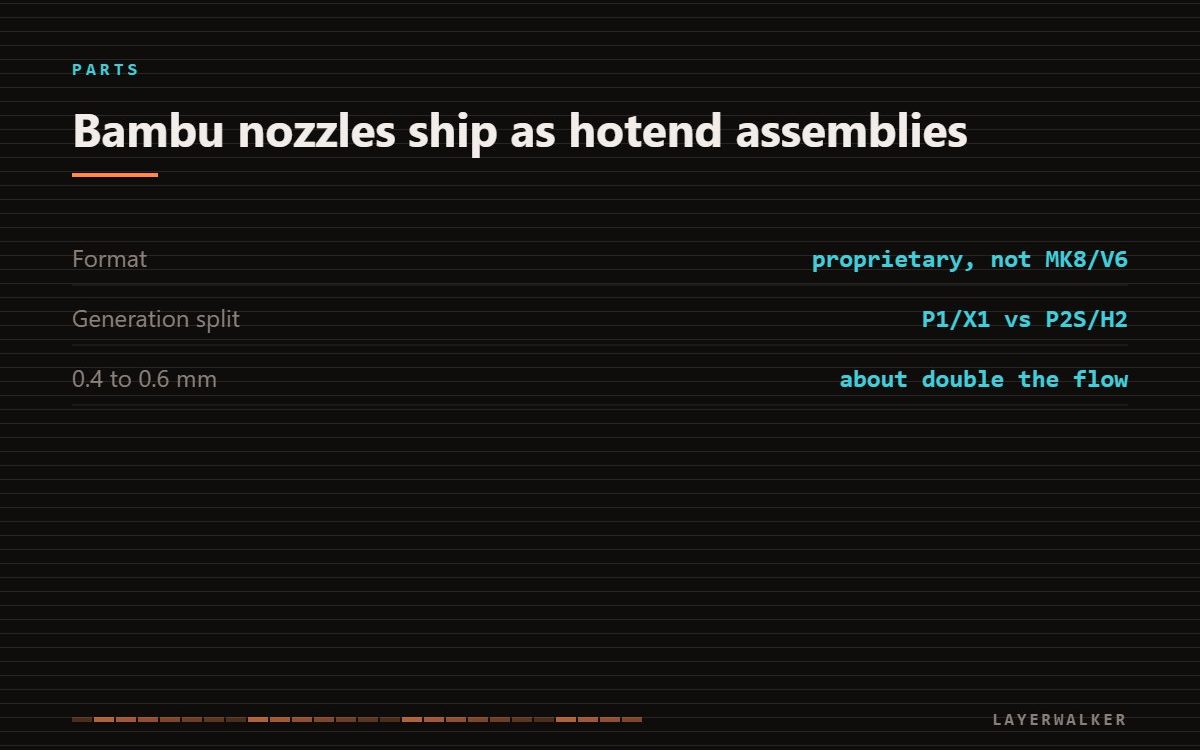
Bambu machines do not take a generic threaded nozzle. The tip arrives as part of a hotend assembly that clips in, which makes swapping fast but means you cannot fit an MK8 or V6 nozzle to one. The assemblies also differ between generations.
Where to buy


What to look for
Buy by machine generation first, diameter second. The P1P, P1S and X1 series share one assembly; the newer P2S, X2D, H2D and H2S line uses a different one. Multi-packs covering 0.2, 0.4, 0.6 and 0.8 mm are the efficient way in if you expect to change diameter, and third-party high-flow assemblies exist for people pushing volumetric speed.
Why the format matters more than the material
On most printers, nozzle choice is a thread question: MK8, V6 or Volcano, as covered in our guide to nozzle formats. Bambu removes that choice by integrating the tip into the assembly. The upside is a swap measured in seconds with no hot-tightening and no leaks; the downside is that you replace more metal than you strictly need to, and the price per change is higher.
When hardened is worth it
The stock tip handles PLA, PETG and ABS indefinitely. Anything filled with carbon or glass fibre will abrade it, and a worn bore shows up as under-extrusion and dimensional drift rather than as visible damage. The rule is the same as for any machine, and our note on hardened steel nozzles covers where the trade-off sits: hardened steel conducts heat less well, so high-flow work may want a different alloy rather than simply a harder one.
Diameter changes more than surface finish
Going from 0.4 to 0.6 mm roughly doubles the volume you can push per second, which shortens large prints far more than raising speed does. It also raises the minimum feature size and the maximum usable layer height. Going down to 0.2 mm does the reverse and is worth it only for genuinely small detail.
When the fault is the sensor, not the nozzle
A hotend that will not reach temperature is often a sensor fault rather than a blocked tip; on Bambu machines that reports as its own HMS code. Check the code before buying a nozzle, because the two failures feel similar from the outside.
FAQ
Can I fit a V6 nozzle to a Bambu? No. The assembly is proprietary and not a thread swap.
Do P1S and H2D share hotends? No. They belong to different generations with different assemblies.
How long does a stock nozzle last? Indefinitely on unfilled filament; a spool or two of carbon-filled material will wear it noticeably.

LayerWalker
Print defect diagnosis, calibration procedures and parts that actually fit. Corrections welcome through the contact page.

