Anycubic Kobra 3 Review: Open, Light, 300 °C
LayerWalker is a participant in the Amazon Services LLC Associates Program. We may earn a commission when you buy through links on our site, at no extra cost to you.
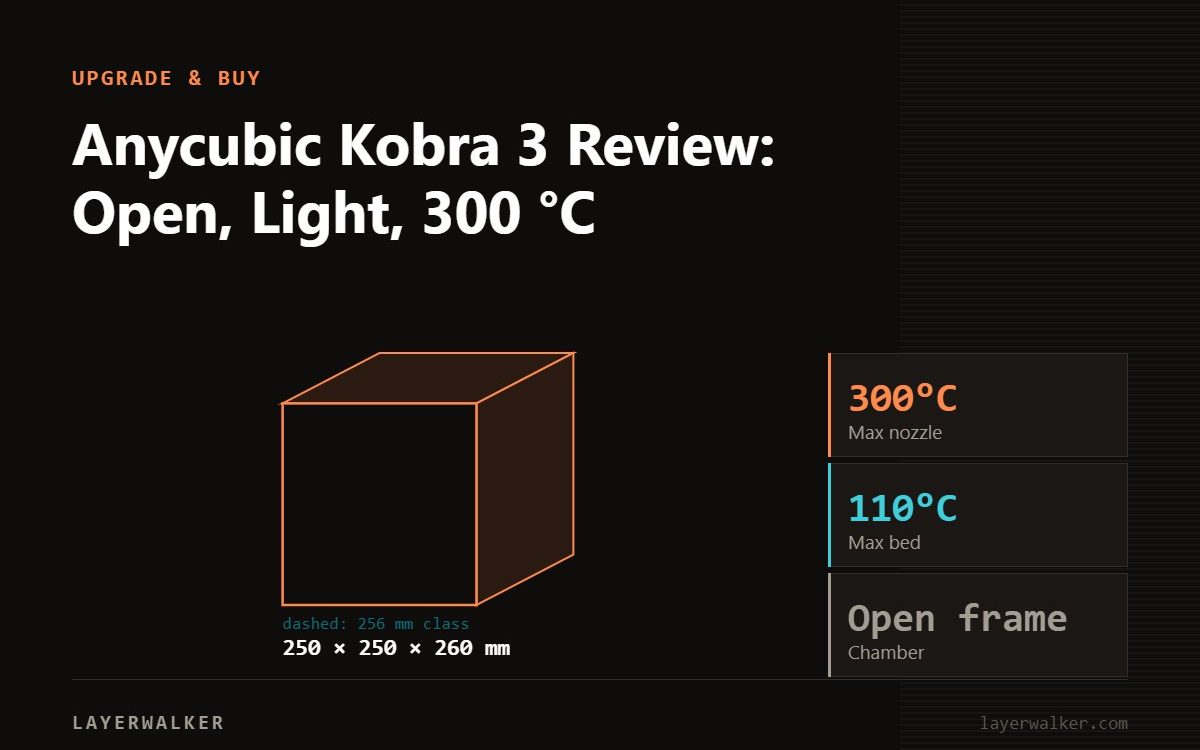
The Kobra 3 is the open-frame version of Anycubic’s current generation: 250 x 250 x 260 mm, a 300 degC nozzle, a 110 degC bed, 300 mm/s recommended with 600 mm/s maximum, and only 9.2 kg. No enclosure means no reliable ABS. If you want the same generation enclosed with a warm chamber, that is the Kobra S1 at 320 degC; if you want size, the Kobra 3 Max gives 420 x 420 x 500 mm.
This assessment is from Anycubic’s published specification rather than a workshop test. The Kobra 3’s appeal is straightforward: current-generation speed and temperatures in a light, cheap, open machine.
Where to buy


Specification, and the family around it
| Kobra 3 | Kobra 3 Max | Kobra S1 | |
|---|---|---|---|
| Build volume | 250 x 250 x 260 mm | 420 x 420 x 500 mm (88 L) | 250 x 250 x 250 mm |
| Max nozzle temp | 300 degC | 300 degC | 320 degC |
| Max bed temp | 110 degC | 90 degC | 120 degC |
| Chamber | None | None | 55-65 degC |
| Speed | 300 mm/s rec, 600 max | 600 mm/s max | 300 mm/s rec, 600 max |
| Weight | 9.2 kg | 19 kg | 18 kg |
Read that table as one decision made three ways. Same generation, same speed class; you are choosing between light and cheap, very large, or enclosed and hotter.
What the Kobra 3 gets right
300 degC and a 110 degC bed are current-generation figures, not budget ones, and 260 mm of Z is slightly more than the 250 mm cube norm. At 9.2 kg it is light enough to move with one hand and to put on a shelf, which matters more in a small room than any spec.
Anycubic’s habit of publishing a recommended speed as well as a maximum is worth respecting: 300 mm/s recommended is what the machine is tuned to sustain, and comparing that against another brand’s headline maximum is comparing different things.
The open frame decides the material list
110 degC at the bed allows ABS in theory. Without a chamber, the part cools unevenly, corners lift and layers bond poorly, and no slicer setting fixes that. Treat the Kobra 3 as a PLA, PETG and TPU machine.
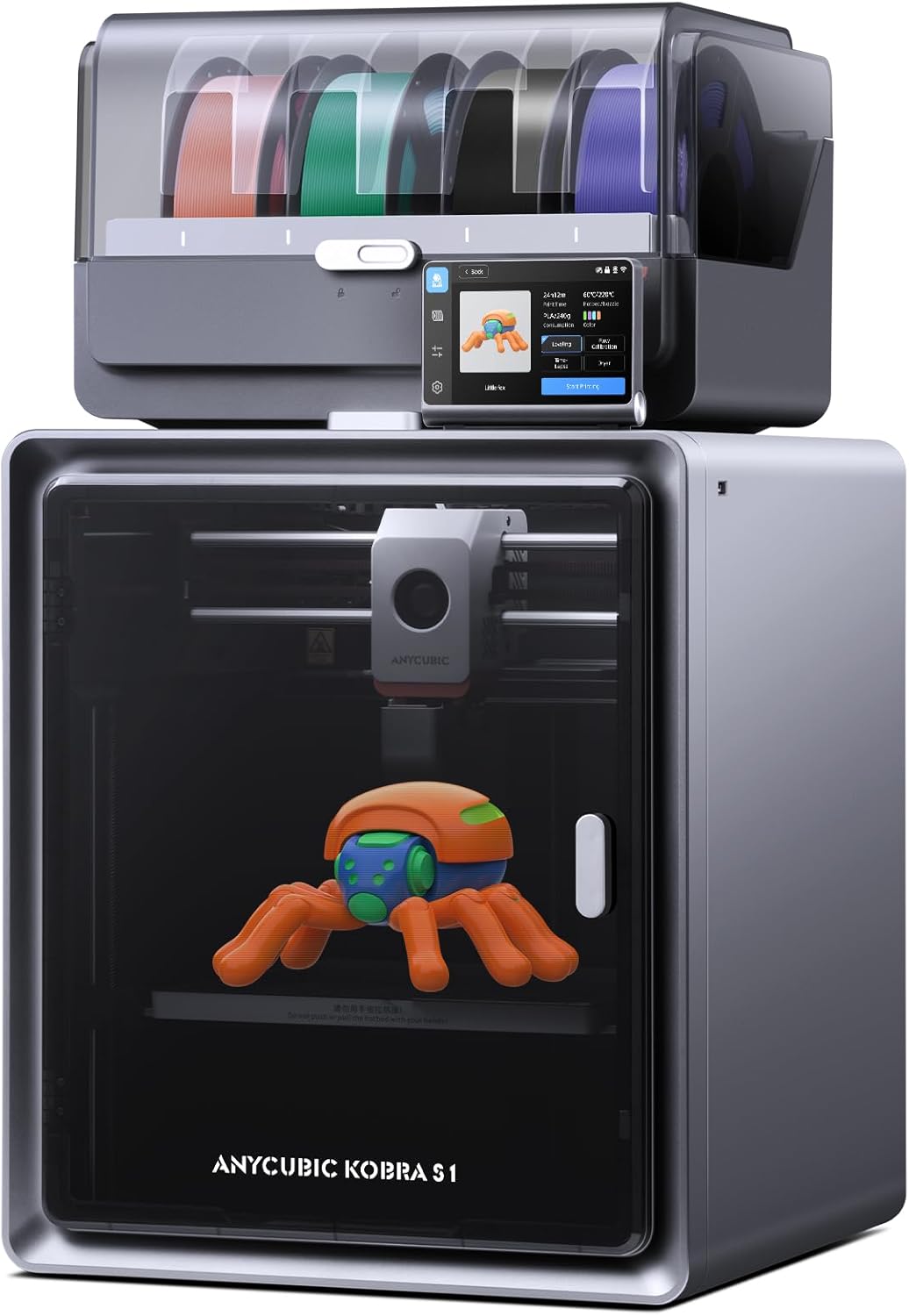
If ABS, ASA or nylon are on your list, the Kobra S1 in the same family gives you 320 degC, a 120 degC bed and a 55 to 65 degC chamber; see our Kobra S1 assessment. Filled filaments need a hardened nozzle on any of them.
Multi-colour and the range’s pace
Anycubic’s colour system is the ACE Pro unit, which also dries filament, and there are Combo bundles for both Kobra 3 and Kobra S1. The range now also includes a Kobra X with native four-colour printing and ACE 2 Pro units. Check carefully which model and which generation a listing is offering, because the naming is dense. Our Kobra 3 Combo page and Kobra 3 Max notes cover the variants.
Who should buy it
Buy the Kobra 3 if you want a light, inexpensive, current-generation open printer for PLA and PETG, and you would rather spend the difference on filament or a colour unit. Buy the Kobra S1 if materials matter. Buy the Kobra 3 Max if size matters, keeping in mind its bed tops out at 90 degC.
Anycubic Kobra 3 Review FAQ
Can the Kobra 3 print ABS?
Not reliably. The bed reaches 110 degC but there is no chamber.
Is the Kobra 3 enclosed?
No. The Kobra S1 is the enclosed model in this generation.
How fast is it really?
Anycubic recommends 300 mm/s, with 600 mm/s as the maximum.
What is the biggest Kobra?
The Kobra 3 Max at 420 x 420 x 500 mm, 88 litres.

LayerWalker
Print defect diagnosis, calibration procedures and parts that actually fit. Corrections welcome through the contact page.