Elegoo Neptune 3 Pro: Tall Z, 260 °C Ceiling
LayerWalker is a participant in the Amazon Services LLC Associates Program. We may earn a commission when you buy through links on our site, at no extra cost to you.
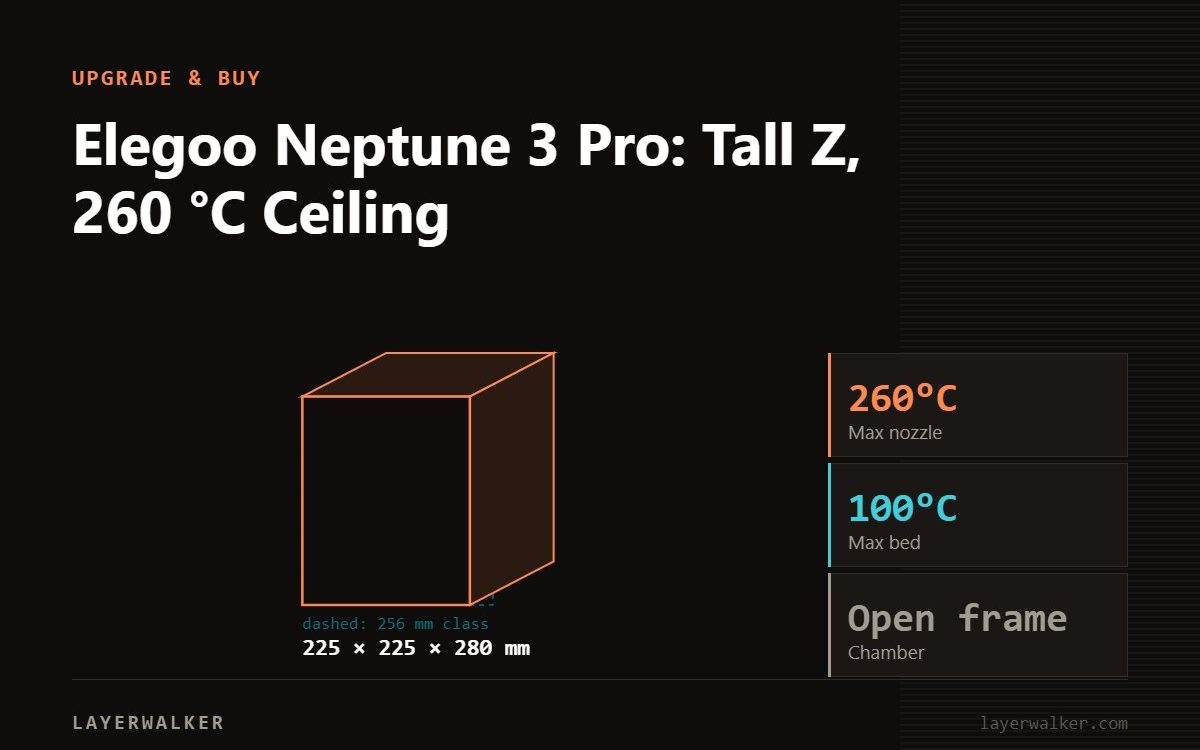
The Neptune 3 Pro is Elegoo’s budget bed-slinger from the pre-Klipper generation: 225 x 225 x 280 mm, a 260 degC nozzle, a 100 degC bed with a 250 W heater, a 36-point non-contact levelling mesh, a dual-gear direct extruder with a titanium throat, and a removable 4.3 inch capacitive touchscreen. It weighs 8.1 kg. The 260 degC nozzle is the ceiling to notice; the Neptune 4 Pro reaches 300 degC with Klipper and a 121-point mesh for not much more.
This assessment is from Elegoo’s published specification rather than a workshop test. The Neptune 3 Pro is still a sensible cheap printer, and it is worth being precise about what the newer generation added.
Where to buy


Specification
| Spec | Neptune 3 Pro |
|---|---|
| Build volume | 225 x 225 x 280 mm |
| Print surface | PEI, 235 x 235 mm |
| Max nozzle temp | 260 degC |
| Max bed temp | 100 degC, 250 W heater |
| Levelling | 36-point, non-contact sensor |
| Extruder | Dual-gear direct drive, titanium alloy throat |
| Screen | 4.3 inch removable capacitive touchscreen |
| Filaments | PLA, TPU, PETG, ABS, ASA |
| Size / weight | 475 x 445 x 515 mm, 8.1 kg |
What is genuinely good about it
280 mm of Z on a 225 mm bed. That is taller than most machines in this class and taller than the Neptune 4 Pro’s 265 mm, so for figurines and vases the 3 Pro actually has an edge.
A dual-gear direct extruder with a titanium throat. Direct drive with real gear grip is what makes TPU work, and a titanium throat resists heat creep. Both are features you would expect a tier up.
A 36-point non-contact mesh, which measures the bed properly rather than sampling corners, and a removable touchscreen you can hold in your hand while setting up.
The 260 degC ceiling, and the ABS caveat
Elegoo lists ABS and ASA as compatible, and the 100 degC bed supports that. But 260 degC is low for ABS, which is usually printed at 240 to 260 degC, leaving no headroom, and the machine is open-framed with no chamber. Treat ABS as technically listed rather than practically comfortable.
For PLA, PETG and TPU, 260 degC is ample and the rest of the specification is well matched. That is the honest use case.
Against the Neptune 4 Pro
| Neptune 3 Pro | Neptune 4 Pro | |
|---|---|---|
| Build volume | 225 x 225 x 280 mm | 225 x 225 x 265 mm |
| Max nozzle temp | 260 degC | 300 degC |
| Max bed temp | 100 degC | 110 degC |
| Speed / accel | Pre-Klipper generation | 500 mm/s / 20,000 mm/s2 |
| Firmware | – | Klipper |
| Levelling | 36 points | 121 points (11 x 11) |
| Extruder ratio | Dual-gear direct | Dual-gear direct, 5.2:1 |
| Weight | 8.1 kg | 8.9 kg |
The 4 Pro is a real generational step: Klipper, 500 mm/s, 300 degC and a 121-point mesh. The 3 Pro’s only advantage is 15 mm more Z. Our Neptune 4 Pro assessment covers it.
Who should buy it
Buy the Neptune 3 Pro only if the price gap to a 4 Pro is large and your list is strictly PLA and PETG, or if the extra Z height matters for what you print. Otherwise buy the 4 Pro; Klipper and 300 degC are worth the difference. Our Neptune 4 page and entry-level guide set out the wider field.
Elegoo Neptune 3 Pro FAQ
How hot does the Neptune 3 Pro nozzle get?
260 degC, against 300 degC on the Neptune 4 Pro.
Can it print TPU?
Yes. The dual-gear direct extruder is well suited to flexibles.
Can it print ABS?
It is on Elegoo’s compatibility list, but 260 degC and an open frame make it marginal in practice.
Is it taller than the Neptune 4 Pro?
Yes, 280 mm of Z against 265 mm.

LayerWalker
Print defect diagnosis, calibration procedures and parts that actually fit. Corrections welcome through the contact page.