Prusa Mini Upgrades: The Heater Block and Hotend Options, a Dryer, and What the Mini Does Not Need
LayerWalker is a participant in the Amazon Services LLC Associates Program. We may earn a commission when you buy through links on our site, at no extra cost to you.
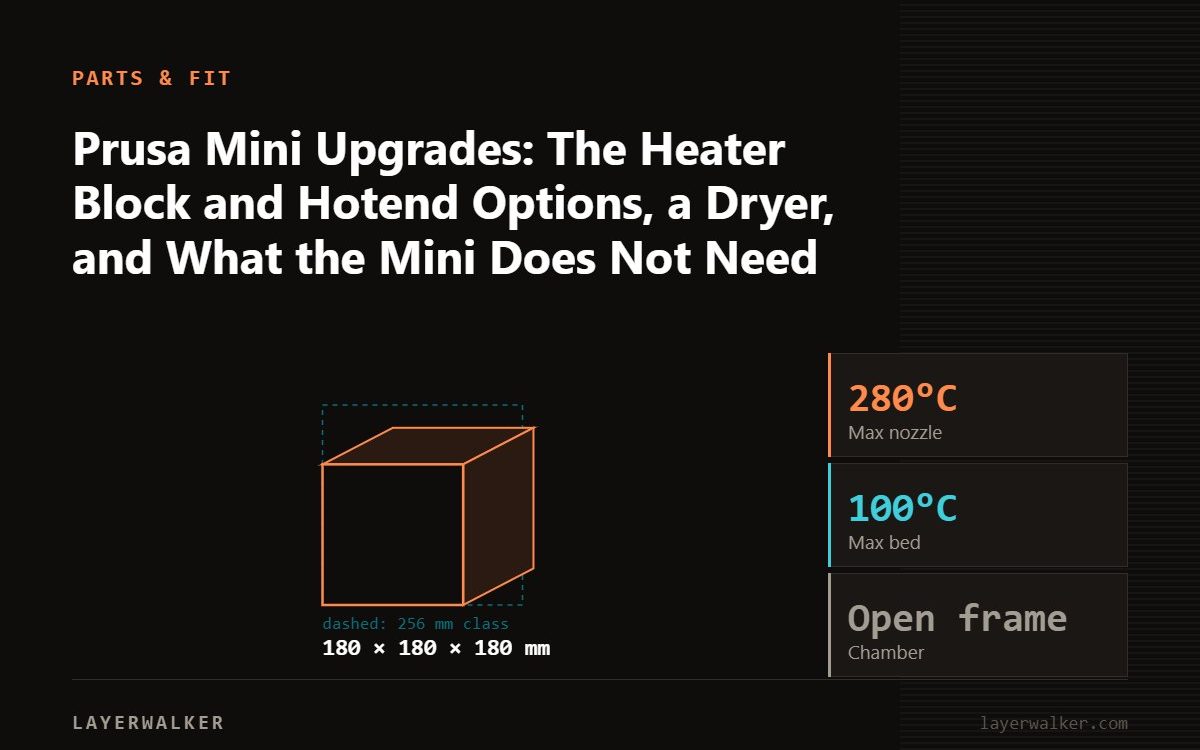
The Prusa Mini needs little. A higher-wattage heater block or an upgraded hotend gives faster heat-up and more flow on a printer whose stock 40 W heater is the bottleneck for speed; a filament dryer keeps PETG printable; a spare steel sheet lets one cool while the other prints. Skip frame mods and firmware forks; the Mini prints well as it is.
The Mini is small, cheap for a Prusa, and shipped with a Bowden extruder and a modest heater. Prusa has since improved parts through the Mini+ revision, and the remaining upgrade market is about heat: a stronger heater block gets to temperature faster and holds it under fast extrusion. Everything else on the Mini is already the way Prusa wanted it.
Where to buy

What is worth buying
- A higher-wattage heater block or hotend upgrade listed for the Mini, such as a 24 V 40 W-plus Maxiwatt-style block; faster heating and fewer temperature dips at speed.
- A filament dryer; the Mini’s spool sits in the open. See drying.
- A spare textured or satin sheet in the Mini’s size.
- Bowden couplers and a spare PTFE tube as consumables; the Mini’s Bowden path is where clogs start.
What to skip
- Direct-drive conversions unless you print TPU regularly; they add weight to a light gantry.
- Frame braces; the Mini’s cantilever is stiffer than it looks and the mesh handles the rest.
- Firmware forks; Prusa’s own firmware is current and well supported.
The parts in the box
The listed Maxiwatt-style 24 V hotend heater is the higher-wattage heat upgrade for the Mini; confirm it names the Mini or Mini+ and matches the 24 V system.
Fitting a hotend
- Cool the hotend and unload filament.
- Open the toolhead, disconnect the heater and thermistor, remove the old unit.
- Fit the new hotend, reconnect, close up.
- Run the printer’s PID or temperature calibration if offered, then a first-layer test. A clog straight after a swap is usually a connector not seated.
Prusa Mini Upgrades FAQ
Does the Mini+ need the same upgrades?
Yes; the Mini+ improved the probe and a few parts but shares the hotend.
Can the Mini print TPU?
95A, slowly, on the stock Bowden with a tight extruder. Not its strength.
Do MK4 nozzles fit the Mini?
The Mini uses a V6-style nozzle; the MK4 uses the Nextruder. No.

LayerWalker
Print defect diagnosis, calibration procedures and parts that actually fit. Corrections welcome through the contact page.