Prusa Error 13203: Thermal Runaway on the Heatbed
LayerWalker is a participant in the Amazon Services LLC Associates Program. We may earn a commission when you buy through links on our site, at no extra cost to you.
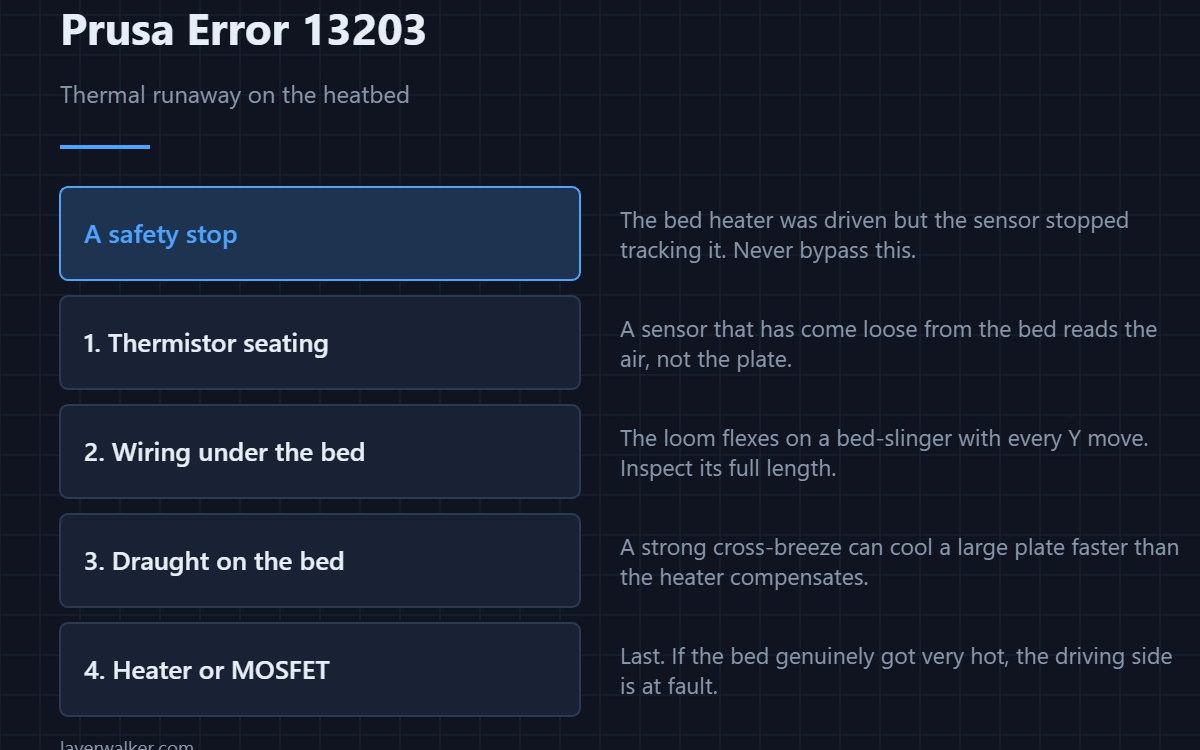
Prusa error 13203 is thermal runaway on the heatbed: the heater was being driven but the sensor stopped tracking it, so the firmware shut everything down. Like the hotend version, this is a safety mechanism and not something to disable. The usual cause is a thermistor that has come loose from the bed, or a break in the loom under it.
Runaway differs from a preheat failure in a way worth understanding. A preheat error means the bed never got hot. Runaway means it was heating and then the reading diverged from reality — which is more dangerous, because the heater may still be delivering power to a plate nobody is measuring.
Where to buy


Check in this order
- Thermistor seating. If it has worked out of its pocket in the bed it reads the air rather than the plate, and the firmware drives the heater harder.
- Wiring under the bed. On a bed-slinger that loom flexes with every Y move. Inspect its full length, especially at cable ties.
- Draughts. A strong cross-breeze on a large plate can cool it faster than the heater compensates, which reads as divergence.
- Heater or MOSFET. Last. If the bed genuinely became very hot, the fault is on the driving side and that is a board-level repair.
Do not raise the timeout
Widening the window so the message stops appearing removes the protection without fixing anything. The same argument applies here as to 13204 on the hotend: the check exists because an unmonitored heater is a real hazard.
Telling the bed codes apart
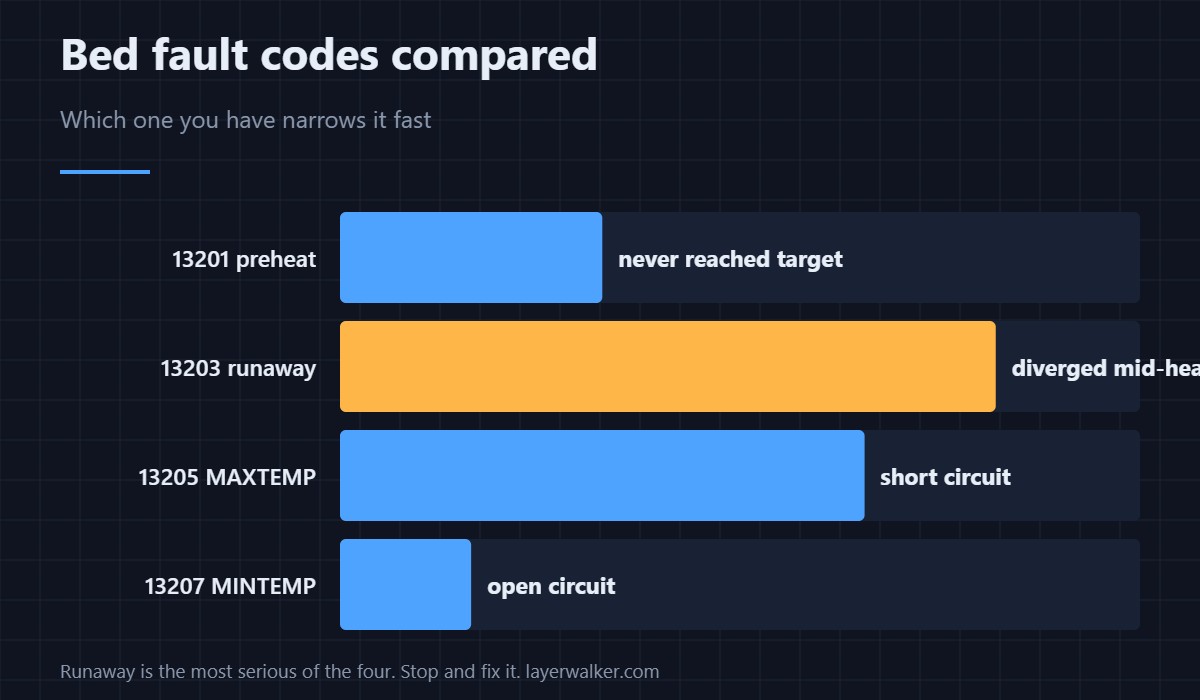
13201 never reached target. 13205 read above range, a short. 13207 read below range, an open circuit. 13203 reached temperature and then diverged. Target temperatures by material are in bed temperature.
This error reads 12203 on MINI, 31203 on CORE One, 35203 on CORE One L and 23203 on MK3.5.
Prusa Error 13203 FAQ
Is thermal runaway on the bed dangerous?
The condition it detects is. The printer stopping is the safe outcome. Find the cause before running it again.
Can I disable the check?
You should not. It is the only automatic protection against a bed heater running with a sensor that is not reporting truthfully.
Why does it happen only on high bed temperatures?
Because the divergence grows with the heating rate. A fault that stays hidden at 60 °C can become obvious on the way to 100 °C.
Could a draught really trigger this?
On a large plate near an open window, yes. It is worth ruling out because it costs nothing, though wiring is the more common cause.

LayerWalker
Print defect diagnosis, calibration procedures and parts that actually fit. Corrections welcome through the contact page.