HMS 0C00-0300-0003-0008: Possible Spaghetti Defects Were Detected
LayerWalker is a participant in the Amazon Services LLC Associates Program. We may earn a commission when you buy through links on our site, at no extra cost to you.
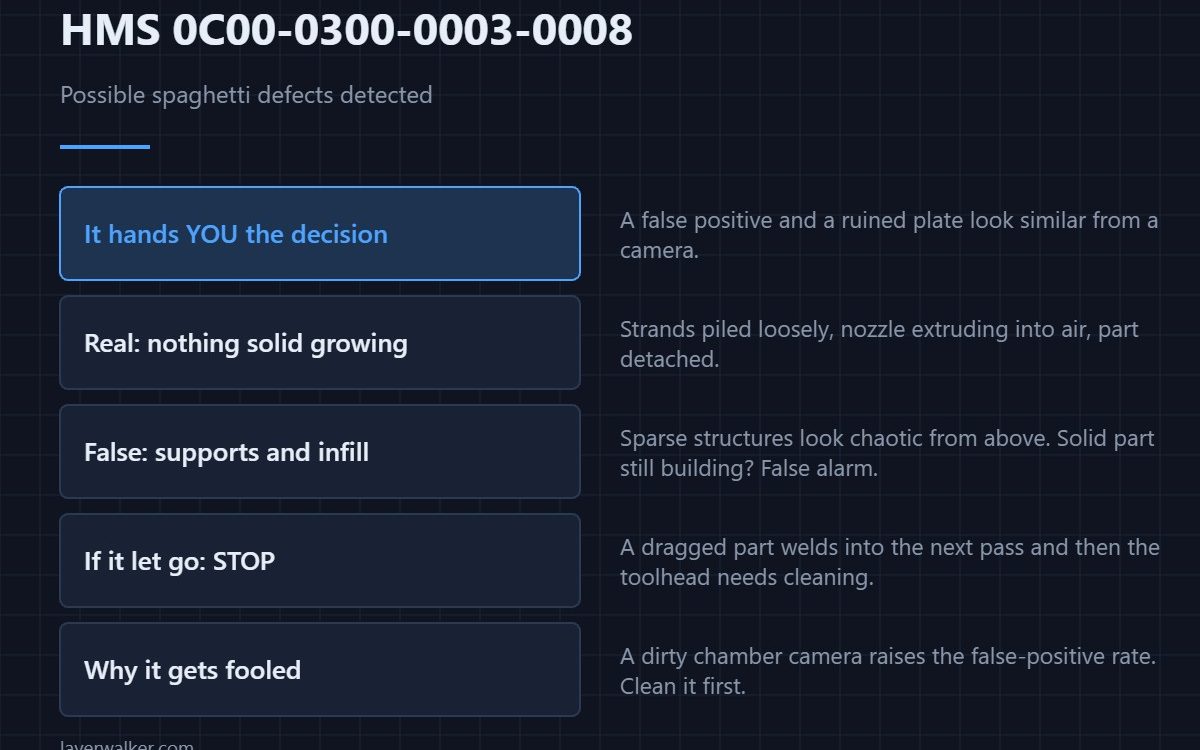
HMS 0C00-0300-0003-0008 means the AI monitoring saw what looks like spaghetti — loose extruded strands where solid part should be — and asks you to check the print and decide whether to stop. It hands you the decision because a false positive and a ruined plate look similar from a camera.
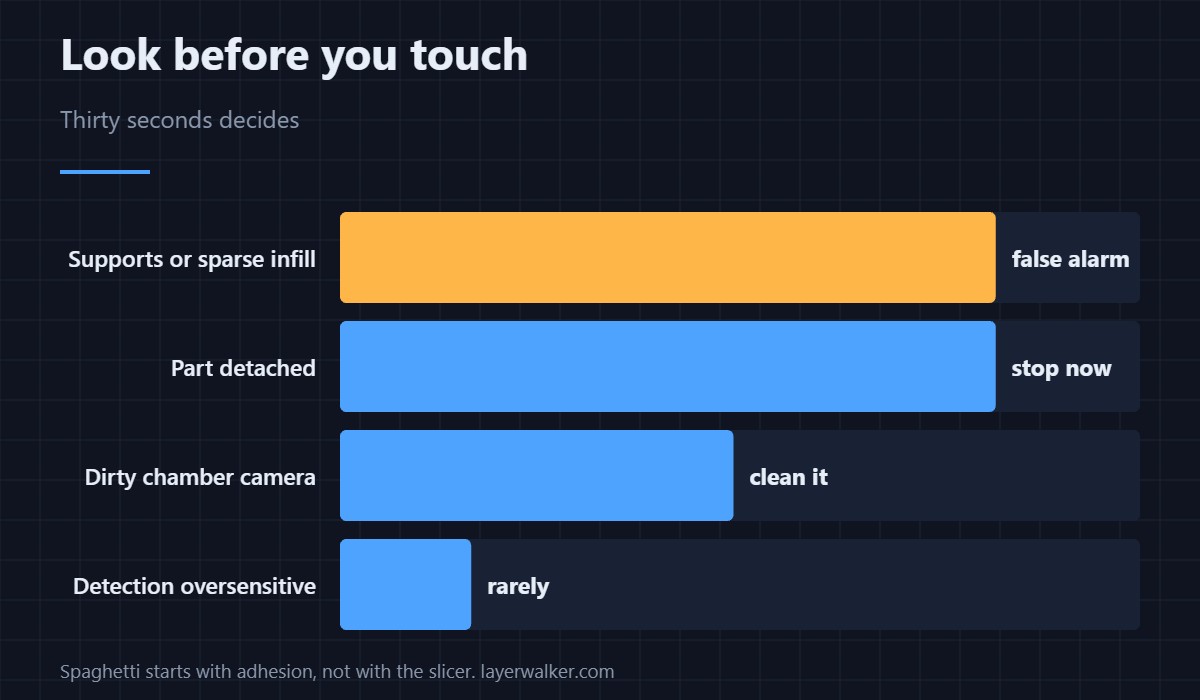
Look at the print before you touch anything. Thirty seconds of looking saves either a plate or twelve hours.
Where to buy


OVERTURE 2KG Bundle Matte PLA, Low Warp & Matte Surface 3D Printer Filament

Tell a real failure from a false positive
Real spaghetti means the part has detached and the nozzle is extruding into air, so you will see strands piled loosely and nothing solid growing. A false positive is usually a support structure, a sparse infill pattern, or a stringy bridge that merely looks chaotic from above. If a solid part is still being built, it is almost certainly a false alarm.
If the part has let go
Stop the print. A detached part being dragged welds into the next pass, and that turns a failed plate into a toolhead that needs cleaning. The adhesion causes behind a part letting go are in a first layer that will not stick.
Why the camera can be fooled
Detection works on a view of the plate, so anything that degrades that view raises the false-positive rate. A dirty chamber camera is the common cause, and it has its own code: HMS 0C00-0100-0001-0009. Clean it before concluding the detection is oversensitive.
How HMS 0C00-0300-0003-0008 relates to the extrusion codes
A printer extruding into air with no part attached also reports as printing without extruding in some circumstances, and the related decision code is HMS 0C00-0300-0003-000D. Seeing both at once is a strong signal that the plate is genuinely lost.
Preventing the real version
Spaghetti nearly always starts with adhesion, not with the slicer. A clean plate, a correct first layer and a brim on tall narrow parts remove most of it — the squish test is in Z offset and first layer squish.
HMS 0C00-0300-0003-0008 FAQ
Should I trust the detection?
Trust it enough to look. It is deliberately tuned to warn rather than to be certain.
Why does it fire on supports?
Because sparse structures look like loose strands from above. That is the common false positive.
Can I turn it off?
You can, and you will then find failures hours later instead of minutes later.
Does it stop the print itself?
No. It asks you to decide, which is the right behaviour given how often it is a support.

LayerWalker
Print defect diagnosis, calibration procedures and parts that actually fit. Corrections welcome through the contact page.