Creality PLA Filament: Hyper, Ender and CR Lines, and Which One Your Printer Wants
LayerWalker is a participant in the Amazon Services LLC Associates Program. We may earn a commission when you buy through links on our site, at no extra cost to you.
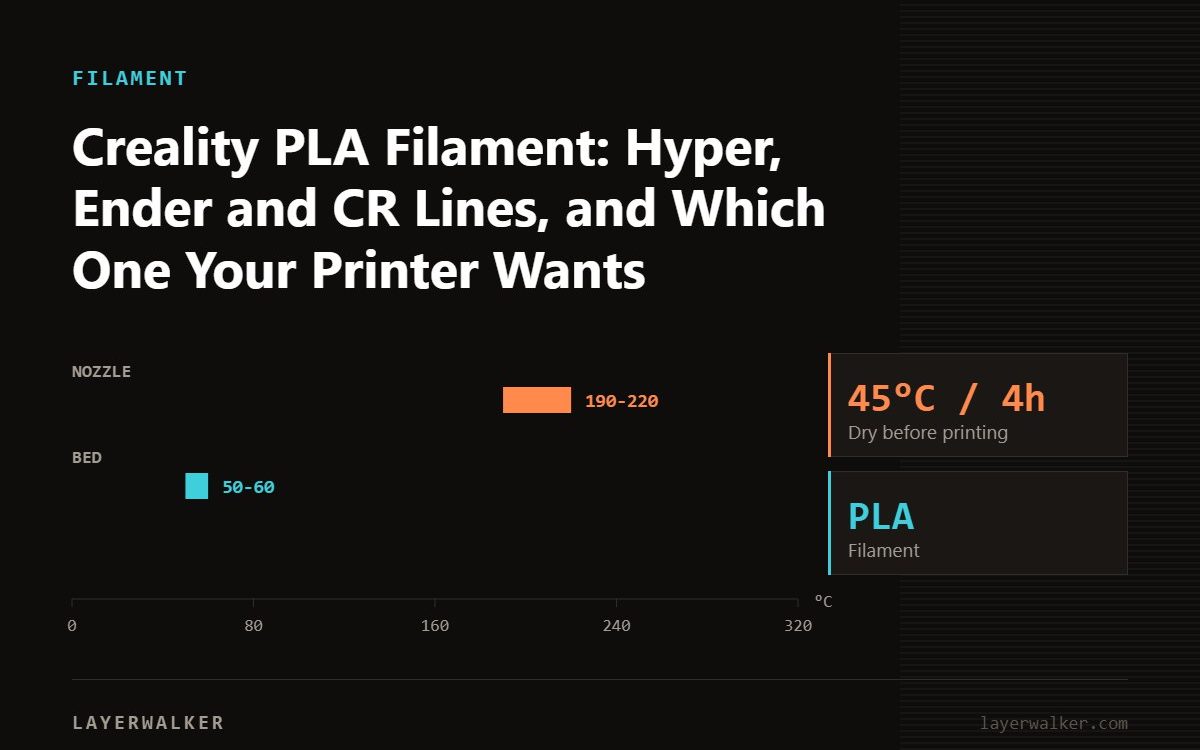
Creality’s standard PLA is a mid-range spool that prints like any plain PLA; buy it for a bed-slinger. Hyper PLA is a low-viscosity blend made for the K1 series and other fast CoreXY printers; it also prints fine slow. Creality PLA+ is the toughened line for parts. Match the line to the printer speed, not the brand of the printer.
Creality filament used to be the spool that came in the box and nothing more. The range is now several distinct PLAs that behave differently, and the names are not obvious. Standard PLA is a plain, decent mid-range filament. Hyper PLA is engineered to melt fast enough for 300 mm/s printing on the K1 line, and it strings slightly more at normal speed in exchange. PLA+ is the toughened variant. None of them require a Creality printer; all of them are standard 1.75 mm.
Where to buy


Creality PLA Filament 1.75mm 2KG, Case 1 Total 2 Packs in a Carton, Black

The lines
- Creality PLA (Ender PLA). Plain PLA, 200 to 215 °C, the everyday spool for any bed-slinger.
- Hyper PLA. High-flow blend for fast printers; 210 to 230 °C, tolerates 200 mm/s and above on a capable hotend. Slightly more prone to stringing when printed slow; dry it.
- Creality PLA+. Toughened, prints 215 to 230 °C, for parts that get handled.
- Silk, matte and speciality lines follow the usual rules for those finishes.
What to check on the spool
- Tolerance. Creality states ±0.03 mm on current lines; check it is printed on the box.
- Spool type. Recent Creality spools include cardboard and plastic; cardboard sheds dust into a CFS or AMS feed path and some multi-material units need adapter rings.
- Vacuum seal. Bundle packs sometimes ship loose in the outer box; dry before use.
- Which line is actually in the bundle; multi-packs mix Hyper and standard.
The spools in the box
Creality’s 2 kg black-and-white PLA bundle is the standard-line workhorse pair. The other listed Creality spools are the Hyper and PLA+ lines; pick Hyper for a K1-class printer and PLA+ for tough parts.
Settings that work
- Standard PLA: 205 °C, bed 60 °C, full fan.
- Hyper PLA: 220 °C at speed, 210 °C slow; full fan; slightly longer retraction.
- PLA+: 225 °C, bed 60 °C.
- Run a flow calibration per line; Hyper typically wants a slightly lower flow than standard.
When to buy something else
Parts that see heat: PETG. Fine models: a tighter-tolerance premium PLA shows on detail. Print farms: compare price per kilogram against other mid-range makers; Creality is competitive but not always cheapest.
Creality PLA Filament FAQ
Does Hyper PLA work on an Ender 3?
Yes, at normal speeds. You will not see its benefit without a fast printer.
Does Creality filament work in a Bambu AMS?
Plastic spools, yes. Cardboard spools need the adapter rings.
Is Creality PLA the same as the sample in the printer box?
Same line, usually; the sample is a small coil of standard PLA.

LayerWalker
Print defect diagnosis, calibration procedures and parts that actually fit. Corrections welcome through the contact page.