Anycubic Filament: PLA, Silk and High-Speed Lines, and What They Are Good For
LayerWalker is a participant in the Amazon Services LLC Associates Program. We may earn a commission when you buy through links on our site, at no extra cost to you.
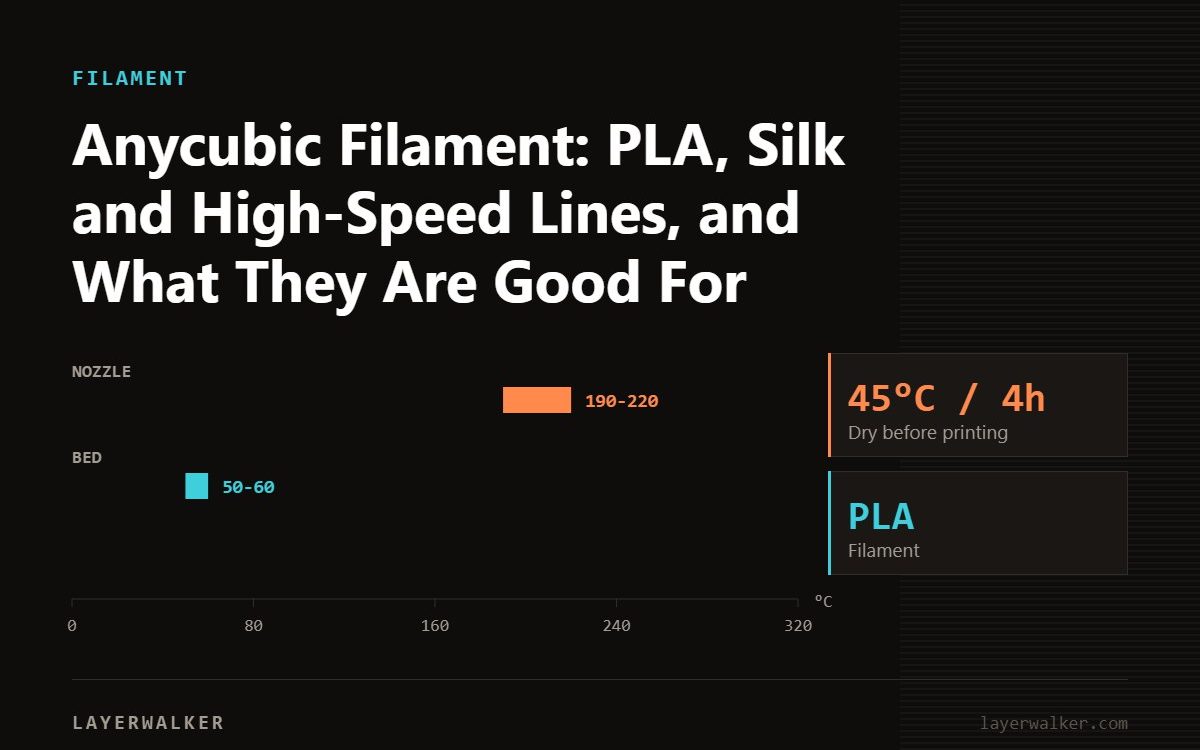
Anycubic’s PLA is a budget plain PLA that prints like any other at 200 to 215 °C; its Silk PLA is a glossy display filament with silk’s weaker layers; its High Speed PLA is a low-viscosity blend for the Kobra S1 and other fast printers. None of them require an Anycubic printer. Buy by the line, not the logo.
Anycubic sells filament mainly to feed its own printers, and the lines mirror that: a standard PLA in the box, a silk range for the display prints that beginners love, and a high-speed blend timed to the fast Kobra models. Quality sits in the budget-to-mid range with a stated tolerance. It is a reasonable first spool and a reasonable bulk spool; it is not the spool for colour-matched assemblies or fine models.
Where to buy


The lines
- Anycubic PLA. Plain PLA, 200 to 215 °C, everyday parts.
- Anycubic Silk PLA. Glossy metallic finish; weaker layer bonds, more stringing; print hot and slow. Display only.
- Anycubic High Speed PLA. Lower viscosity for the Kobra S1 and similar; 210 to 230 °C; strings a little more when printed slowly.
- PETG, TPU and resin follow their own material rules.
What to check on the spool
- Tolerance stated, ±0.02 or ±0.03 mm depending on line.
- Vacuum seal and desiccant; dry a spool that arrives loose.
- Plastic spool for dryers and the ACE Pro or an AMS.
- Which line is in a bundle; silk and standard are often mixed.
The spools in the box
The listed Anycubic spools are the standard PLA and the Silk PLA in common colours, with a high-speed option for a Kobra-class printer. Tune one spool of each line you buy.
Settings that work
- PLA: 205 to 210 °C, bed 60 °C, full fan.
- Silk: 215 to 225 °C, outer wall 30 to 40 mm/s, longer retraction.
- High Speed: 220 °C at speed, 210 °C slow.
- A flow calibration per line; silk usually wants a little more flow.
When to buy something else
Parts that see heat: PETG. Anything structural in silk: use plain PLA or PLA+. Colour-matched assemblies: a premium maker.
Anycubic Filament FAQ
Does Anycubic High Speed PLA need a Kobra?
No, but it only pays off on a fast printer.
Does Anycubic filament work in a Bambu AMS?
Yes, on its plastic spool.
Is the ACE Pro a dryer?
It heats, so it keeps spools dry during printing; dry a wet spool in a proper dryer first.

LayerWalker
Print defect diagnosis, calibration procedures and parts that actually fit. Corrections welcome through the contact page.