Best Filament for Miniatures on an FDM Printer: Plain PLA, a Small Nozzle, and Realistic Expectations
LayerWalker is a participant in the Amazon Services LLC Associates Program. We may earn a commission when you buy through links on our site, at no extra cost to you.
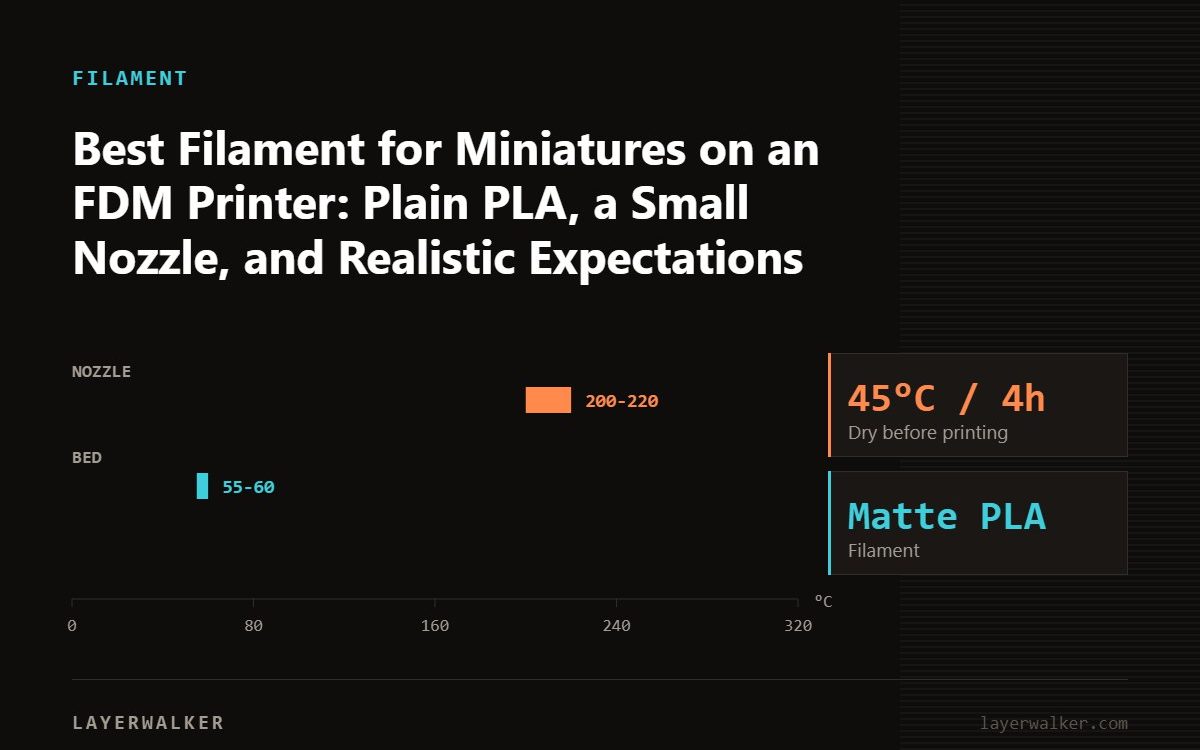
Print miniatures in plain PLA, ideally a light grey that shows detail and takes primer, with a 0.2 or 0.25 mm nozzle and 0.08 to 0.12 mm layers. Avoid PLA+ and silk, which blur fine features. At 28 mm scale an FDM printer will never match resin; at 54 mm and above, with these settings, it gets close enough for tabletop.
The filament matters less for miniatures than the nozzle and the layer height, but it still matters. Plain PLA is the stiffest and sharpest common material, it bridges well, and it primes and paints without fuss. Everything that makes other filaments better for functional parts makes them worse here: PLA+ additives soften edges, silk hides detail under gloss, PETG strings and sags on small features, and matte fillers blur. Pick a plain, well-made PLA in a colour that shows you what you printed.
Where to buy


SUNLU PLA+ 3D Printer Filament, 16 Color Bundle Multicolor, 1.75mm
What to look for
- Plain PLA, no additives. The label should not say plus, silk, matte, or pro.
- Tight tolerance, ±0.02 to ±0.03 mm. Small nozzles are unforgiving of diameter swings.
- Light grey or white. Detail is visible, primer covers easily. Dark colours hide flaws until paint reveals them.
- Dry spool. Wet PLA strings, and strings between a miniature’s arms are hard to remove without damage.
The spools in the box
The listed spools are plain PLA in workhorse colours from makers with stated tolerance. Pick the grey or white, keep it in a dry box, and tune once for the small nozzle.
Settings that make FDM miniatures work
- Nozzle 0.2 or 0.25 mm. This is the biggest single change. Expect long prints.
- Layers 0.08 to 0.12 mm. Adaptive layer height helps on faces.
- Temperature at the low end, 195 to 205 °C, for sharp edges and less ooze.
- Speed 20 to 40 mm/s on outer walls; small features need time to cool.
- Minimum layer time 8 to 10 seconds so tiny layers solidify; print two or three models at once to give each layer time.
- Tree supports, thin, with a 0.1 mm interface gap; see overhangs.
- Seam hidden at the back or aligned; see seam settings.
Where resin takes over
28 mm tabletop figures with facial detail, anything with cloth folds under 1 mm, and anything you will look at from under 30 cm. FDM at 0.2 mm handles terrain, vehicles, larger busts and 54 mm figures well; below that, resin is the right tool.
Best filament for miniatures FAQ
Can I use PLA+ for miniatures if that is what I have?
Yes, at the low end of its temperature range; expect slightly softer edges.
Does a 0.4 mm nozzle work at all?
For terrain and large models, yes. For figures, the nozzle width shows on every edge.
Grey or white primer?
Grey shows detail while you check the print; white takes bright paint better.

LayerWalker
Print defect diagnosis, calibration procedures and parts that actually fit. Corrections welcome through the contact page.