Original Prusa MINI+: The Small Open-Source Printer, and MINI vs MINI+
LayerWalker is a participant in the Amazon Services LLC Associates Program. We may earn a commission when you buy through links on our site, at no extra cost to you.
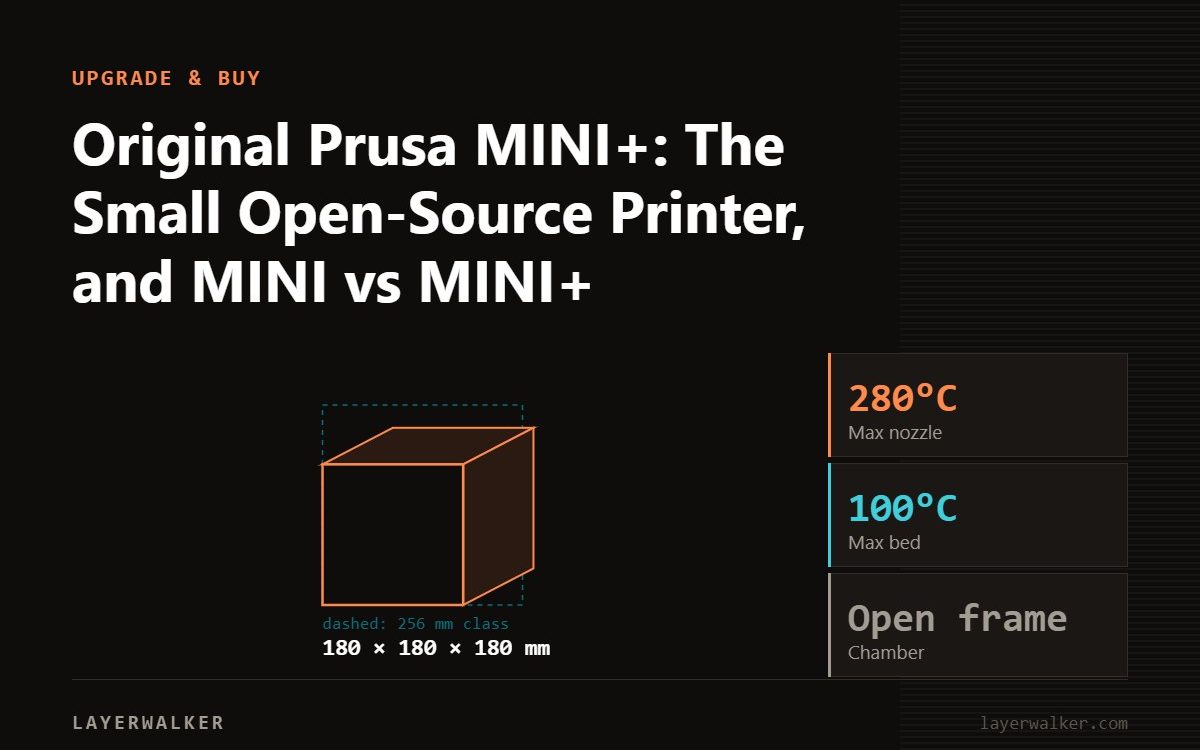
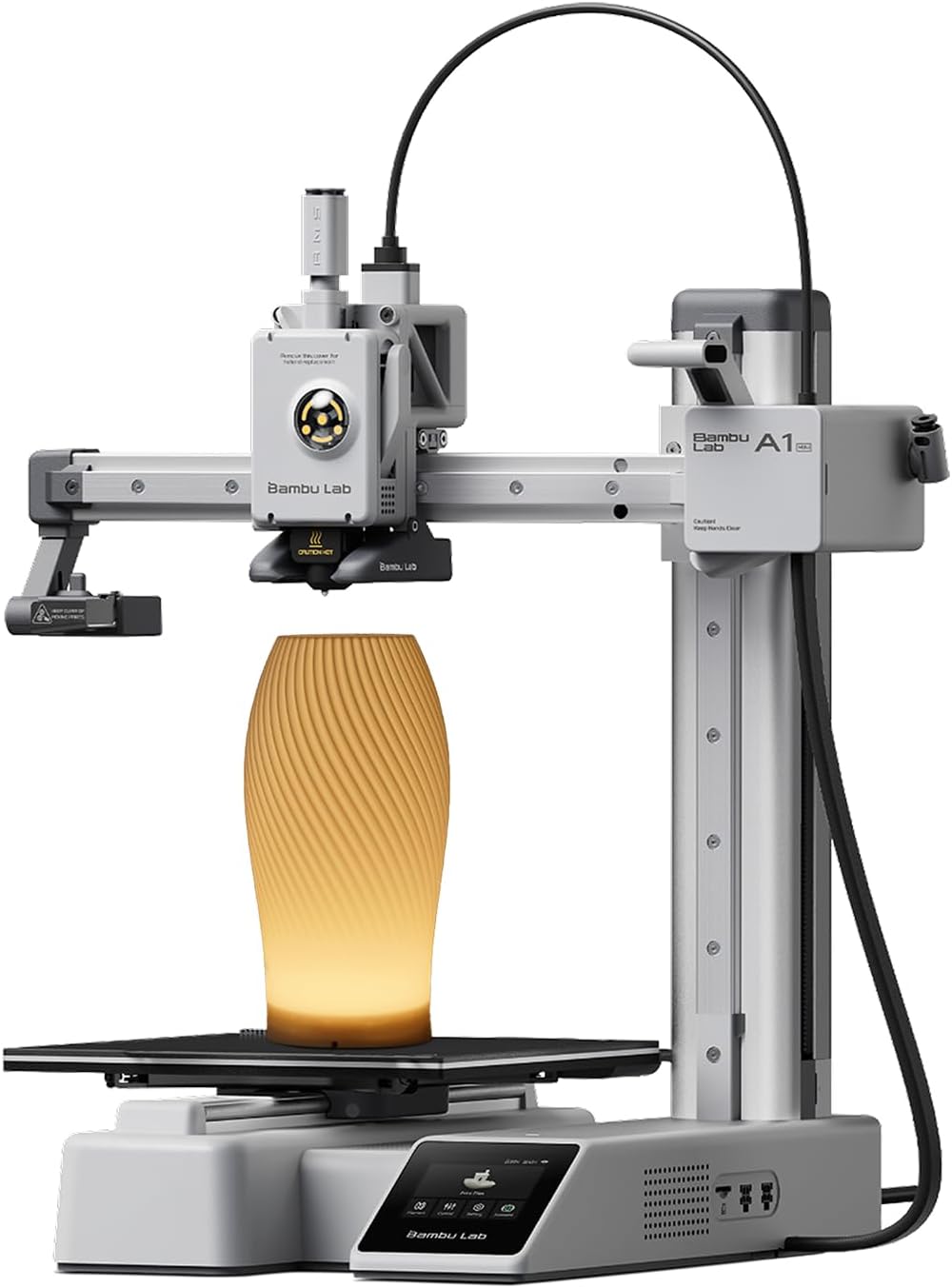
The MINI+ is Prusa’s 180 × 180 × 180 mm cantilever printer: 280 °C Bowden hotend, 100 °C bed, SuperPINDA inductive levelling, open source, kit or assembled, with Prusa support. The “+” added the SuperPINDA probe and a few refinements over the original MINI. Against the Bambu A1 mini it is slower, less automated and more expensive; its case is repairability, open firmware, education pricing and a decade of support. Schools and Prusa loyalists buy it; most first-time buyers should look at the A1 mini.
Where to buy


Specifications
| Item | Value | Note |
|---|---|---|
| Build volume | 180 × 180 × 180 mm | Same as A1 mini |
| Frame | Cantilever, single Z | Compact; some flex at the far X end |
| Max nozzle temperature | 280 °C | Bowden extruder |
| Max bed temperature | 100 °C | Removable spring-steel sheet |
| Levelling | SuperPINDA inductive | Z-offset set once |
| Firmware | Prusa Buddy, open source | Input shaping added later |
| Enclosure | Optional Prusa Enclosure for MINI+ | Temperature controlled |
| Sold as | Kit or assembled | Kit takes an evening |
MINI versus MINI+
Same printer; the MINI+ ships with the SuperPINDA probe (temperature-stable, no more first-layer drift as the bed warms) and minor part revisions. Original MINI owners can fit the SuperPINDA; there is nothing else to chase. See MINI+ upgrades.
MINI+ versus A1 mini
| Spec | Prusa MINI+ | Bambu A1 mini |
|---|---|---|
| Build volume | 180 × 180 × 180 mm | 180 × 180 × 180 mm |
| Extruder | Bowden | Direct drive |
| Max nozzle temperature | 280 °C | 300 °C |
| Levelling | Inductive, offset once | Nozzle probing, no offset |
| Calibration | Manual flow | Auto flow, resonance, belt |
| Multi-material | No | AMS lite |
| Camera | Optional | Included |
| Firmware | Open source | Proprietary |
| Support | Prusa live chat, EU/US | Bambu ticket |
The A1 mini is the better printer; the MINI+ is the better-owned printer. See the A1 mini page and, for the bigger Prusa, the MK4S page.
Who still buys it
- Schools and universities on Prusa education pricing, for repairability.
- Print farms standardised on Prusa Connect.
- Buyers who want open firmware and no cloud.
If the envelope is what stops you
The 180 mm cube is the MINI+’s real limit, and it is the reason most people who like Prusa end up buying something else. Inside the same line the answer is the CORE One: an enclosed CoreXY machine that keeps the open firmware, the published spare parts and the support that make people choose Prusa in the first place, without the cantilever and without the Bowden path. It is sold as a kit or assembled, the same way the MINI+ is.
That is a much larger sum, so the framing is worth stating plainly. Buy the MINI+ if the price and the small footprint are the point. Buy the A1 mini if you want the same size class with modern automation. Buy the CORE One if what you actually need is an enclosed machine and you want it from Prusa. The one thing not worth doing is buying a MINI+ and then spending on upgrades to make it behave like a bigger machine.
The units in the box
The MINI+ is Prusa direct. The listings are the MK4S kit, the Bambu A1 mini as the direct comparison, and the CORE One for the case above.
Prusa MINI FAQ
Can the MINI+ print TPU?
Firm TPU slowly; the Bowden path limits it.
Is the MINI+ being replaced?
Prusa has not announced a successor at the time of writing.

LayerWalker
Print defect diagnosis, calibration procedures and parts that actually fit. Corrections welcome through the contact page.