Bambu Lab PETG: Basic, HF and Translucent, and Which One the AMS Should Hold
LayerWalker is a participant in the Amazon Services LLC Associates Program. We may earn a commission when you buy through links on our site, at no extra cost to you.
Bambu Lab PETG HF is the one to buy for a P1, X1 or A1: a high-flow blend tuned for the hotend that prints fast with less stringing than standard PETG. PETG Basic is the older, slower-flow line. Translucent PETG is for clear parts. All of them need drying before they go in the AMS, because the AMS is not sealed.
Bambu’s PETG lines exist because PETG is the second material almost every Bambu owner buys, and stock PETG at Bambu speeds strings and sags. PETG HF fixes that with a lower-viscosity blend that melts fast enough for the high-flow hotend, and it comes with an RFID tag so the AMS loads its tuned profile. The result is the least frustrating PETG experience on those printers; the remaining variable is water, and Bambu cannot fix that in the bottle.
Where to buy

ELEGOO Rapid PETG 3D Printer Filament 1.75mm Black 4 Pack Bundle

CREALITY 250g PETG Filament Bundle, 1.75mm 3D Printer Filament, 8 spools

Creality PETG Filament 1.75mm, 3D Printer Filament 4KG,Black+White+Blue+Red
The lines
- PETG HF. High flow, 240 to 270 °C profile, prints at full Bambu speeds with a tuned RFID profile. The default choice.
- PETG Basic. Standard-flow PETG; fine, slower, more stringing at speed. Being superseded by HF.
- PETG Translucent. For clear or tinted see-through parts; print slow and hot for clarity.
- PETG-CF follows the carbon-fibre rules and needs the hardened nozzle and gears.
What to check
- HF or Basic; the spools look alike and the profiles differ.
- Refill versus spool. Refills need a Bambu reusable spool.
- Dryness. Bambu vacuum-packs well, but a spool that has lived in the AMS for a week has taken on water. Dry it, and keep desiccant fresh in the AMS.
The spools in the box
Bambu PETG HF in core colours is the spool for the AMS on any Bambu printer; the listed high-speed PETG spools from other makers are the value alternatives that print nearly as well once you pick the generic PETG profile and run flow calibration.
Settings on a Bambu printer
- Use the auto-loaded PETG HF profile; it is tuned for the hotend.
- Run flow dynamics calibration on each new spool.
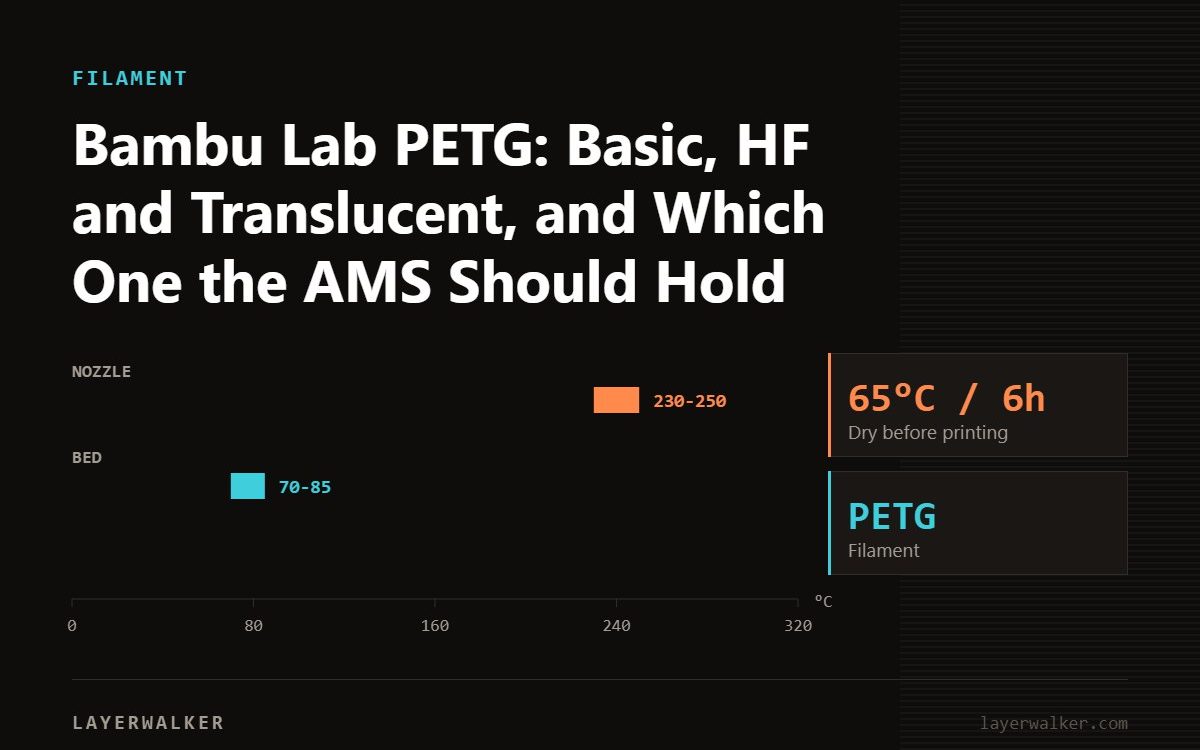
- Dry at 65 °C for 6 hours before loading, and every few days if the spool lives in the AMS. Wet PETG in an AMS strings and can cause feed errors.
- Textured PEI plate. Bambu’s own smooth plates take PETG with glue stick only.
- Enclosure door open or top glass off on the P1S and X1C for PETG; it prefers a little airflow.
When to use something else
Outdoor parts in sun: ASA, which the enclosed Bambu printers print well. Stiff structural brackets: PETG-CF on the hardened nozzle. Fine detail: PLA. See PLA versus PETG.
Bambu PETG FAQ
Is PETG HF worth it over a cheaper PETG?
On a Bambu printer at full speed, yes; the difference in stringing is visible. At slow speeds, a dry mid-range PETG is fine.
Can the AMS dry filament?
The original AMS does not heat; the newer heated AMS does. A separate dryer is still the reliable route.
Does PETG HF need the hardened nozzle?
No; only the CF variant does.

LayerWalker
Print defect diagnosis, calibration procedures and parts that actually fit. Corrections welcome through the contact page.