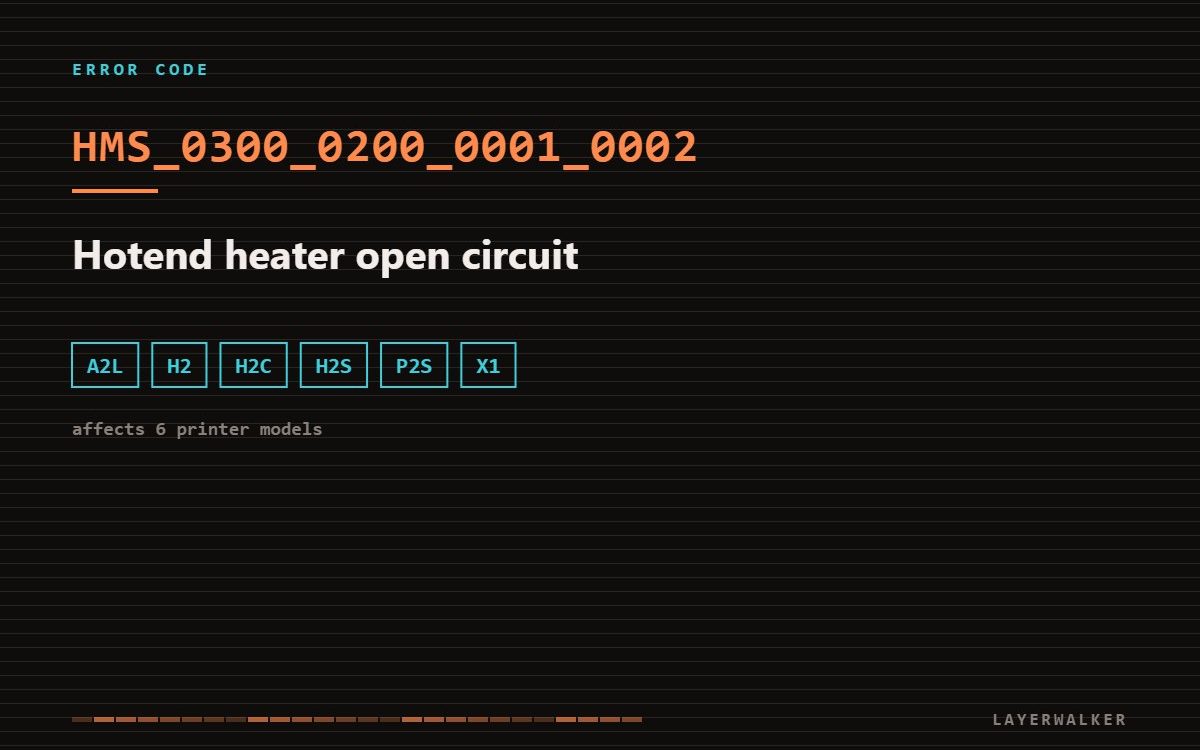
HMS 0300-0200-0001-0002: hotend heater open circuit
LayerWalker is a participant in the Amazon Services LLC Associates Program. We may earn a commission when you buy through links on our site, at no extra cost to you.
The printer sees nothing where the hotend heater should be. Check the connector at the toolhead first: a crimp that has backed out of its housing looks perfectly seated from outside and reads open on a meter.
This is the mirror image of the short-circuit code. Open circuit means infinite resistance: the current has no path at all. A 24 V cartridge should read roughly 10 to 15 ohm at room temperature, so anything reading open is either a broken conductor or a disconnected joint.
Affected machines: A2L, H2, H2C, H2S, P2S, X1 series.
Where to buy


Genuine Bambu Lab Hotend with Nozzle for P1S P1P X1C X1 Carbon 3D Printer .4mm Hardened Steel

2 Pack 0.4mm A1 Mini/A1/A2L Hotend Kit Hardened Steel Nozzle for Bambu Lab

HMS 0300-0200-0001-0002: check the crimp before you check the cartridge
The most frequent cause is mechanical, not electrical. Each lead ends in a metal crimp that clicks into a plastic housing. If the retaining barb is worn, the crimp slides back a millimetre or two under vibration. The connector still looks and feels plugged in, but the pin no longer touches. Pull gently on each individual wire behind the housing while watching for movement.
Hotend does not heat at all and the code appears within seconds of starting a print
Backed-out crimp, broken heater lead, or a failed cartridge element
- Power off at the wall and let the hotend cool.
- Unplug the cartridge and measure across its pins. Roughly 10 to 15 ohm is healthy; an open reading means the element itself has failed.
- If the cartridge reads correctly, the break is upstream. Tug each wire behind the connector housing to find a crimp that has backed out.
- Flex the lead along its length while measuring. A reading that flickers between open and normal means a broken conductor inside intact insulation.
Work with the machine unplugged at the wall. A heater lead that has been arcing at a loose crimp can be hot enough to have annealed the copper, so treat any discoloured wire as needing replacement rather than reseating.
Open, short, and sensor faults are three different codes
Bambu splits hotend heating problems into separate codes, and the distinction matters because they lead to different parts. This one is the heater circuit reading open. A short reads near zero instead, and a temperature sensor fault is a different component entirely. Read the code carefully before ordering anything.
Wrong code? The full Bambu HMS code index lists all 588 codes with the subsystem each one points to and which printers show it.

LayerWalker
Print defect diagnosis, calibration procedures and parts that actually fit. Corrections welcome through the contact page.